Penis Sounding for Men: Sizes, Safety & Prostate Technique
Penis sounding for men: prostate-reaching technique, partial-erection mechanics, male sizing, S-curve navigation, and male-specific aftercare. Honest, safe.
 By Kevin Voss
Penis sounding is the practice of inserting a smooth, sterile rod (a "sound") into the male urethra for sexual sensation. It activates nerve endings along the urethra and, with deeper insertion through the prostatic urethra, can stimulate the prostate from inside.
This guide is the male-anatomy companion to the universal pillars on this site. It assumes you already know what sounding is in general, or that you'll go read What Is Urethral Sounding?, the complete urethral play guide, and our universal beginner guide first. Everything below is the bits that change when the anatomy is male: the S-curve through the bulbar urethra, partial-erection mechanics, prostate-reaching depth, and what aftercare looks like through a male urinary tract.
I've been doing this for about ten years. Sister page: Female Urethral Sounding Guide.
I'm not a doctor. This is harm-reduction education based on personal experience and research. For medical concerns, see a healthcare provider.
What Penis Sounding Actually Is
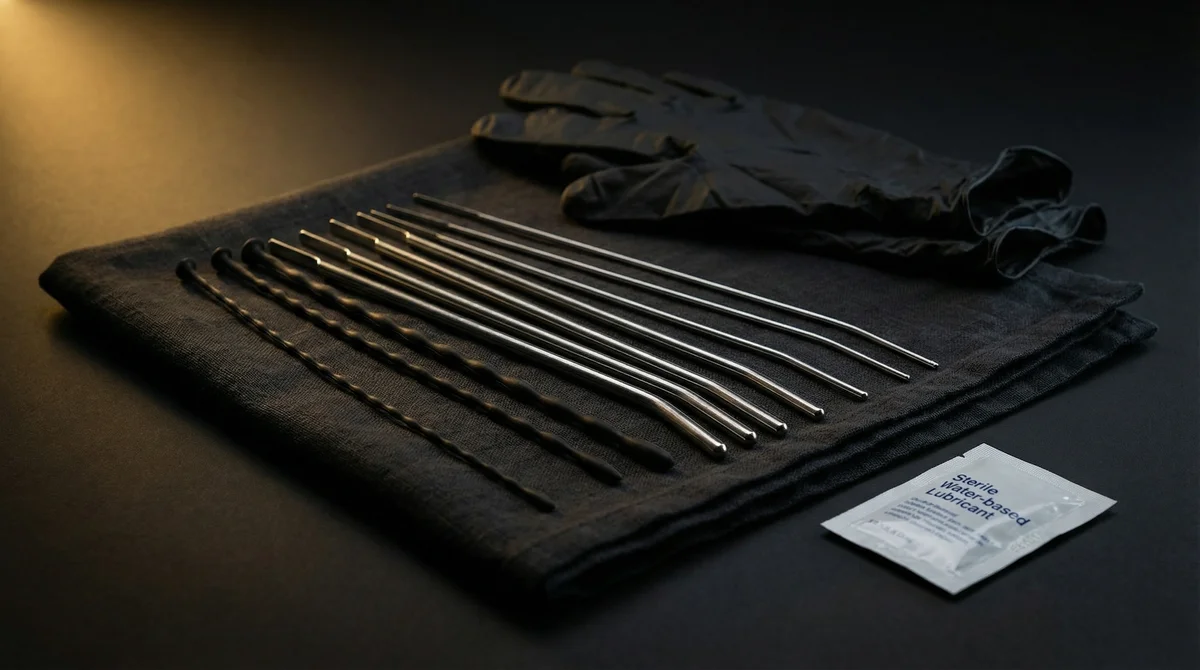
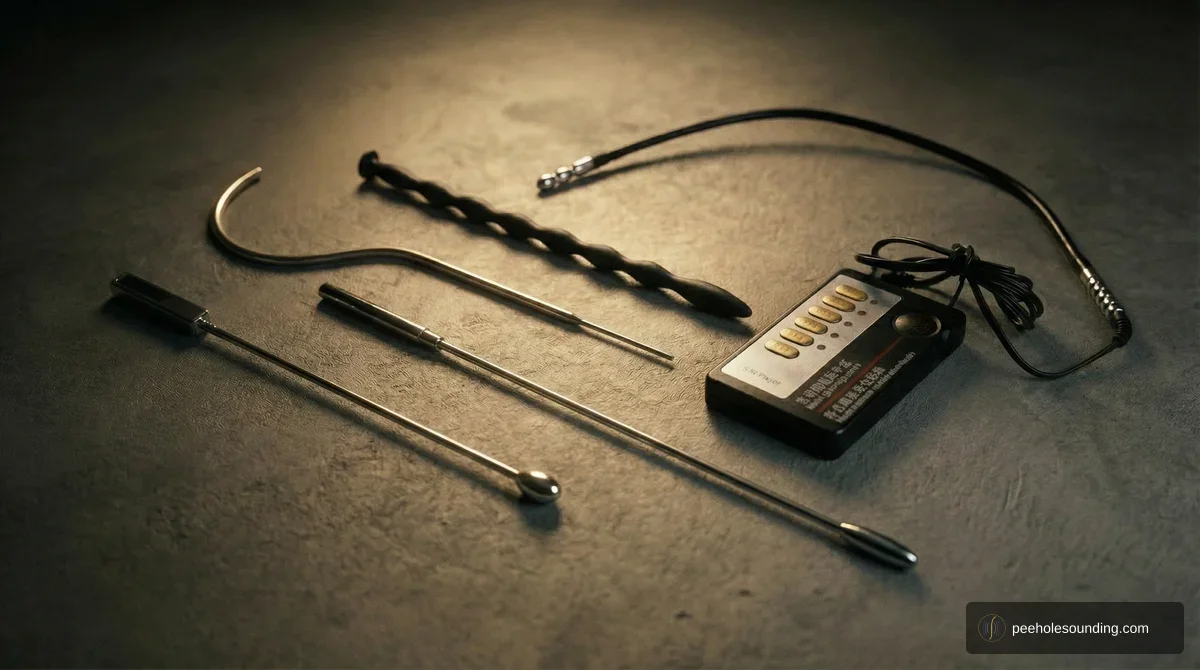
Penis sounding borrows real medical instruments (Hegar dilators, Van Buren sounds, and similar; see types of urethral sounds for the full breakdown) and uses them recreationally for the sensations they produce. Urologists have used these tools for decades to dilate strictures and explore the urethra. We use them because the male urethra is dense with nerve endings and runs past the prostate, both of which surface stimulation never reaches.
Why men try it
Three honest reasons:
- Internal urethral sensation. The male urethra is roughly 7 to 8 inches long and lined with nerve endings the entire way. Surface stimulation of the penis never touches them.
- Prostate proximity. A long enough sound, inserted carefully, can reach and stimulate the prostate from inside the urethra. It's a different sensation from anal prostate massage: more direct, more focused, less surrounding pressure on the bowel.
- A sensation nothing else replicates. Following a sound's path inward (feeling it move along the penile urethra, settle through the bulbar curve, and press up against the prostate from inside) is genuinely unlike masturbation or partnered sex. There's no surface-friction equivalent, no anal-pressure equivalent. It's its own thing: slow, internal, deeply attentive, and (for most men who stick with it) increasingly pleasurable as the body learns the territory.
For the universal sensation framing (what it feels like in general, why it can feel good), see Does Sounding Feel Good?. And for the side of this that sensation alone doesn't explain (vulnerability, D/s dynamics, medical play), see the full breakdown of the sounding kink.
Sound vs. plug, don't confuse them
A sound is a long, smooth rod. You insert it, enjoy the sensation, then remove it.
A plug is short, often flared or wearable, and designed to stay in.
If you're looking at product pages and not sure which you want, our penis plugs guide covers the wearable category. This guide is about sounds.
Is Penis Sounding Safe?
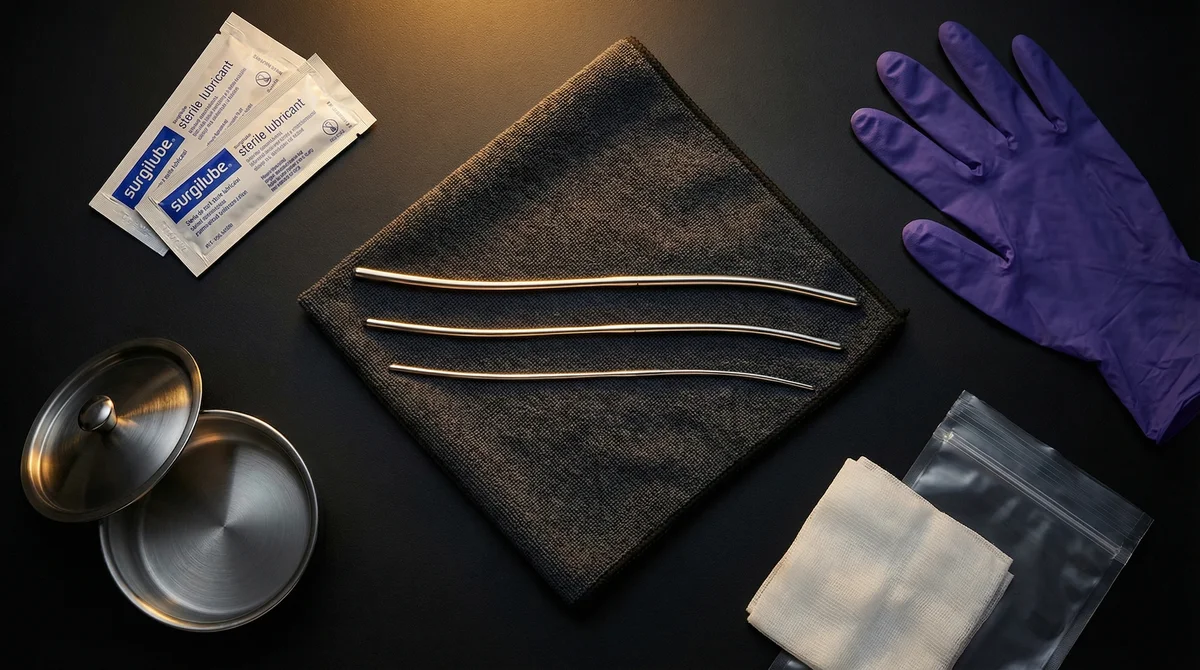
Yes, when you do it right. The urethra is a working passage, not a fragile one; what it doesn't handle well is bacteria, friction, or force. The real risks (UTI, irritation, false passage, bladder injury) are all preventable with the same three habits: sterilize, lube generously, never force.
The full universal risk list and the "when to call a doctor" red flags live in our safety protocols guide. Read that first. The rest of this section is the stuff that's genuinely male-specific.
Male-specific risk angles to know about:
- Active prostatitis or recent prostate biopsy. The prostatic urethra runs through tissue that's already inflamed in these cases. Don't sound. Wait until your urologist clears you.
- Known urethral stricture. Strictures are most common in the bulbar urethra (the curve at the base), which is exactly the part you have to work through. A stricture changes the safe technique entirely; talk to a urologist before sounding past it.
- Prince Albert or other meatal piercing. Sounding around fresh piercings is a bad idea; with healed piercings, you can usually sound around the jewellery, but check that the bar isn't deflecting the sound's path.
For everything else (what to do if you bleed, when to actually go to the doctor), see the safety pillar.
Sounding While Erect vs. Flaccid
This is the question I get asked the most that's genuinely male-only: should you be hard or soft?
Partially soft is easiest, but don't stress about it. All three states work. A full erection tightens the meatus and straightens the urethra a bit, which makes the opening slightly harder to get a sound past, but plenty of men sound fully hard and do fine. Complete flaccidity makes the penis harder to handle and the urethra a bit floppier, but it still works. Partial is just the sweet spot: relaxed urethra, manageable penis. If your body lands somewhere else when it's time to start, that's fine too. Work with what you've got.
Once the sound is in, an erection often returns on its own. That's fine, and it's the cleanest answer to a question I'll cover in the mechanics section: yes, you can leave the sound in while you get hard, and yes, plenty of men orgasm with it inserted.
Male Anatomy: How Sounding Mechanics Change With a Penis
The universal step-by-step (sterilize, lube, position, insert slowly, pee after) lives in How to Insert a Urethral Sound. Read it. Below are the bits that change when the anatomy is male. These are the parts a universal guide can't cover well, because they don't apply to female anatomy.
The S-curve through the bulbar urethra
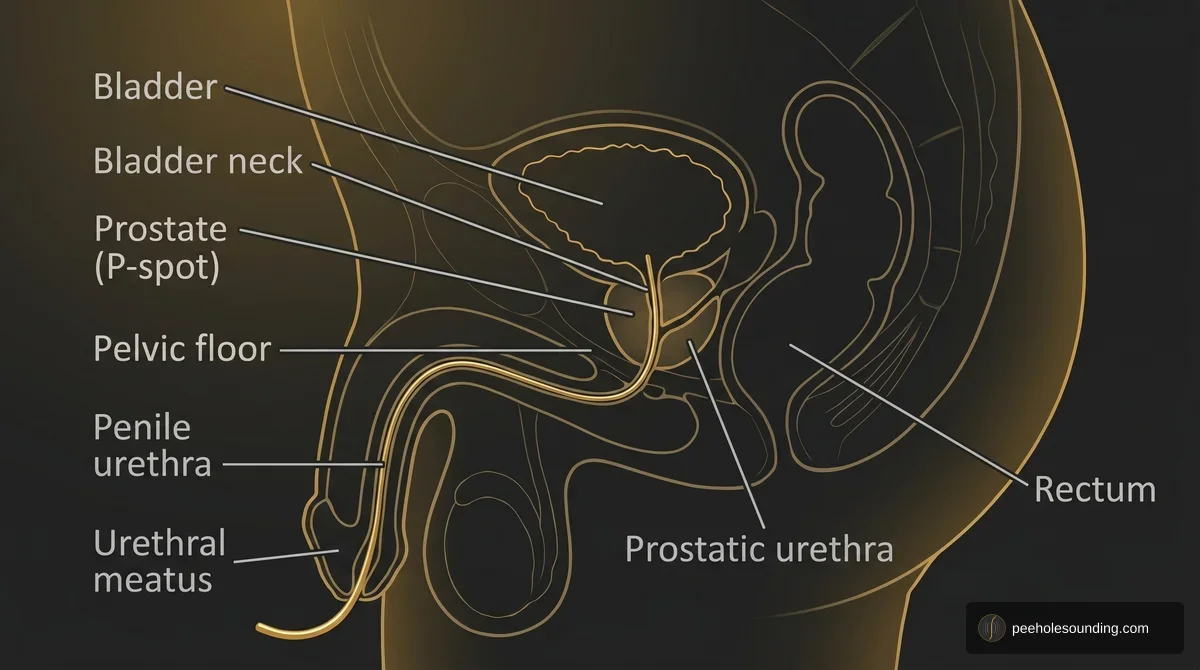
The male urethra isn't straight. From the meatus, it runs straight along the underside of the penis, then bends sharply at the bulbar urethra (where the penis meets the body), then runs upward through the prostatic urethra to the bladder. That bend is real, and it's why deeper sounding is a different practice from shallow play.
For shallow sessions (the first 2 to 3 inches), the bend doesn't matter; you're entirely within the penile urethra. The sound goes straight in by gravity. This is where you start, and where most sessions stay.
To go deeper, you need either a curved sound (Van Buren style) or a flexible one (soft silicone, a urethral catheter, or anything else that bends with the urethra). Both work, they just get there differently. With a curved steel sound, the shape does the work; with a flexible sound, the material lets the urethra steer it. Either way, the technique changes: hold the penis along your stomach so it points up toward your chest, then as the sound's tip reaches the bulbar curve, slowly lower the penis down between your legs while letting the sound follow the urethra's curve. Don't push through resistance; let the angle change do the work. If the sound stops, you're probably at the bulbar bend; reposition before forcing.
This is not a beginner technique. Build up to it.
What to do if you get fully erect mid-insertion
Two scenarios, and the material you're using matters a lot:
Erection while the sound is still in the penile urethra (shallow). No problem with any material. The penile urethra is elastic and tracks the erection. The sound stays put. You can leave it in, remove it, or keep playing. Your call.
Erection while you're working through the bulbar curve. This is where the material decides how much it matters. With a rigid metal sound (Van Buren, Hegar), going fully hard mid-curve is a real problem: the urethra tries to straighten while the sound stays bent, and the mismatch is one of the most common causes of false passage. Stop, ease back to partial, then continue. With a flexible silicone sound or urethral catheter, this is much less of a deal: the sound bends with the changing geometry, so a mid-insertion erection mostly just shifts the sensation rather than risking injury. So the "stop and ease back" rule applies mainly when you're using rigid metal at depth.
For sterilization, lube, post-session urination, and the rest of the universal protocol, see How to Insert a Urethral Sound, our sterilization guide, and our lube guide.
Sizing for Male Beginners
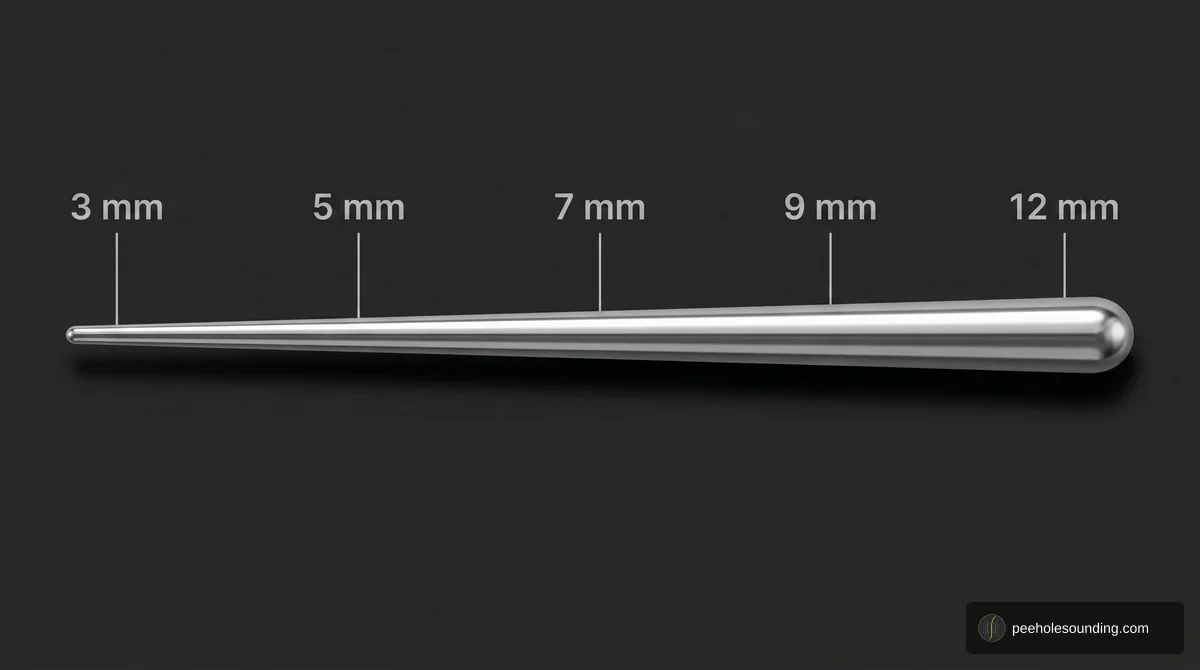
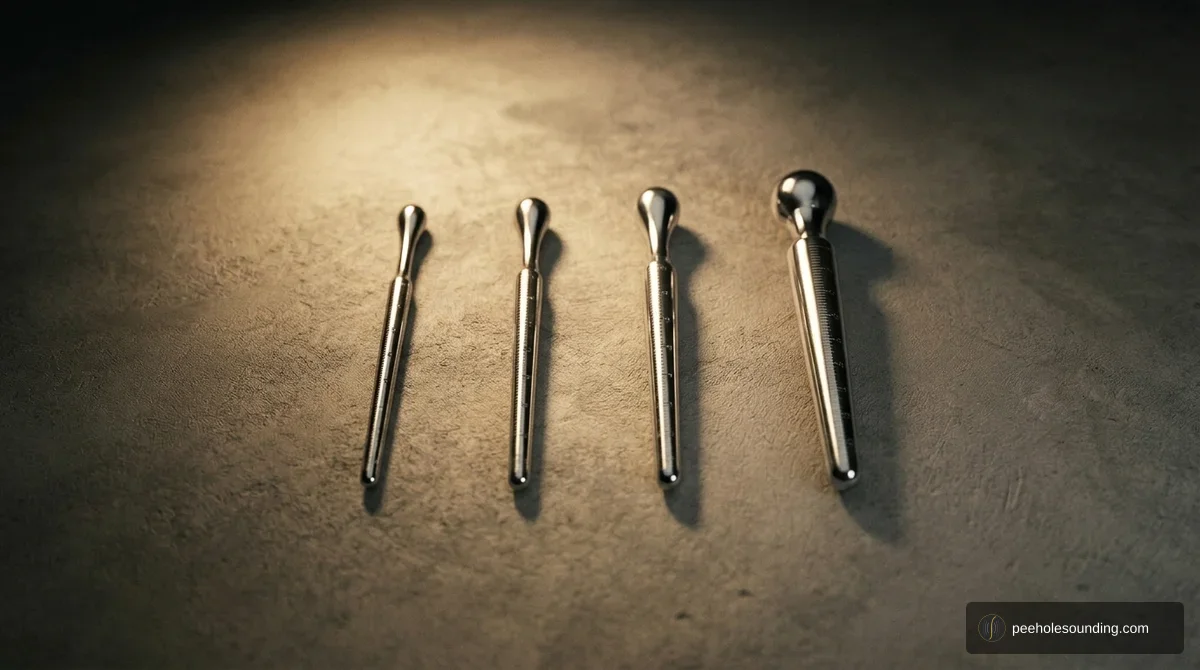
The full sound-type-by-sound-type sizing reference lives in our sounding rods sizes chart, and the personalized recommendation tool is at What Size Sounding Rod?. What follows is just the male-anatomy starter recommendation: the bit that doesn't carry over from the universal chart.
The most counterintuitive thing about male sounding is that very thin sounds are more dangerous than slightly thicker ones. A pencil-thin sound concentrates all its force on a single contact point and is easier to scratch the urethral wall with. A slightly thicker sound distributes pressure evenly and practically guides itself.
| Experience | French (Fr) | Diameter | Sound type |
|---|---|---|---|
| First-ever male session | 9-15 Fr | 1/8 to 3/16 in | Small Hegar (rod 2 or 3) |
| Comfortable male beginner | 16-20 Fr | 3/16 to 9/32 in | Medium Hegar |
| 3+ months of male practice | 22-28 Fr | 9/32 to 11/32 in | Larger Hegar or curved |
| Advanced (incl. prostate-reaching) | 30+ Fr | 13/32+ in | Curved Van Buren for depth |
To convert from French gauge (Fr) to millimetres (mm), simply divide by 3. For a rough approximation in inches, divide the Fr value by 75. When in doubt, round down.
Penis Sounding and Prostate Stimulation
Most guides mention in passing that deep insertion can stimulate the prostate and leave it at that. Here's how it actually works in male anatomy.
The prostate sits behind the bladder, wrapped around the prostatic urethra, the segment of the urethra that runs through it. To reach it from inside, a sound has to pass through the meatus, the penile urethra, the bulbar S-curve described above, and into the prostatic urethra. The pleasurable contact point is roughly where the prostatic urethra passes through prostate tissue.
Why this is the interesting part
Anal prostate massage works by pressing on the gland through the rectal wall: indirect. With a sound seated in the prostatic urethra, you're in direct contact with the nerve-dense tissue inside the gland itself. Different category of signal entirely.
The orgasm angle surprises most men who try it. During orgasm the prostate contracts rhythmically as part of ejaculation; with a sound inside it, those contractions squeeze the gland around the rod and the tissue rubs against it with each pulse. You get an orgasm that feels deeper, broader, and more drawn out. Not "better" than a regular orgasm, just a different category of sensation.
But orgasming with a sound this deep is advanced territory. Build up to comfortable deep sounding first, and use soft silicone or a urethral catheter rather than rigid metal. Flexible material moves with the contractions instead of fighting them.
This is not a beginner technique. A few prerequisites:
- Comfortable at intermediate sizes (~9/32 in or 22 Fr) for at least a few months
- Comfortable working through the bulbar S-curve at shallower depths first
- Using a properly curved sound (Van Buren or similar); straight sounds don't follow the path. Soft silicone sounds and urethral catheters are even better here, because they bend with the curve rather than fighting it
- Sober, unhurried, and willing to stop if anything is off
Past the prostate: where to stop
Reaching and passing through the prostate, on the way toward the bladder, is where real advanced territory starts. As you work inward, you'll meet two distinct barriers.
First barrier (light): the start of the prostate. A small bump in resistance as the urethra enters the prostatic segment. Easy to push through if you don't know any better, but it's the signal that you're now in prostate territory.
Second barrier (firm): the urethral sphincter at the bladder neck. Distinctly more resistance. This is the internal urethral sphincter, the muscular ring that keeps urine in the bladder, and it does not want you past it. This is where to stop. Letting the sound's tip rest against the sphincter, not pushing through it, is the clean endpoint of any deep session. Forcing past it takes you into the bladder, which is its own practice (bladder sounding) with a much bigger risk profile: bleeding, bladder-wall trauma, retrieval issues if the sound migrates. That's expert territory and needs specific tools.
Forcing depth before you're ready is one of the fastest ways to give yourself a false passage at the bulbar bend, or bladder issues if you push past the sphincter. Go slow. Stop at the second barrier.
Aftercare: The Male-Specific Bits
The universal aftercare protocol (hydration, monitoring for fever, the complete red-flags list) lives in our safety protocols guide. Here's what's genuinely different through a male urinary tract.
Pee within 15 to 30 minutes. This matters more in male anatomy than female, partly because the male urethra is much longer and gives bacteria more surface area to settle on, and partly because a male UTI is harder to clear once it takes hold. Don't skip this step.
A short "sounding burn" on the first post-session void is normal. It's the meatus and the penile urethra registering that something passed through. It usually fades within seconds and doesn't recur on the second void. If burning persists into the next void, treat it as a UTI signal.
Mild fullness or weight at the base of the penis can linger for an hour or so after a deeper session; that's the bulbar urethra registering the stretch, not damage. It fades.
Partial-erection aftercare. It's common to be partially or fully erect for a while after a session, especially after prostate-reaching depth. Wait until you're mostly soft before any rough handling, and skip the next session if you're still tender.
For everything else (fever, persistent bleeding, when to actually go to the doctor), see the safety pillar.
Male-Specific Myths
The universal myth-busting list (it permanently stretches you, it's only for pain people, bigger is better) lives in our myths guide. Three myths I get only from men:
- "It'll make you infertile." No. The urethra and the vas deferens are separate plumbing. Sperm enter the urethra at the prostatic segment via the ejaculatory ducts; a sound passing through doesn't damage them. Severe, repeated injury could in principle scar things, but normal sounding doesn't.
- "It'll ruin your erections." No causal link. The mechanics of erection (corpora cavernosa, blood pressure regulation) are anatomically separate from the urethra (corpus spongiosum). What can mess up erections temporarily is a technique-related injury, the same way any sex injury can. But that's a reason to follow good technique, not a reason to avoid sounding.
- "Only gay men do this." False. Sounding has nothing to do with orientation. It appeals to men of every orientation for the same reasons: novel internal sensation and prostate access. The community spans every orientation.
When Penis Sounding Is Right for You
Penis sounding rewards patience: the right size, the right lube, the right erection state, and respect for the bulbar curve. If you're curious-but-cautious, read our universal beginner guide first to get oriented, then come back here for the male-anatomy specifics.
If a partner is reading along, the female sounding guide is the sister page.
The first time will probably feel weirder than you expect. The second time will make more sense. By the fifth or sixth session, you'll know whether this is for you.
Frequently Asked Questions
Related Guides
Urethral Play: The Complete Guide to Sounds, Plugs, Stretching & Vibration
Jun 19
Urethral Sounding for Beginners: Sizes & First Session
Apr 5
What Is Urethral Sounding? A Complete Guide to Safety, Pleasure & Getting Started
Feb 15
Sounding Rods Sizes Chart: French Gauge to mm to Inches
Apr 28
What Size Sounding Rod Should Beginners Start With?
Mar 15
Is Sounding Safe? Sounding Safety Protocols & Risks
Mar 5
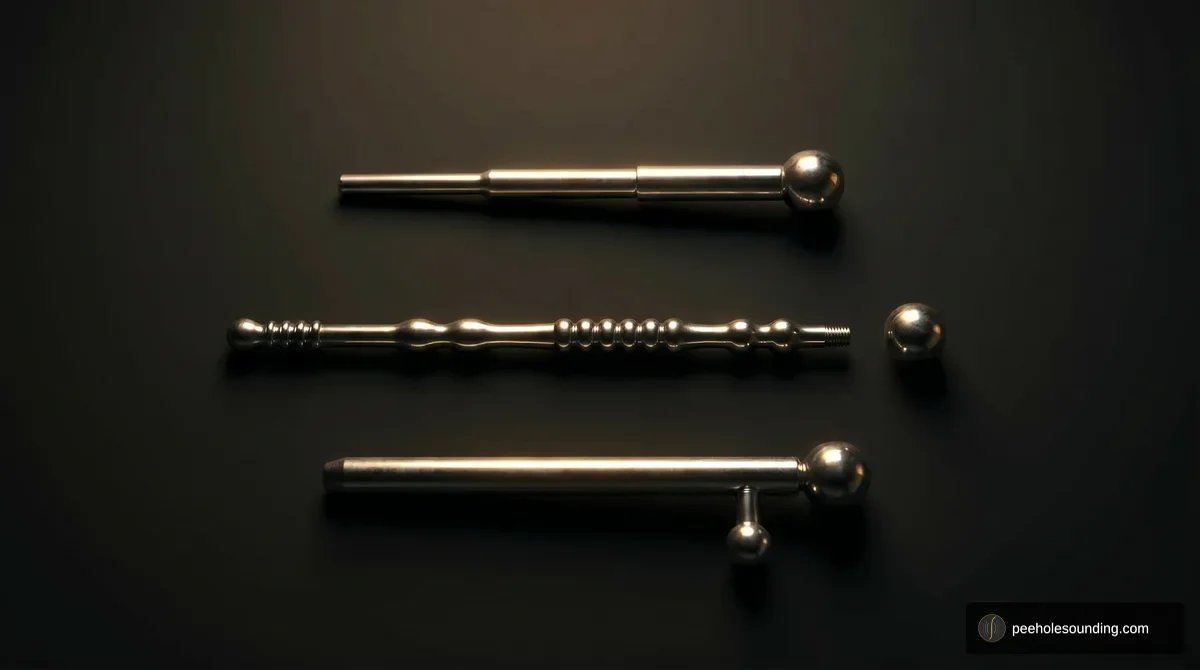
Best Penis Plugs in 2026: A Beginner-Friendly Buyer's Guide
Apr 16

Female Urethral Sounding: Beginner Techniques & Safety
Mar 30
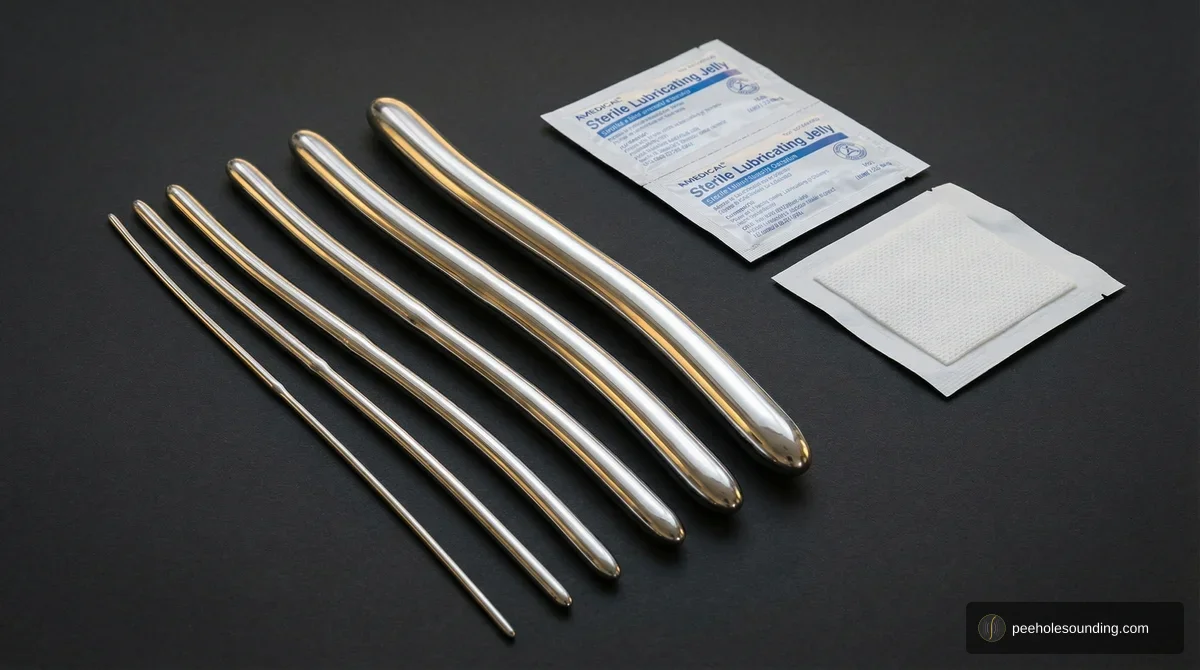
How to Insert a Urethral Sound (Step-by-Step)
Mar 25
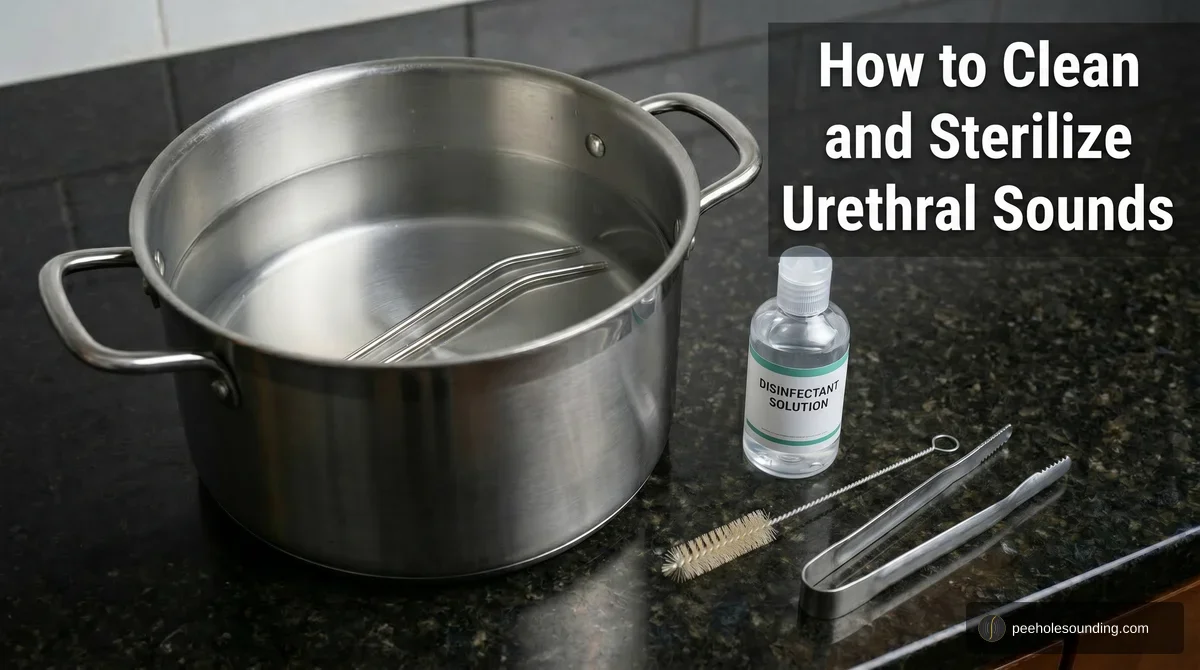
How to Clean and Sterilize Urethral Sounds
Mar 20
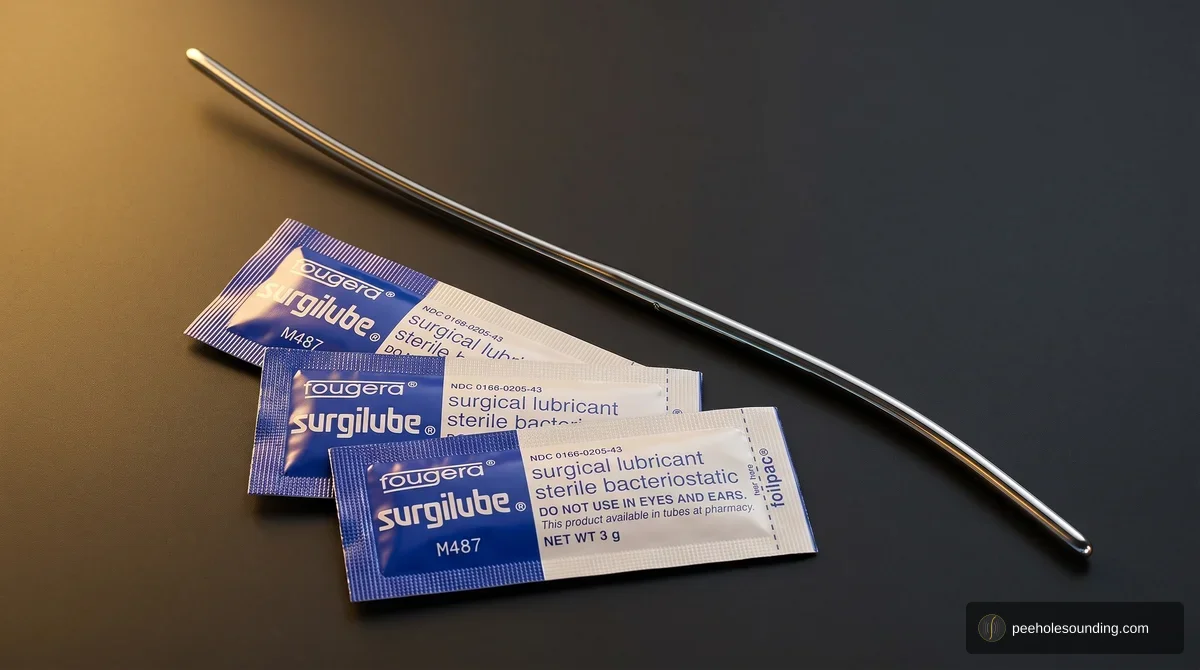
Best Lube for Sounding: Sterile Picks That Actually Work
Apr 20
Sounding Toy Guide: Types, Materials & How to Choose
Mar 10
Sounding Pleasure: What It Feels Like & Why People Chase It
Feb 22