What Size Sounding Rod Should Beginners Start With?
Complete sounding size guide with mm-to-French-gauge chart. Learn the right starting size for beginners, sizing by sound type, and when to size up safely.
 By Kevin Voss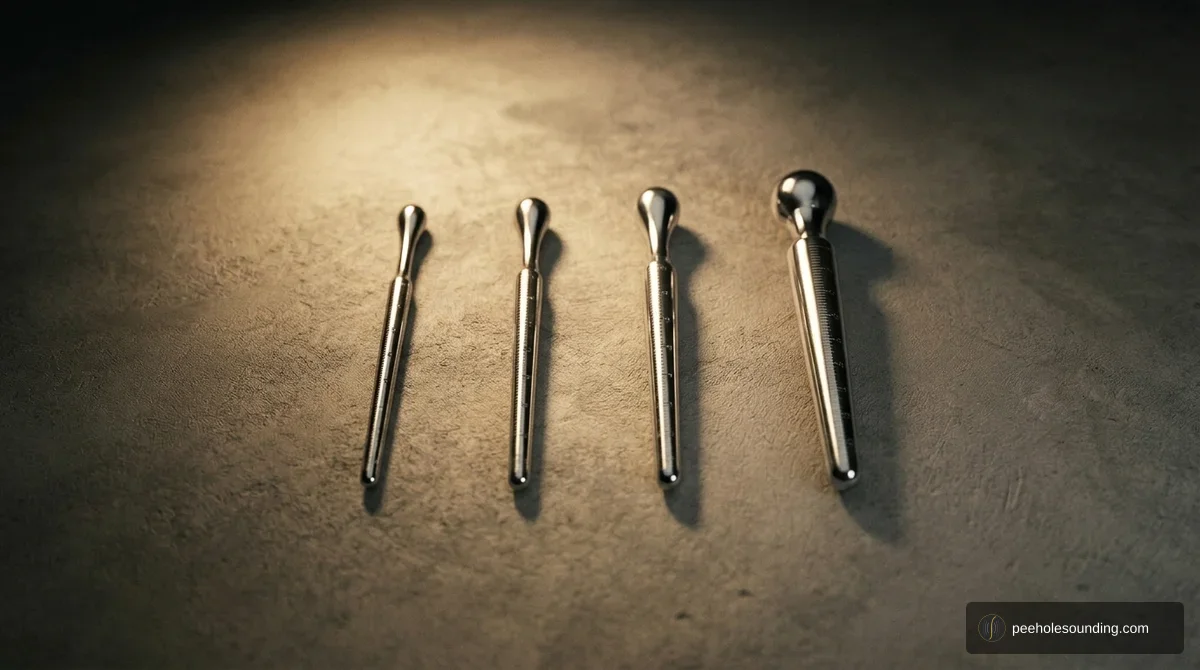
Most beginners should start with a sound between 1/8 inch and 3/16 inch in diameter. Your urethra is about 1/4 inch to 5/16 inch wide, but you don't start by filling it completely — you start smaller and work up as your body adapts.
I bought my first Hegar set off Amazon with no idea what size to start with. I went straight for a rod that matched my urethra diameter, thinking that was the logical move. It was way too much. After ten years, 5/16 inches is still more than I can comfortably handle. Start smaller than you think.
Why Thinner Isn't Safer (The Mistake Everyone Makes)
This is counterintuitive, so read it twice: a thinner sounding rod is more dangerous for beginners, not less.
Here's why. A thin rod concentrates all of its force onto a tiny contact area. Think of the difference between pressing a sharp pencil tip into your palm versus pressing the flat side of a marker. Same pressure from your hand, completely different result. A thin sound can slip sideways inside the urethra, scrape the walls, or puncture through the urethral lining if you lose control of it.
Doctors use the very thinnest sounds — under 1/16 inch — with camera guidance (cystoscopy) so they can see exactly where the tip is going. Below about 1/8 inch, you're in territory where control becomes difficult and puncture risk goes up significantly.
A properly sized sound, on the other hand, sits snug against your urethral walls. The pressure distributes evenly around the circumference. It can't slip sideways because there's nowhere for it to go. It practically guides itself.
Too thick is also a problem — forcing in a sound that's too large causes pain, tearing, and overstretching. But between too thin and too thick, too thin is the more dangerous mistake for someone just starting out.
I'm not a doctor, and I'll always tell you to see one if something feels off. But after ten years of doing this, I can tell you what works and what doesn't.
Understanding Sounding Sizes
Three measurement systems float around in the sounding world: millimeters, French gauge, and inches. This causes endless confusion, especially when one seller lists a sound in mm and another lists the same type in French gauge.
Millimeters vs. French Gauge vs. Inches
French gauge (Fr) is the sizing system used in medical settings for catheters and sounds. It was created by Joseph-Frédéric-Benoît Charrière, a 19th-century French surgical instrument maker. The conversion is simple:
French gauge = millimeters × 3
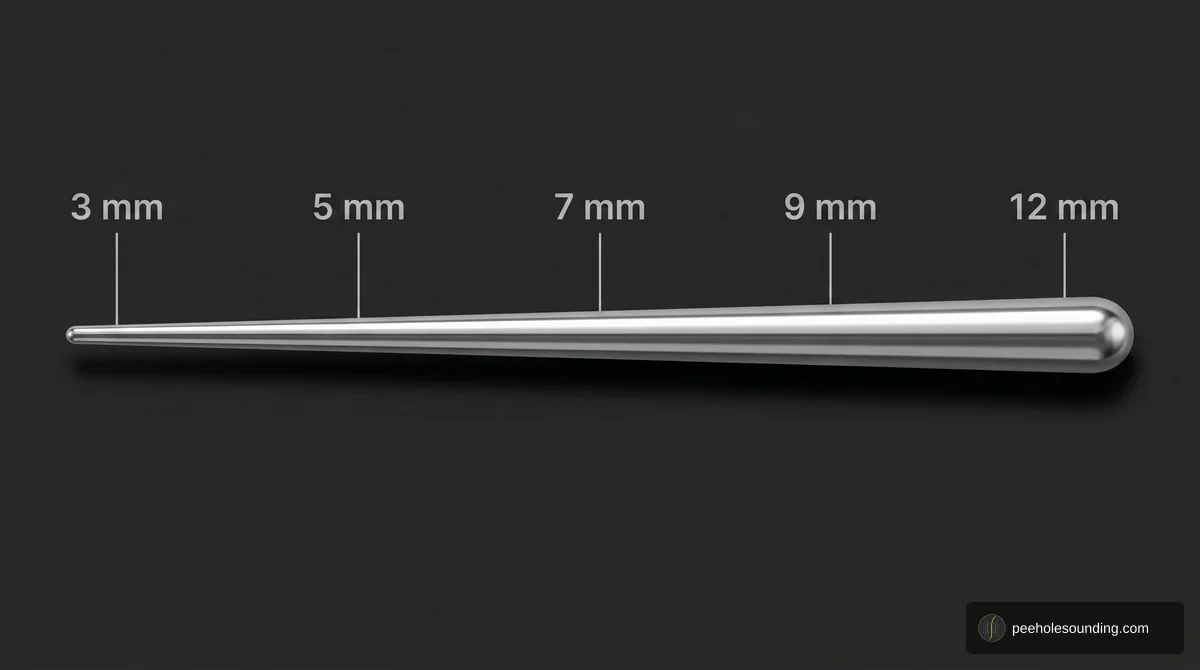
So a 5/16 inch (~8 mm) sound is about 24 Fr. A 1/4 inch (~6 mm) sound is about 18 Fr. The full Fr / mm / inch conversion table lives in the sounding rods sizes chart; below, you'll find which starting sizes match different experience levels.
Always check which unit a product listing uses before you buy. I've seen people order a “24 French” sound thinking it was similar to their usual 5/32 inch rod — they ended up with a 5/16 inch sound that was far too thick to insert.
Recommended Starting Sizes by Experience
- Medical only1-2mm · under 1/16″
Requires camera guidance — never for recreational use
- Beginner3-5mm · 1/8″ – 3/16″
Sweet spot for most people starting out
- Intermediate6-8mm · 1/4″ – 5/16″
After months of regular practice and gradual progression
- Experienced9-11mm · 3/8″ – 7/16″
Requires gradual dilation over time
- Advanced12mm+ · 1/2″+
Deep stretching territory
| Size (mm) | French Gauge | Approx. Inches | Experience Level | Notes |
|---|---|---|---|---|
| 1-2mm | 3-6 Fr | under 1/16″ | Medical only | Requires camera guidance — never for recreational use |
| 3-5mm | 9-15 Fr | 1/8″ – 3/16″ | Beginner | Sweet spot for most people starting out |
| 6-8mm | 18-24 Fr | 1/4″ – 5/16″ | Intermediate | After months of regular practice and gradual progression |
| 9-11mm | 27-33 Fr | 3/8″ – 7/16″ | Experienced | Requires gradual dilation over time |
| 12mm+ | 36+ Fr | 1/2″+ | Advanced | Deep stretching territory |
Need every Fr ↔ mm ↔ inch value in one table? See the sounding rods sizes chart — that's the full reference. This page focuses on which size you should start with.
Sizing by Sound Type
Not all sounds use the same sizing conventions. Here's how starting sizes break down by type.
Hegar Sounds
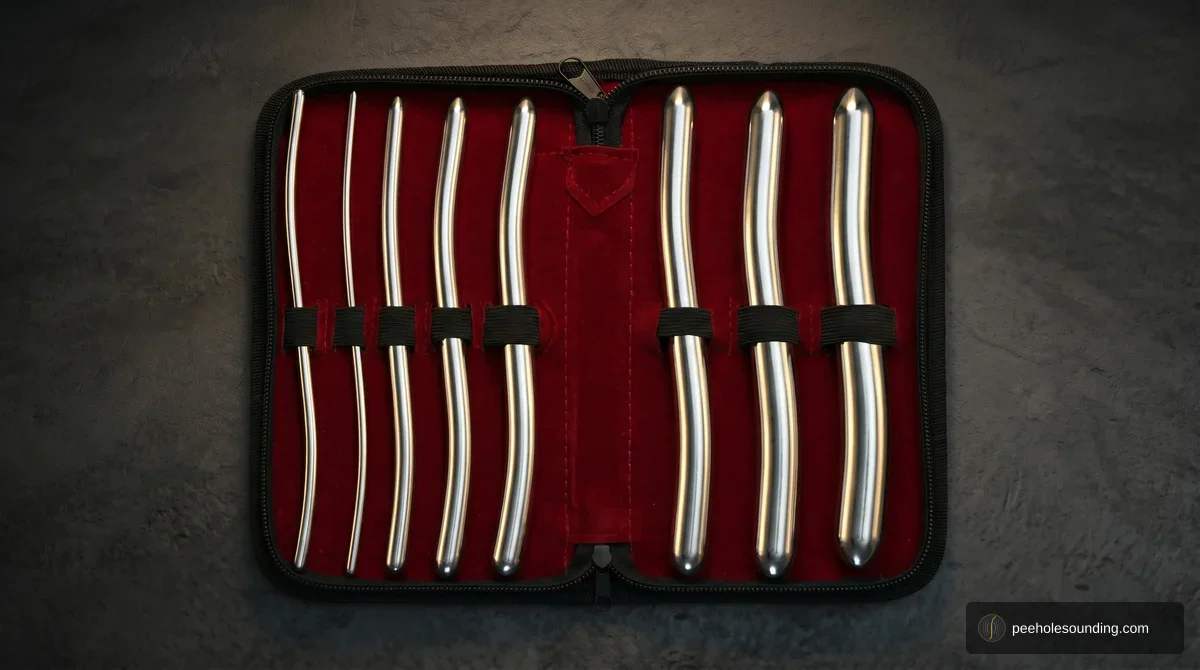
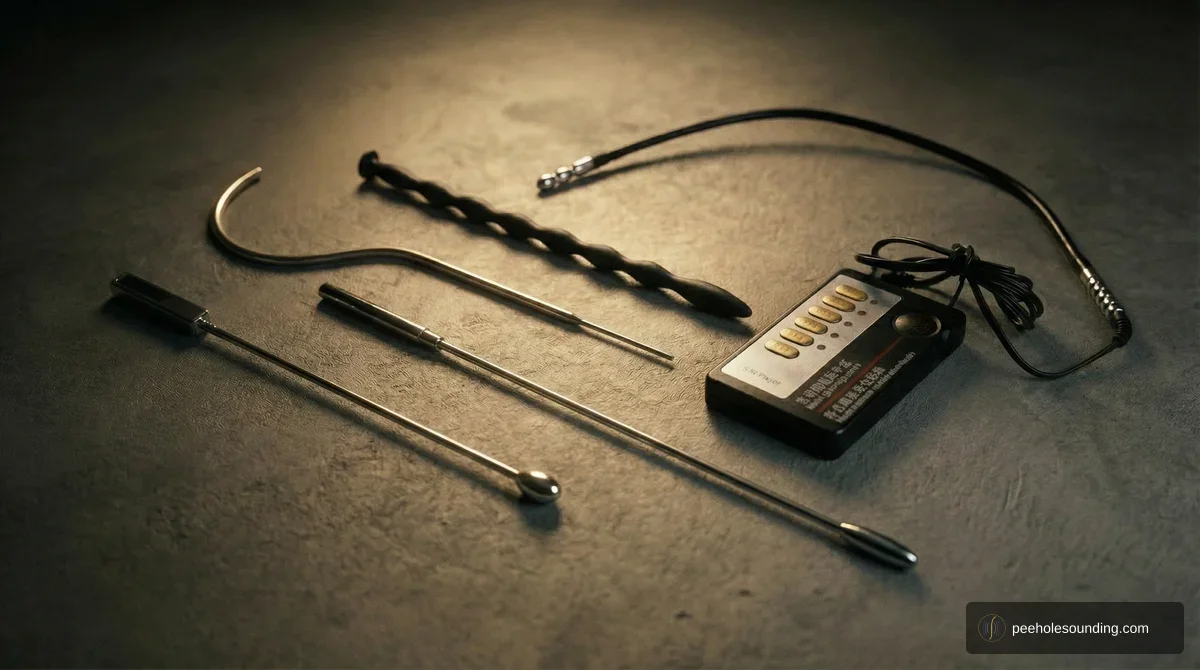
Hegar sounds are the most popular beginner set — they're the Honda Civic of the sounding world. Each rod is dual-ended with two different diameters, about 1/32 inch apart. A full set ranges from about 1/8 inch to 3/4 inch across all rods.
Where to start: Hegar 4 (4 mm / 12 Fr, about 5/32 inch). Go by the number stamped on the rod, not by which rod comes first in the case. An 8-piece set starts at Hegar 3, a 14-piece starts down at Hegar 1, so “the smallest rod” is a different size depending on what you bought. Find the 4.
Skip anything thinner. Hegar 3 (3 mm) sits at the very bottom of the beginner band and I wouldn't start there, and the 1 to 2 mm rods in a 14-piece set are medical-only, used with camera guidance. A rod that thin concentrates force on a tiny contact patch and is easier to misdirect. Thinner isn't safer. Once Hegar 4 feels comfortable over a few sessions, move to Hegar 5 (5 mm / 15 Fr, about 3/16 inch).
If you're curious about how different sound types compare, I've written a full breakdown.
Dittel (Straight) Sounds
Dittel sounds are single-ended with a uniform diameter along the shaft. They're slightly simpler to use than Hegar sounds because there's no curve to navigate.
Where to start: Same 1/8 inch to 3/16 inch range. Pick a single rod in that size or a graduated set.
Rosebud Sounds
Rosebud sounds have a bulbed tip that tapers to a thinner shaft. In a typical 6-piece kit, the smallest starts around 3/16 inch — right in the beginner range.
Where to start: The 2nd or 3rd sound in a standard set, which puts the bulb tip at roughly 3/16 inch to 1/4 inch.
Does Material Change the Size You Need?
Yes, and this trips people up.
Stainless steel is rigid. The diameter you see listed is exactly what you feel. A 5/32 inch steel sound is 5/32 inch, period.
Silicone compresses slightly under pressure, so it can feel a bit smaller than its stated size once inserted. But silicone also has significantly more surface friction than polished steel, even with lube. That friction makes it feel larger during insertion.
In my experience, I'd go about 1/32 inch thicker in silicone than I would in steel to get a similar sensation of fullness. If 5/32 inch steel feels right for you, try 3/16 inch silicone.
Sizing for Different Bodies
For Penis Owners
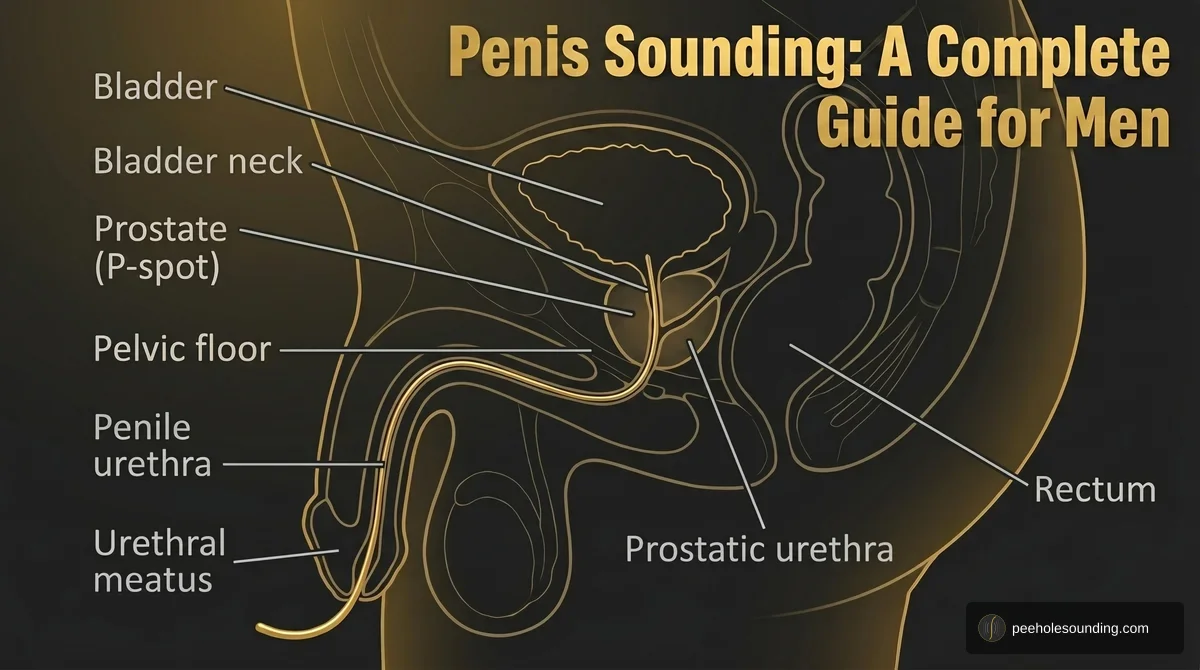
The average male urethra is about 1/4 inch to 5/16 inch in diameter, but that doesn't mean you start at that size. A sound that fills your entire urethra is far too much for a beginner. You need room for lube and gentle movement. Here's the thing about the meatus (the urethral opening at the tip of the penis): it's the narrowest point of the whole male urethra. That makes it your gate. If a rod passes the opening without force, everything behind it is wider still. What surprises people is that a rod which clears the meatus can still meet resistance an inch or two in. That's the angle changing, not the diameter.
Starting size: 1/8 inch to 3/16 inch.
As a beginner, keep the sound in the first few inches of the urethra — don't try to go past the base of the penis until you're comfortable with the basics. Depth and size are two separate progressions, and you shouldn't tackle both at once.
For a deeper dive on male-anatomy sizing — prostate technique, depth pacing, curve choices — see our male-anatomy companion guide.
For Vulva Owners
The female urethra is roughly 1/4 inch in diameter but only about 1.5 inches long — much shorter than the male urethra. This means you need shorter sounds (3-4 inches max) and should start at the lower end of the diameter range.
Starting size: 5/32 inch to 1/4 inch, in sounds no longer than 3-4 inches.
A few additional considerations: the female urethral opening sits close to the vaginal opening, which increases the risk of introducing bacteria. Never use a sound vaginally and then urethrally — always keep them separate. Clean front to back, and consider using surgical gloves for extra hygiene.
For a deeper dive, check out the full female sounding guide.
How to Find Your Personal Starting Size
The 1/8 inch to 3/16 inch recommendation works for most people, but everyone's anatomy is different. Here's how to find your personal fit.
The right-size sound should:
- Feel snug against the urethral walls — a gentle sensation of fullness
- Slide in smoothly with sterile lube, using minimal force
- Not cause pain, sharp pressure, or a feeling of overstretching
If your first sound is too thick: It won't go in without pain or significant pressure. Go down one size. If you bought a single rod, you'll need a smaller one or a graduated kit.
If your first sound slides in with zero resistance: You feel almost nothing. Go up one size. You want to actually feel it — that gentle fullness is part of what makes sounding feel good.
My honest advice: buy a graduated kit rather than a single rod. It costs $15-30 more but saves you from guessing wrong and having to reorder. A basic Hegar set with 8 rods covers you from 1/8 inch to 3/4 inch — that's everything from your starting size through years of progression.
How Do You Know If a Sounding Rod Is Too Big?
A sounding rod is too big if it stalls and needs real pressure to move, or if insertion burns instead of feeling full. One more tell: the discomfort keeps going after you stop moving the rod. A correctly sized rod feels snug and heavy. It never feels like forcing.
Signs the rod is too big:
- It won't advance unless you push. Held vertically, a well-sized rod descends under its own weight.
- Burning or stinging rather than a stretched, heavy fullness.
- The sensation doesn't settle within a few seconds of holding still.
- Urinating still burns hours later, not just on that first pee.
- More than faint pink on the rod. Bright red blood ends the session — see safety protocols.
Here's the thing, though: a rod that slides in easily and then stops at one point usually isn't too thick at all. That's the curve behind the base of the penis, or a pelvic floor that's clenched up. Change the angle, add lube, breathe. Size is the answer when the resistance starts right at the opening, or when relaxing changes nothing.
What to Do When a Rod Is Too Big
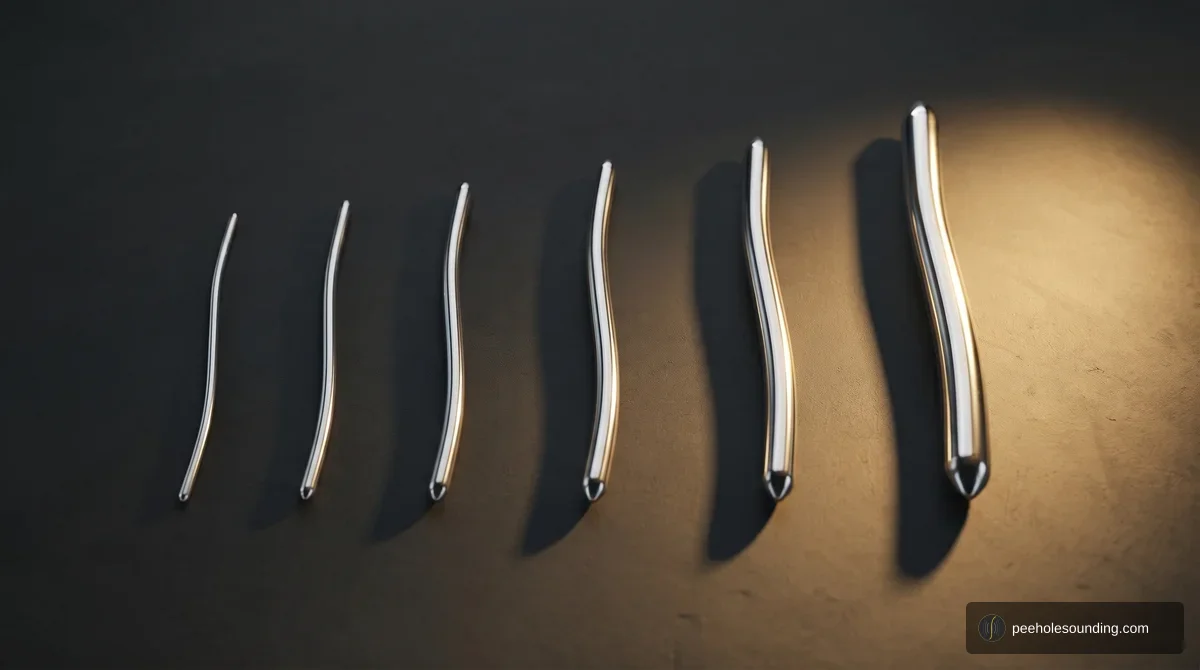
Stop, and withdraw slowly on the same angle you went in on. Then drop one increment — about 1/32 inch, or 3 French gauge. That's the argument for a graduated kit over a single rod. Wait days before the next attempt, not hours, and use more lube than felt necessary last time. The same rule governs a dilator set worked on a schedule: a rod that stalls isn't the rod for today.
The one time I pushed through a stall, it went in — and I spent the next two days with a burning pee. The stall was the information. If a smaller rod stops in the same spot every session, that's a urologist's question rather than a sizing one. A fixed stopping point can mean scar tissue.
Depth changes how loud all of this is. Every signal above comes through clearly near the tip, where the nerves are dense and sharply mapped. Deeper in — the back of the urethra, the prostate, the sphincter at the bladder neck that holds your urine in — those nerves report dully and vaguely.
So a feeling you'd shrug off as slightly uncomfortable down there can already be a rod pressing hard enough to bruise or tear. In deep play, mild discomfort is the stop signal, not the halfway mark. That's the real reason beginners are told to stay in the first few inches.
When to Size Up (and How to Do It Safely)
Signs You're Ready for the Next Size
- Your current sound inserts easily with lube, with little to no resistance
- You feel minimal sensation of fullness — it's comfortable but not very stimulating
- You've used this size comfortably for at least 3-5 sessions
Don't rush this. Sizing up because you're excited is how people get hurt. I spent about three months at each size when I was starting out, and that patience paid off.
Safe Progression Rules
- Always go up one size at a time (about 1/32 inch, or 3 French gauge). Never skip sizes. Clinical urethral dilation protocols also emphasize gradual, incremental progression.
- Wait days between sizing-up attempts, not hours. Your urethra needs recovery time.
- Re-lube generously when trying a new size. More lube than you think you need.
- If the new size causes pain beyond mild pressure and gentle stretching, go back down. Pain is your body telling you something. Listen to it.
- Never force a sound in. If it doesn't glide with moderate, steady pressure, it's too soon or too big.
For detailed guidance on the dilation process, read the urethral dilation guide. For a week-by-week schedule and plateau handling, see our safe progressive dilation walkthrough.
How Long Does Progression Take?
There's no universal timeline. It depends on how often you practice, your individual anatomy, and your goals. Some people are happy at their starting size and never feel the need to go larger. Others enjoy the gradual progression as part of the practice.
Typical pace: weeks to months between size increases. If you're sounding once or twice a week and everything feels good, you might be ready to try the next size after 4-8 weeks. If you're sounding less frequently, give it longer.
Common Sizing Mistakes
- Starting with the thinnest rod in a kit. The number one beginner mistake: thin rods are harder to control and carry the higher puncture risk.
- Skipping sizes. Jumping two or three increments is asking for a tear. One step at a time.
- Confusing French gauge with millimeters. A “10 French” sound is only about 1/8 inch, not 3/8 inch. Check the unit before ordering.
- Sizing up on excitement rather than comfort. Your urethra adapts on its own schedule, and the patience is what keeps the practice pleasurable long term.
Frequently Asked Questions
Related Guides
What Is Urethral Sounding? A Complete Guide to Safety, Pleasure & Getting Started
Feb 15
Urethral Sounding for Beginners: Sizes & First Session
Apr 5
Is Sounding Safe? Sounding Safety Protocols & Risks
Mar 5

Female Urethral Sounding: Beginner Techniques & Safety
Mar 30
Sounding Rods Sizes Chart: French Gauge to mm to Inches
Apr 28
Hegar Sounds: Sizes, Full mm/Fr Chart & How to Choose
Apr 12
Urethral Stretching Guide: Safe Progressive Dilation for Beginners
Apr 24
Penis Sounding for Men: Sizes, Safety & Prostate Technique
May 9
Sounding Toy Guide: Types, Materials & How to Choose
Mar 10