Hegar Sounds: Sizes, Full mm/Fr Chart & How to Choose
Hegar sounds explained: what they are, full size chart with mm and French gauge, beginner starting size, type comparisons, cleaning, and how to buy safely.
 By Kevin Voss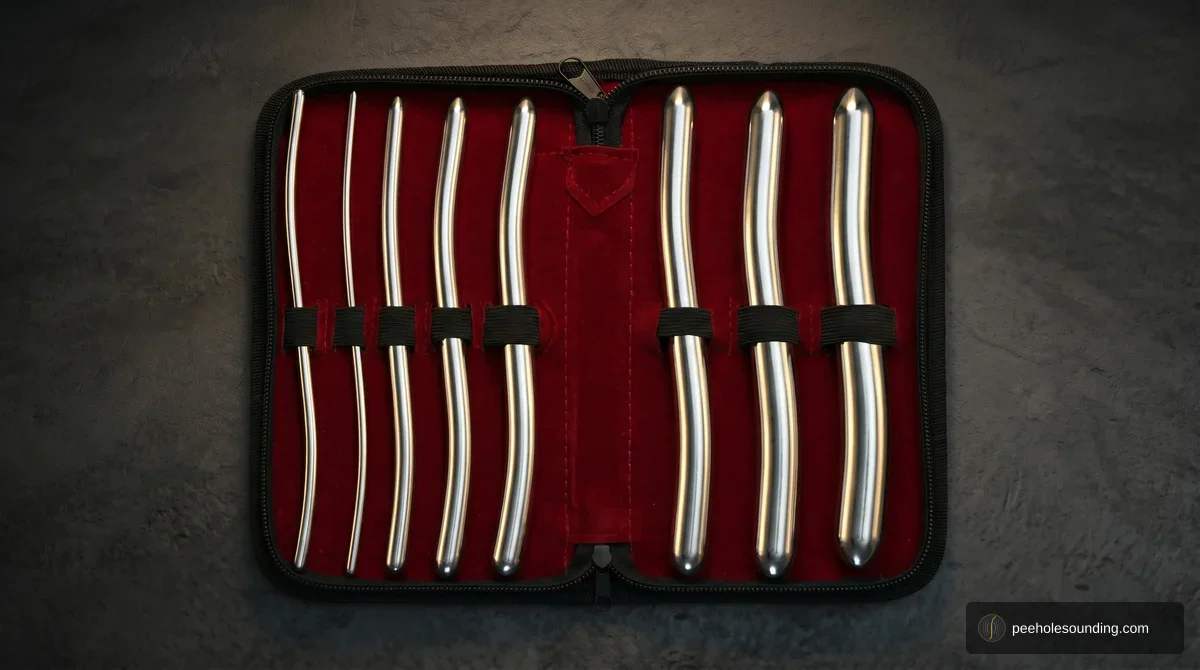
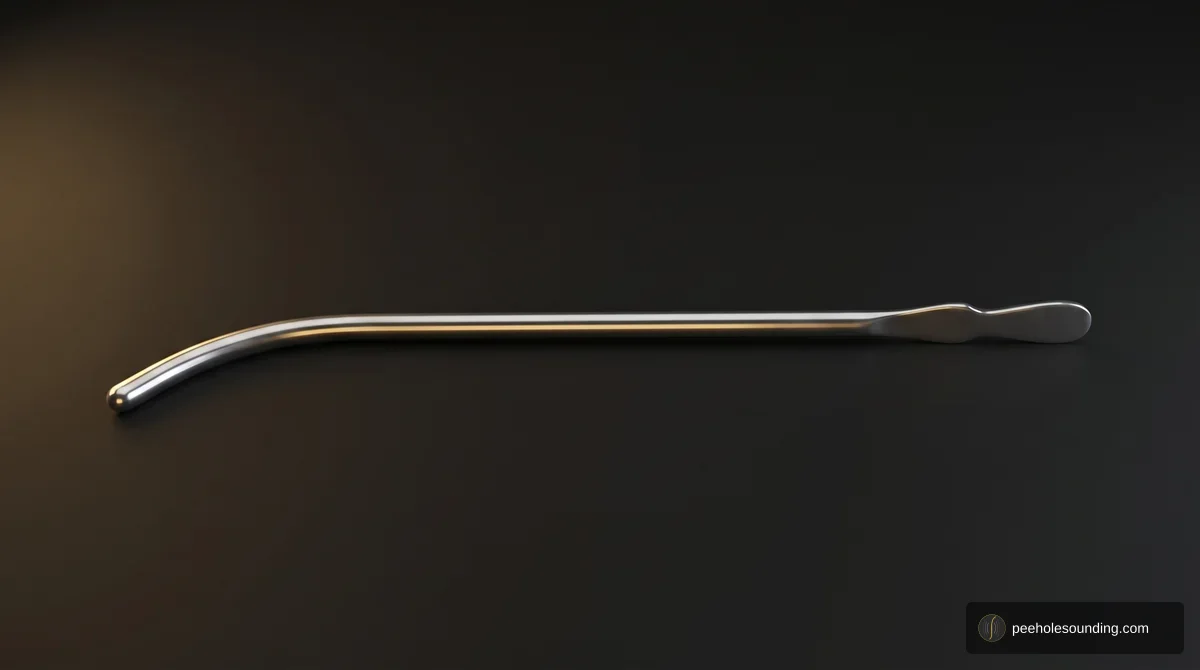
Hegar sounds are smooth, double-ended stainless-steel rods, slightly curved, originally designed in 1879 by the gynecologist Alfred Hegar to dilate the cervix. They're marked in millimeters, come in sets of 8, 10, or 14, and in an 8-piece set cover roughly 3 mm to 18 mm across all rods. They're the most popular starter set for urethral sounding because the graduated sizing is built in (each rod gives you two sizes about 1 mm apart), and the smooth, rounded tips are forgiving.
If you're buying one set and nothing else, make it Hegars. That is, if you're not planning on going deeper as a male. If depth and bladder play are the goal from day one, you'll eventually want Van Buren sounds with their pronounced curve that follows the male urethra. But for everyone else (beginners, vulva owners, and most penis owners who stay in the first few inches), Hegars are the set. I've been sounding for about ten years, I've owned a pile of sound types at this point, and the Hegars are still what I reach for when I want something predictable.
What Are Hegar Sounds?
The short answer
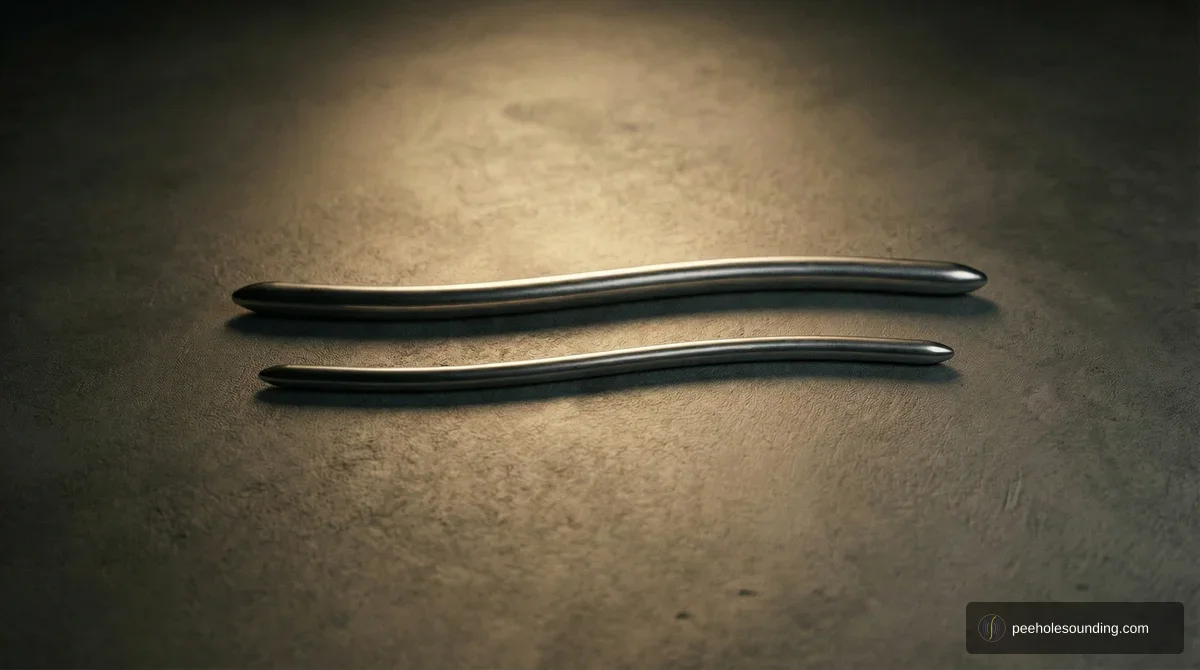
A Hegar sound is a single rigid rod, usually polished stainless steel, with a rounded tip on each end at slightly different diameters. They're gently curved, not straight, not aggressively S-shaped, and most are about 8 inches long. The diameter stamp on each rod is the Hegar number, and the Hegar number is just the diameter in millimeters. A Hegar 8 is 8 mm thick. That's the whole system.
Hegars are sold individually but almost always bought as a kit. An 8-piece set gets you 16 sizes across the range. A 14-piece set covers finer gradations and more top-end sizes for people who want to progress further.
A quick note on the name
Alfred Hegar was a German gynecologist who introduced this dilator design in 1879 for cervical dilation. The same graduated progression principle that makes it good for the cervix also makes it good for the urethra. The tool never changed; the sounding community just picked it up for the obvious reason. If you see “Hegar dilator set” on a medical supply site, that's the same thing being sold on a kink retailer as a “Hegar urethral sounding set.”
If you want the wider picture of every sound family out there, I cover them all in types of urethral sounds.
Why they're double-ended
Each rod has a different size on each end, typically 1 mm apart. Rod 1 in a standard 8-piece set is 3 mm/4 mm, rod 2 is 5 mm/6 mm, and so on. That matters more than it sounds.
A 1 mm jump in diameter adds about 3 mm to the circumference. That's a real stretch, bigger than beginners expect. The double-ended design is what gives you that small, safe step without having to own 16 separate rods. You practice with the small end for a few sessions, flip the same rod around once you're comfortable, and move on to the next rod only after the larger end feels easy.
Why Hegars Are the Beginner's Go-To
I bought my first Hegar set off Amazon with no real clue what size to start with. I went straight for a rod that roughly matched my urethral diameter, figuring that was the logical move. It was way too much, and I shelved the whole kit for a month before coming back to the smaller end of rod 2. That mistake is exactly why Hegars work: even when I got it wrong, the set had smaller rods waiting for me. I didn't have to reorder.
Three practical reasons Hegars dominate the beginner recommendation:
- Graduated sizing is built in. You buy one set and own your entire first year of progression.
- Rounded, smooth tips. No bulbs, no ridges, no sharp transitions. The tip meets the meatus gently and distributes pressure evenly as it slides in.
- Affordable. A decent medical-grade set runs less than a single well-reviewed silicone sound from a kink retailer.
The honest drawbacks, so you know them going in:
- Rigid steel isn't the most comfortable option. Soft silicone is genuinely more comfortable for most people and meaningfully safer for deeper play. It flexes with your anatomy instead of fighting it. Hegars win on graduated sizing and predictable feedback, not on comfort. If you already know you want depth or long sessions, a soft silicone set (covered in my types of urethral sounds guide) is the better pick.
- No flared base. A Hegar has no flange at the end. Which means yes, theoretically you can drop one all the way into your urethra mid-session. For penis owners it's usually not critical: once your erection softens the urethral grip relaxes and the rod tends to back out on its own, and a gentle bear-down (the same pressure you'd use to pee) will almost always push it out through the meatus. The 8-inch length and gentle curve also make a rod genuinely hard to lose. It's not going to disappear into a 7- or 8-inch urethra. But this is still the trade for graduated sizing, and it's why the retrieval rule in the safety guide exists: if for any reason you can't get it out yourself, you go to the ER. You don't fish.
Hegar Sound Sizes: The Full Chart
What the Hegar number means
The Hegar number is the diameter of that end of the rod in millimeters. A Hegar 10 is 10 mm across. A Hegar 12 is 12 mm. There's no conversion, no weirdness.
The sounding community usually thinks in French gauge (Fr), and most product listings outside the medical supply world use Fr too. The conversion is easy: French gauge = millimeters × 3 (every value in one table in the sounding rods sizes chart). So a Hegar 5 is 15 Fr. A Hegar 8 is 24 Fr.
8-piece Hegar set breakdown
| Rod # | Small end | Large end | mm (small/large) | Fr (small/large) | Who it's for |
|---|---|---|---|---|---|
| 1 | Hegar 3 | Hegar 4 | 3 / 4 mm | 9 / 12 Fr | 3 mm end too thin for safety; Hegar 4 (large end) is a good starting point for penis owners |
| 2 | Hegar 5 | Hegar 6 | 5 / 6 mm | 15 / 18 Fr | Recommended starting rod for vulva owners; next step for penis owners |
| 3 | Hegar 7 | Hegar 8 | 7 / 8 mm | 21 / 24 Fr | Intermediate after a few comfortable sessions |
| 4 | Hegar 9 | Hegar 10 | 9 / 10 mm | 27 / 30 Fr | Experienced |
| 5 | Hegar 11 | Hegar 12 | 11 / 12 mm | 33 / 36 Fr | Experienced |
| 6 | Hegar 13 | Hegar 14 | 13 / 14 mm | 39 / 42 Fr | Advanced stretching |
| 7 | Hegar 15 | Hegar 16 | 15 / 16 mm | 45 / 48 Fr | Advanced stretching |
| 8 | Hegar 17 | Hegar 18 | 17 / 18 mm | 51 / 54 Fr | Advanced stretching |
14-piece Hegar set breakdown
A standard 14-piece Hegar dilator set runs from 1 mm to 26 mm across all 14 double-ended rods. Every rod has a different diameter on each side, which gives you 28 distinct sizes in one kit. The low end extends well below what's usable recreationally (1 to 2 mm is medical-only territory with camera guidance), and the top end reaches far beyond what most people ever need. 26 mm is serious dilation territory.
The short version: if you don't know whether you want 8 or 14, you want 8. The 14-piece is for people who have already outgrown the 11 mm range and want both finer intermediate steps and the extended top end for continued progression.
Millimeter to French gauge to inches conversion
Product listings and community posts mix units constantly. Bookmark this:
| mm | French gauge | Approx. inches |
|---|---|---|
| 3 mm | 9 Fr | ~1/8” |
| 4 mm | 12 Fr | ~5/32” |
| 5 mm | 15 Fr | ~3/16” |
| 6 mm | 18 Fr | ~1/4” (just under) |
| 7 mm | 21 Fr | ~9/32” |
| 8 mm | 24 Fr | ~5/16” |
| 10 mm | 30 Fr | ~3/8” (just over) |
| 12 mm | 36 Fr | ~15/32” |
| 14 mm | 42 Fr | ~9/16” (just under) |
| 18 mm | 54 Fr | ~23/32” |
For a deeper walkthrough of sound sizing across types, see what size sounding rod should you start with.
What Size Hegar Should a Beginner Start With?
Penis-owner starting size
Start at Hegar 4 (4 mm / 12 Fr). Go by the number stamped on the rod, not by where it sits in the tray. In an 8-piece set that happens to be the large end of rod 1, but a 14-piece starts down at Hegar 1, so “the first rod” means something different depending on what you bought. Find the 4. I'd say 4 mm is the sweet spot to begin: thick enough to be controllable, thin enough to go in without much resistance. Once that's comfortable after a few sessions, move to Hegar 5 (5 mm / 15 Fr).
Skip anything below it. Hegar 3 (3 mm / 9 Fr) is thinner than what's safe for recreational use, and a 14-piece set will happily sell you a 1 mm rod that belongs in a urologist's hands with a camera attached. A very thin sound concentrates force on a tiny contact area and can slip sideways or catch on the urethral lining. I know that sounds counterintuitive (thicker is safer), but it is.
Vulva-owner starting size
Start at Hegar 5 (5 mm / 15 Fr). Again, read the number, not the position in the case. Slightly thicker than the male starting point, which helps here. The female urethra is shorter and more forgiving to a mid-range girth than to a very thin rod. Two big caveats worth flagging:
First, the female urethra is only about 1.5 inches long, which means a standard 8-inch Hegar rod is much longer than you need. Plenty of that length stays outside your body. That's normal. You're not trying to insert the whole rod. Female-specific short Hegar sets exist (usually 3 to 5 inches long) if the full length feels awkward.
Second, urethral sounding is not the same as cervical dilation, which is what Wikipedia will tell you Hegars are for. The dilation-for-vaginismus use case uses the same tool in a different opening entirely: the vagina, not the urethra. Your urethral opening sits just above the vaginal opening, and that's where the sound goes. For the full walkthrough, see the female urethral sounding guide.
The one-size-at-a-time rule
Whatever starting size you pick, move up 1 mm at a time. Hegar 4, then 5, then 6, then 7. In an 8-piece set that walks you across ends and rods (large end of rod 1, small end of rod 2, large end of rod 2, and so on), but the ladder is the millimeter, not the rod. Don't skip. A 2 mm jump may look small on a ruler, but your urethra feels it as a noticeably bigger stretch.
The same principle is what makes beginner sounding progression predictable: patience beats eagerness every time.
Hegar vs Other Sound Types
Hegar vs Van Buren
Van Buren sounds have a pronounced curve at each end, specifically shaped to follow the natural bend of the male urethra up toward the bladder. Hegars are much more gently curved, more forgiving, and not designed for deep bladder play.
Pick Hegar if you're starting out or staying in the first few inches of the urethra. Pick Van Buren once you want to work deeper, reliably, with a tool that helps guide itself through the natural anatomy. Van Burens are not beginner tools.
Hegar vs Rosebud
Rosebuds have a bulbed tip: a ball-shaped end that tapers to a thinner shaft. The sensation is completely different. Where a Hegar is uniform fullness, a Rosebud is a distinct point of pressure that travels.
Pick Hegar if you want predictable, even pressure. Pick Rosebud if you want a tool specifically for stimulating the meatus and first inch of the urethra with a more focused sensation. Or for prostate stimulation, though honestly the length on most Rosebuds probably won't reach.
Hegar vs Dittel
Dittel sounds are single-ended with uniform diameter along the shaft, which makes them simpler to handle for a straight insertion. They don't have the curve a Hegar has. Some people prefer them early on for exactly that reason.
Pick Hegar if you want a graduated set in one box. Pick Dittel if you want a single specific diameter and don't need the progression of a full kit.
Hegar vs Pratt
Pratt sounds are much longer than Hegars (a double-ended Pratt is almost a foot long) with a gentle curve. They're designed for depth more than diameter progression.
Pick Hegar if you want size variety. Pick Pratt if you want length for deeper exploration and you're already past the beginner phase.
Quick decision table
| Sound type | Best for | Starting diameter | Feel | Notes |
|---|---|---|---|---|
| Hegar | Beginners, progression | 5 mm / 15 Fr | Uniform fullness | Buy this first |
| Van Buren | Deep play, bladder sounding | Not for beginners | Guided curve, reaches depth | Graduate up to these |
| Rosebud | Focused sensation near meatus | 5 mm / 15 Fr | Distinct bulb pressure | Second-set material |
| Dittel | Straight uniform insertion | 5 mm / 15 Fr | Uniform, no curve | Simpler to handle |
| Pratt | Depth, not progression | Not for beginners | Long gentle curve | For experienced users |
For the deeper breakdown of every sound family and variant out there, the full types of urethral sounds guide is the reference.
How to Use a Hegar Sound
This is the short version. The full walkthrough lives in how to insert a urethral sound. Read that before your first session.
The core loop for a Hegar:
- Sterilize the rod (method details below).
- Wash your hands and the meatus with mild unscented soap, then rinse.
- Apply sterile, water-based lube generously to the first two inches of the rod. You cannot use too much lube.
- Relax. Sit or recline. Don't try to sound standing up on your first session.
- Align the rod so the gentle curve follows your anatomy. For penis owners, the curve usually arcs up toward your belly as the rod goes in. The male urethra has a natural S-bend that the Hegar curve tracks. For vulva owners, the urethra runs almost straight back; the curve matters less, and you'll find the angle that feels right within a centimeter or two of play.
- Let gravity and anatomy do most of the work. Don't push. A well-sized Hegar slides in under its own weight (for penis owners) or with the lightest guiding pressure (for vulva owners) when the angle is right.
- Stop at any resistance. For penis owners, resistance usually means you've hit the urethral sphincter, not where you force through. For vulva owners, the canal is short and resistance usually means you've reached the bladder sphincter. Back off either way, breathe, try again gently.
- Remove the rod slowly. Pulling out is not the reverse of pushing in. Take your time.
Hegars are forgiving on insertion because of their rounded tips and gentle curve. Where they're less forgiving is on angle: the curve wants to go a specific direction, and fighting it is how beginners scrape their urethra. If it doesn't want to go in, don't force it. Reposition yourself and try again.
Cleaning and Sterilizing Hegar Sounds
Stainless steel is the easiest sound material to sterilize, which is another reason Hegars are the beginner default. Your full sterilization reference is how to clean and sterilize urethral sounds. This is the Hegar-specific summary.
What actually works
- Boiling water. Full rolling boil for at least 10 minutes. Works for stainless.
- Pressure cooker / autoclave. 15 minutes at 15 psi. Gold standard.
- Chemical sterilant. Medical-grade cold sterilant (e.g., chlorhexidine or isopropyl solutions) according to product directions. Works but requires a thorough rinse in sterile water afterward.
- 10% bleach solution soak. Works but demands a very thorough rinse. Residual bleach in your urethra is not a fun problem.
Wash thoroughly with soap and water first to remove organic material. Sterilization is the second step, not the only step.
What to avoid
- Dishwashers. Inconsistent temperature, leftover detergent residue, and you don't want that in your urethra.
- Rubbing alcohol alone. Not hot enough, not long enough contact time for full sterilization.
- Dry heat. Fine for solid surgical stainless but risky if your set is cheap plated steel. Heat can damage the plating.
Storage notes
Dry completely before putting your rods away. Even a little moisture trapped against stainless causes tiny rust spots over time, and those rough patches are exactly what you don't want touching your urethra. The leather cases most sets ship with look nice but absorb moisture. I store my rods in the case but only once they're bone dry, and I replace the foam liner every couple of years.
Buying a Hegar Set: What to Actually Look For
Solid stainless vs cheap plated
A quality Hegar set is solid surgical-grade stainless steel (316L is ideal). A cheap knock-off is often a lower-grade steel with a plating that can chip, scratch, or degrade in a sterilizer. My sounding kit guide has the price bands and the material red flags across every kit type, not just Hegars.
How to spot the difference before you buy:
- Weight. Solid stainless is heavy. If a set feels suspiciously light, it's plated or hollow.
- Seams. Run your thumb down the rod mentally when you look at photos. Any visible seam or line is a dealbreaker.
- Tips. Look at the end. A proper Hegar end is smoothly radiused: not milled flat, not squared off.
- Finish. A quality polish looks consistent all the way around. Hazy or uneven polish means the rod wasn't finished properly and can have microscopic rough spots.
Are Amazon Hegar sets safe?
Sometimes yes, sometimes no.
Here's my honest take: the set I bought as a nervous beginner came from Amazon. It worked, but when I went back years later to compare it to a proper medical-supply Hegar set, the Amazon one had slightly more resistance on the polish, a heavier build at the handle end, and one tip that wasn't perfectly radiused. Good enough for my purposes at the time, not what I'd recommend if you can spend $20 more.
Amazon red flags to watch for:
- Brand names you've never heard of with identical product photos across multiple listings. These are usually the same Chinese-manufactured set being rebranded.
- No mention of steel grade in the listing.
- Reviews mentioning rust after a few sterilization cycles.
- Prices that seem too good to be true for a “14-piece surgical steel set.”
If you're buying on a budget, a $30 Amazon set from a listing with mostly good reviews is probably fine for your first year. If you want confidence, a medical supply retailer or specialty kink retailer is worth the extra money.
Inspect the set the day it arrives, and don't hesitate to return it if anything feels off. Even small issues are worth sending back: a tip that isn't perfectly smooth, a polish flaw you can catch with a fingernail, rods that flex slightly under pressure, or stated sizes that don't match what's printed on the rod. Half a millimeter in the wrong place (a tip that's not perfectly radiused, a sharper transition than there should be) is exactly the kind of tiny flaw that causes scrapes and micro-tears inside the urethra. Worth noting: sets like these are almost never returnable for hygiene reasons, so don't expect to ship the product back. What Amazon will almost always do in a case like this is issue a full refund and let you keep or dispose of the item. Open a claim, describe the defect honestly, and the refund usually clears within a day or two.
8-piece vs 14-piece: which to buy first
Buy the 8-piece. You'll spend a year inside rods 2, 3, and 4 regardless. The 8-piece covers your beginner through advanced progression and runs about $15 to $40 for a decent set.
Upgrade to a 14-piece only if:
- You've outgrown rod 5 of an 8-piece set and want finer half-millimeter steps.
- You're pursuing serious dilation beyond 11 mm.
- You already own multiple sets and want the full range.
For a complete product comparison across all sound types and budgets, I'll link the full best-kits guide here once it's published.
A Note on Safety
Hegars, used right, are low-risk. Most complications come from going too fast, skipping sterilization, or fighting the angle of insertion. For the full rundown on red flags, when to stop a session, and when to see a doctor, the complete reference is sounding safety protocols. Read that before your first session.
I'm not a doctor. This article is based on my personal experience and ten years of practice. If something feels wrong, see a healthcare provider. Urologists have seen this before and won't judge you.
Frequently Asked Questions
Related Guides
Sounding Toy Guide: Types, Materials & How to Choose
Mar 10
What Size Sounding Rod Should Beginners Start With?
Mar 15
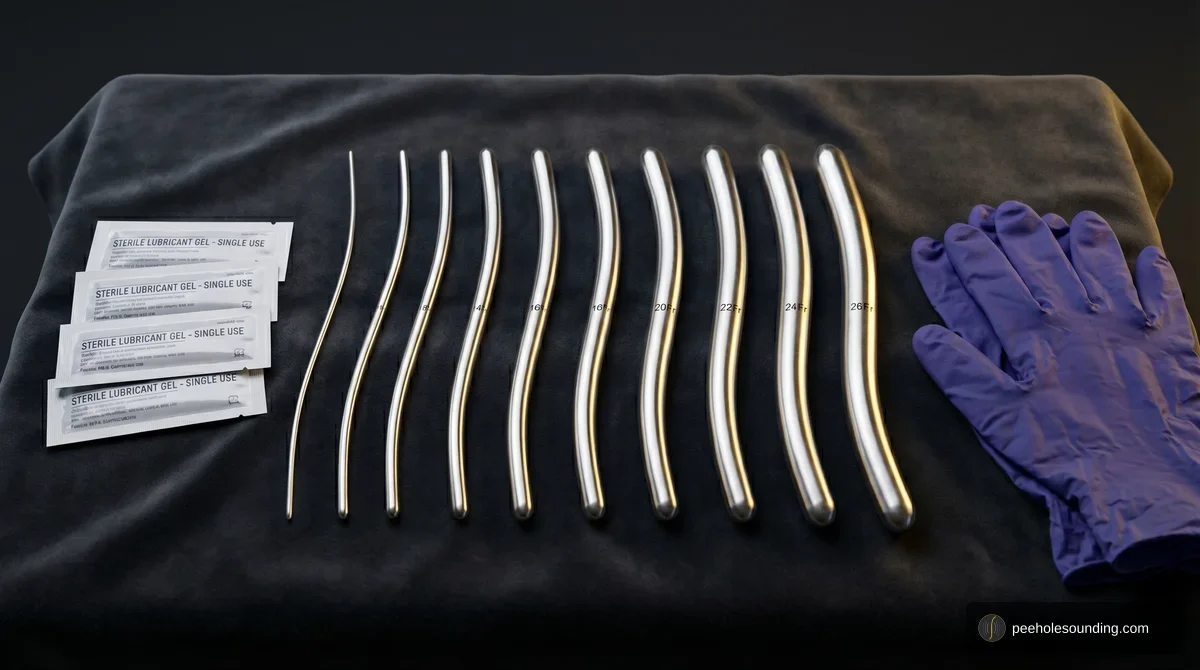
Urethral Sounding for Beginners: Sizes & First Session
Apr 5
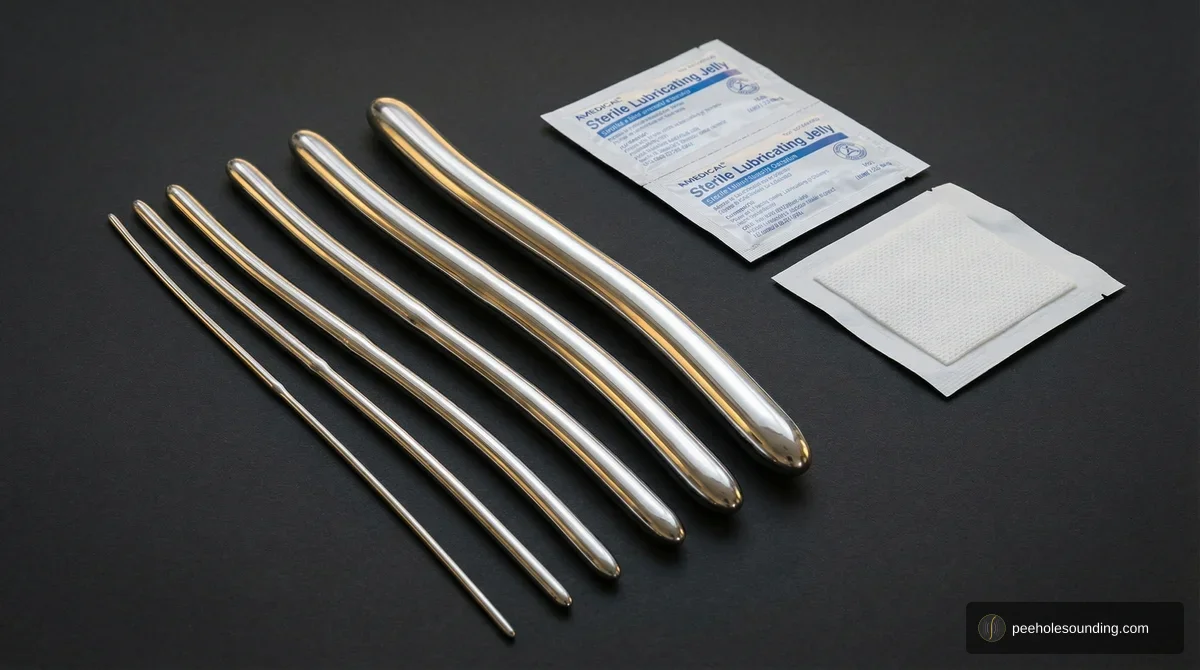
How to Insert a Urethral Sound (Step-by-Step)
Mar 25
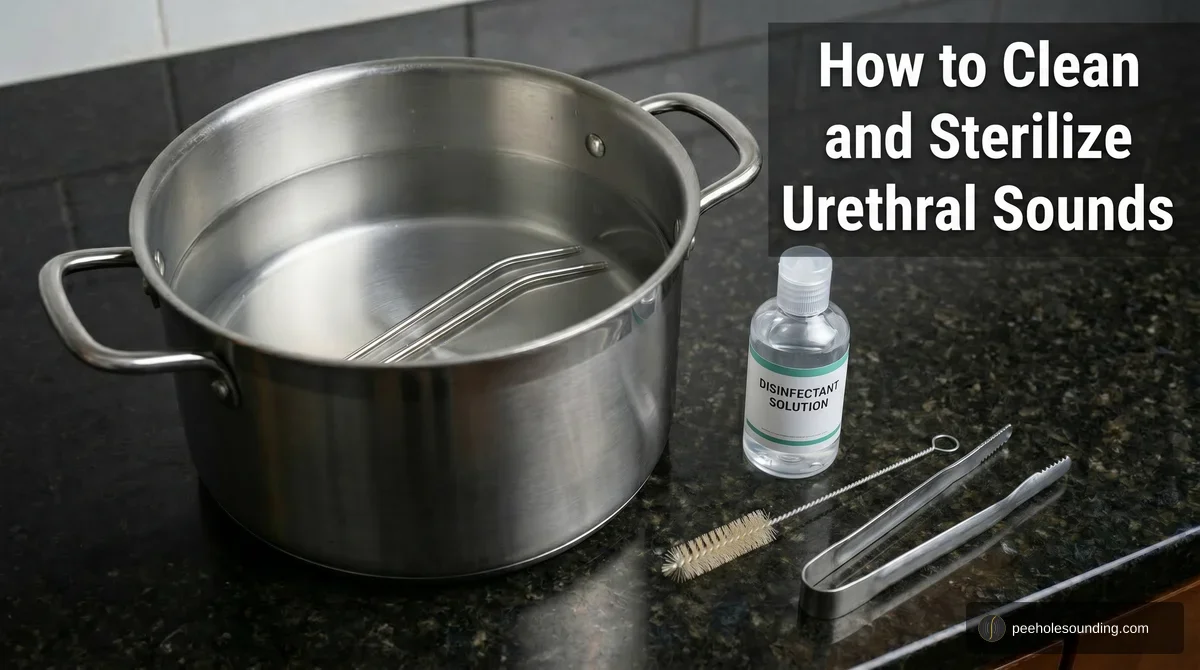
How to Clean and Sterilize Urethral Sounds
Mar 20
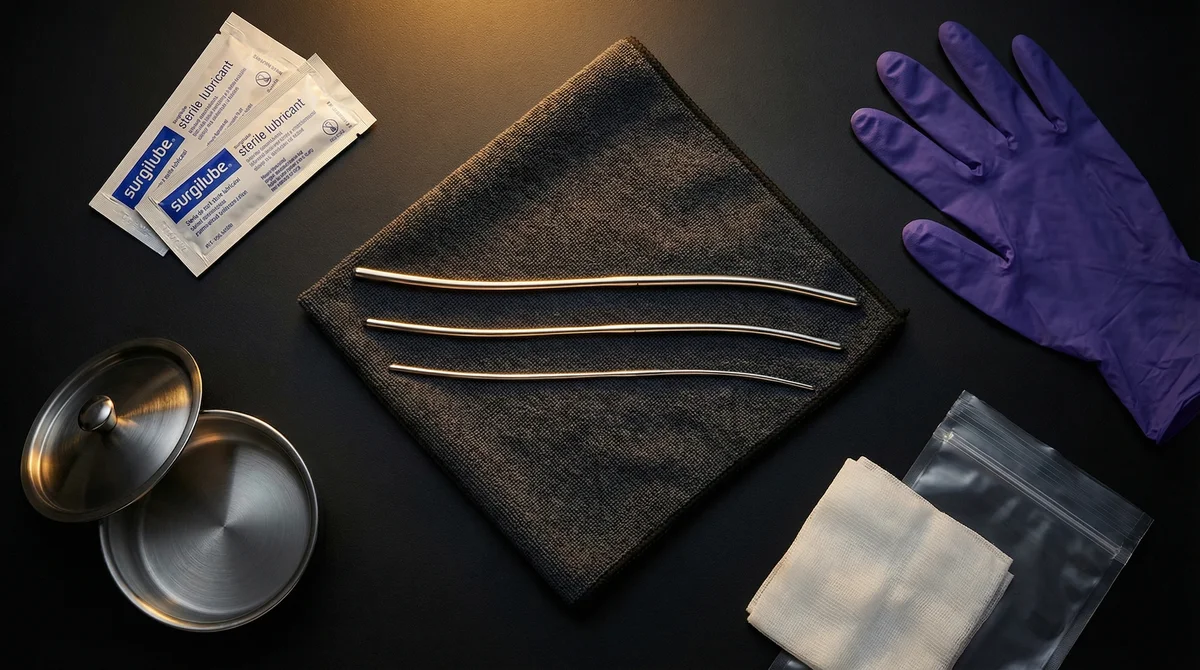
Is Sounding Safe? Sounding Safety Protocols & Risks
Mar 5

Female Urethral Sounding: Beginner Techniques & Safety
Mar 30
Van Buren Sounds: Why They Curve, Sizes & How to Use Them
Aug 7