Urethral Stretching Guide: Safe Progressive Dilation for Beginners
A practitioner's guide to stretching your urethra safely: what it is, how to size up with French gauges, a 4-week beginner protocol, and when to stop.
 By Kevin Voss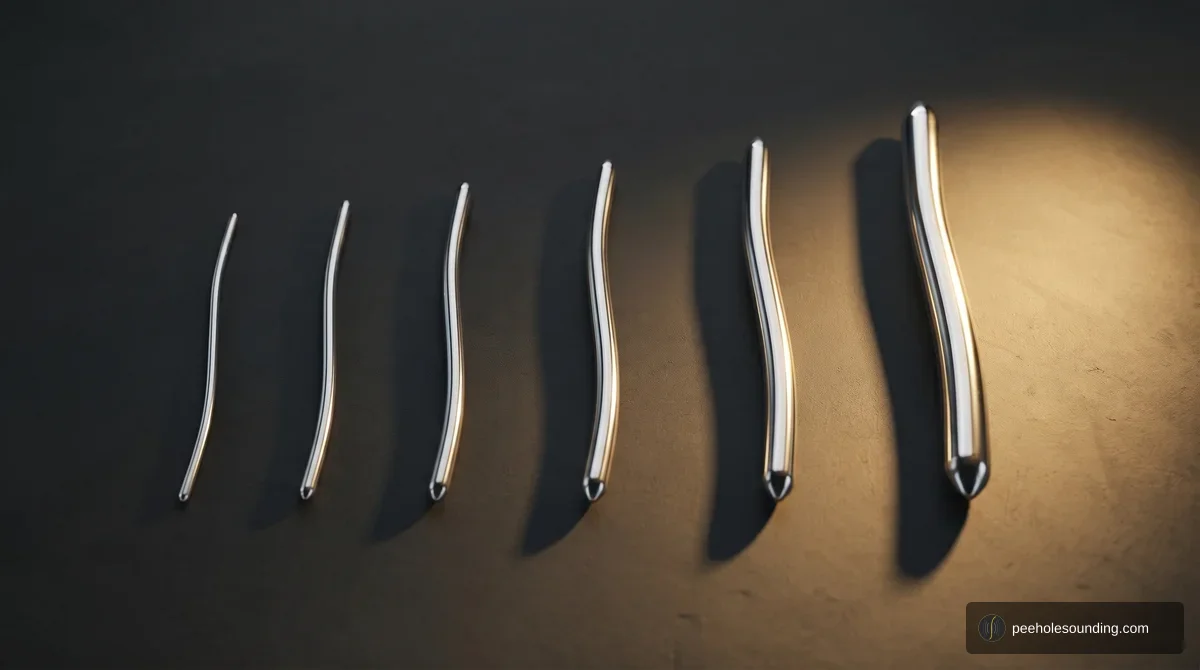
Urethral stretching is the practice of progressively sizing up the sounds you insert so your urethra learns to accommodate larger gauges comfortably. You start at a size that slides in with no resistance, stay there for a while, then take a small step up. And only when the current size is completely boring.
This guide is for people who already do urethral sounding for pleasure and want to go bigger slowly. It is not a guide to medical self-treatment for a stricture. If you have one, see a urologist.
I'm not a doctor. This article is based on my personal experience and community-accepted practice. Always consult a healthcare provider for medical concerns.
I've been sounding for about ten years, and I still remember how nervous I was about my first gauge jump. Slow wins every time.
Here's the short version of how to stretch safely:
- Start at a gauge that goes in with zero resistance.
- Only size up when the current gauge feels boring, not just tolerable.
- Never jump more than 2 French at a time.
- Rest at least 24 to 48 hours between sessions at a new size.
- Stop immediately for sharp pain, bright red blood, or fever.

What Urethral Stretching Actually Is (and What It Isn't)
Urethral stretching is a gradual, repeated process of inserting progressively larger sounds until your body accepts a bigger gauge without discomfort. It is not a one-session procedure. It is not a shortcut. And it is not the same thing as medical dilation, even though both involve the same hardware.
Kink stretching vs. medical dilation, why they're not the same practice
Medical urethral dilation treats a stricture, a scarred, narrowed section of urethra that makes it hard to pee. A urologist prescribes it, sets the schedule, and picks the dilator size. The goal is restoring function.
Kink stretching is consensual, pleasure-driven, and self-paced. The goal is sensation: the fullness of a larger sound, more intense stimulation of the nerves running along the urethra, and the specific feeling of the urethral opening (the meatus) stretching around something bigger than last time. If that framing is new to you, my guide on sounding as a kink covers why people are drawn to this kind of play in the first place.
If you have trouble urinating, a weak stream, or pain peeing that isn't session-related, don't self-treat. See a urologist. Those are stricture symptoms, and the protocol for a real stricture is not the protocol in this guide.
If you're shopping the kink side specifically and trying to figure out whether to buy a dilator or a sound, the penis dilator buyer's guide covers how the two tools actually differ as products and what to look for when buying one.
Meatus stretching vs. deep stretching
Most articles collapse these into one thing. They shouldn't.
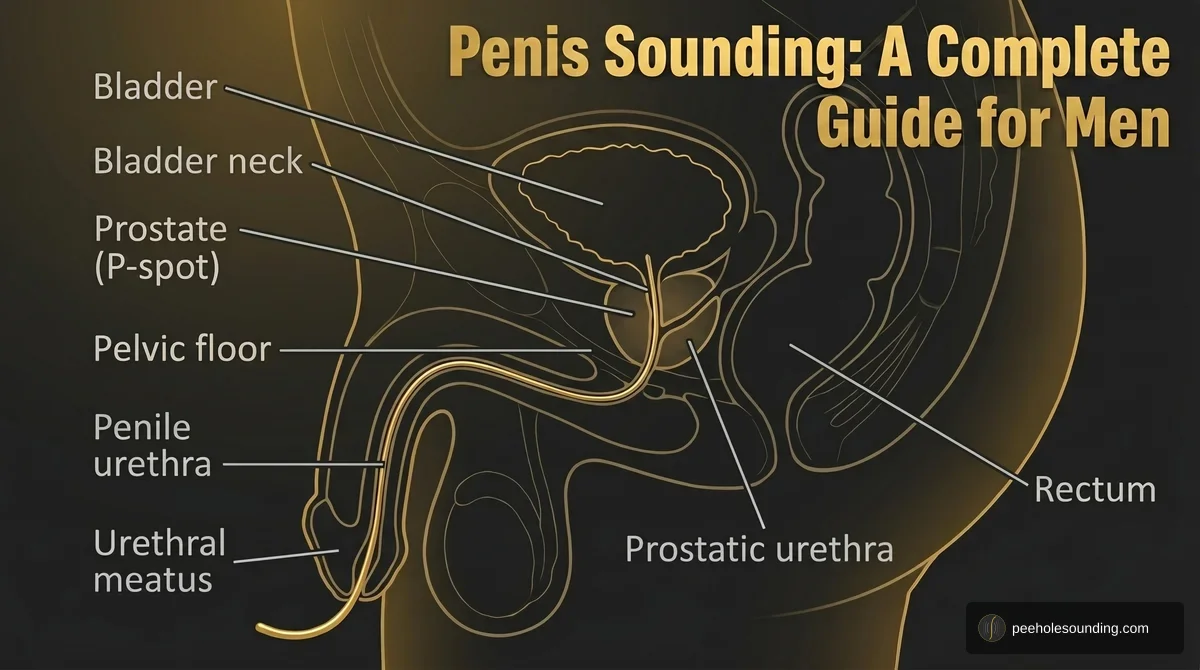
The meatus is the opening at the tip. It's the tightest ring on the whole trip, and the first resistance point anything encounters. Stretching the meatus is mostly about gauge: how wide the opening can comfortably accept.
Deep stretching (getting larger gauges past the first inch or two) is a different problem. The urethra isn't the same width all the way down; it narrows and widens in a few spots. A sound that passes the meatus fine may still feel tight several centimeters in. That's not a problem you can solve with more force. It's a problem you solve with smaller gauge steps.
If you're still getting your bearings on the basics, start with what is urethral sounding? and come back.
Is Urethral Stretching Safe?
Mostly yes, if you go slowly, stay sterile, and actually stop when your body tells you to. The risks are real, and some of them are permanent. But the practitioners I know who have done this for a decade without incident all share the same habit: they go slower than they think they need to.
The real risks
There are four things to actually worry about:
- Sphincter damage and possible incontinence. Repeated aggressive stretching, without full recovery between sessions, can stress the urinary sphincter, the muscular ring that keeps you from leaking. Worst case: stress incontinence (leaking when you cough, sneeze, or lift). There's no clean kink-specific rate in the literature; most recreational-sounding studies cover infection and retained-object cases (Breyer & Shindel 2012; Guerrero & Sharma 2020; Donnenfeld et al. 2025). So when I say "rare with patient practice, common with people who rush," that's pattern recognition, not a published number.
- Strictures from scarring. Micro-tears that heal badly can leave scar tissue that actually narrows the urethra. Irony of ironies: stretching too fast can make you smaller.
- UTI from contamination. Anything you push into the urethra carries bacteria inward. Sterilization isn't optional.
- Bleeding. Faint pink in the first pee after a session isn't unusual. Bright red blood is a stop sign.
I want to be honest about the incontinence risk specifically, because a lot of kink-side guides wave it away. It's the thing urologists are right about, and the same urologists are the first to point out that they mostly see complications when something has already gone seriously wrong, which skews their data. You don't get incontinence from one session. You get it from months of rushing.
Who should not stretch
Skip stretching entirely, at least for now, if any of these apply:
- Active UTI or any urinary symptoms (burning, frequency, urgency)
- Recent urological surgery or active healing from prior kink injury
- Bleeding disorders or you're on blood thinners
- Reduced sensation in the area: if you can't feel pain accurately, you can't self-regulate
- Pregnancy
Stop the session immediately if you experience: sharp or shooting pain, bright red bleeding, fever, chills, sudden difficulty urinating, or a sound that won't come out.
For a deeper look at risk and aftercare, see safety protocols and risk mitigation.
Sizing 101, French Gauge, Hegar, and Where to Start
French gauge to mm conversion table
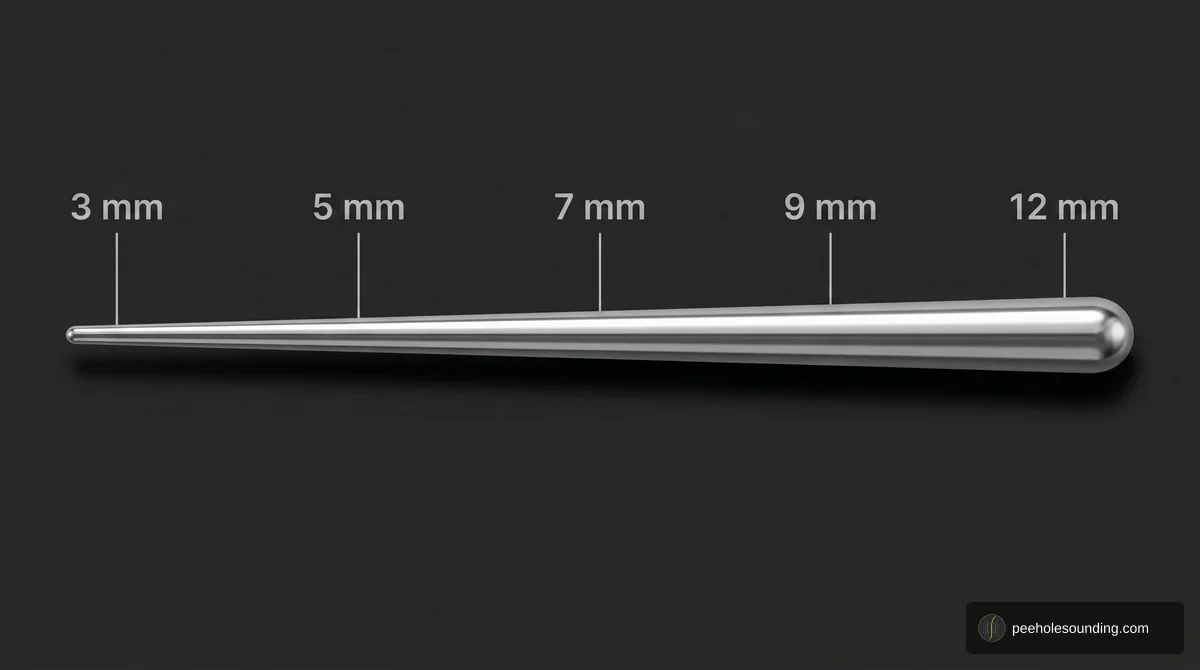
French gauge (Fr) is the standard sizing system for sounds and dilators. Higher numbers mean thicker sounds. The math is simple: 1 Fr = 1/3 mm.
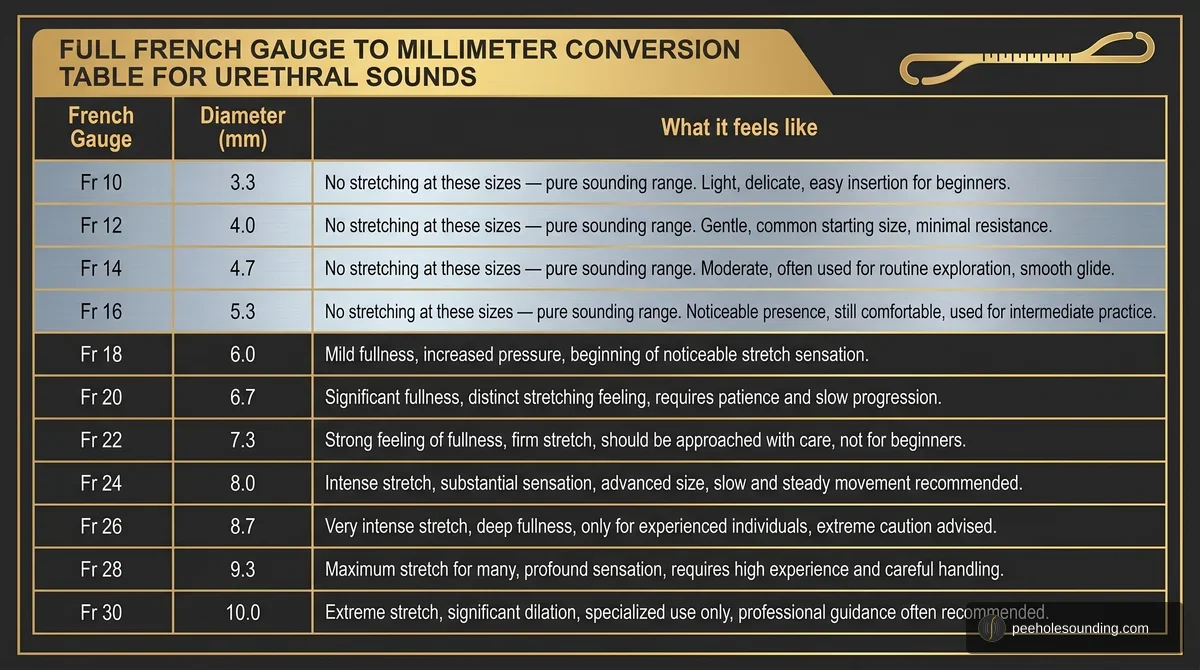
The smallest sounds, roughly Fr 10 to 16 (3.3 to 5.3 mm), are the standard sounding range. No stretching happens at those sizes for most people; they slide in without resistance once you have any practice. They're included here for context so you can see where stretching actually starts.
| French gauge | Diameter (mm) | What it feels like |
|---|---|---|
| Fr 10 | 3.3 mm | Common absolute-beginner sounding size; pure sounding territory, no stretch |
| Fr 12 | 4.0 mm | Standard early-sounding size; still no stretching |
| Fr 14 | 4.7 mm | Very common comfortable size for sounding sessions |
| Fr 16 | 5.3 mm | Upper end of "no stretch" range for most men |
| Fr 18 | 6.0 mm | Where stretching starts to be a thing; noticeable at the meatus |
| Fr 20 | 6.7 mm | Firm but manageable first-timer stretching size for men |
| Fr 22 | 7.3 mm | Common comfortable baseline for men starting to stretch |
| Fr 24 | 8.0 mm | Meaningful stretch; first "I feel that" size for many |
| Fr 26 | 8.7 mm | Deep fullness; usually a months-in milestone |
| Fr 28 | 9.3 mm | Most practitioners plateau around here |
| Fr 30 | 10.0 mm | Advanced territory; real ceiling for a lot of people |
Starter sizes
- Men: start around Fr 22 to 24 (7.3 to 8.0 mm) if you have any prior sounding experience. Complete first-timers can start a notch smaller.
- Women: start around Fr 18 to 20 (6.0 to 6.7 mm). The urethra is shorter, the sphincter is closer to the action, and the consequences of rushing are larger.
If you don't know which set to buy, the detailed sizing article has the buying logic: What size sounding rod do I need?
The gauge-jump rule
Only size up when the current gauge slides in with full control, no resistance, no pinching, and no pain. Not "tolerable." Not "a little tight but fine." Boring. If you still have adrenaline in the session, you're not ready.
My rule of thumb: if I still think about it the next day, I'm not ready to size up. No lingering ache, no phantom pressure, no curiosity about what happened down there. Just a normal morning. That's the green light.
Equipment You Actually Need
A Hegar dilator set
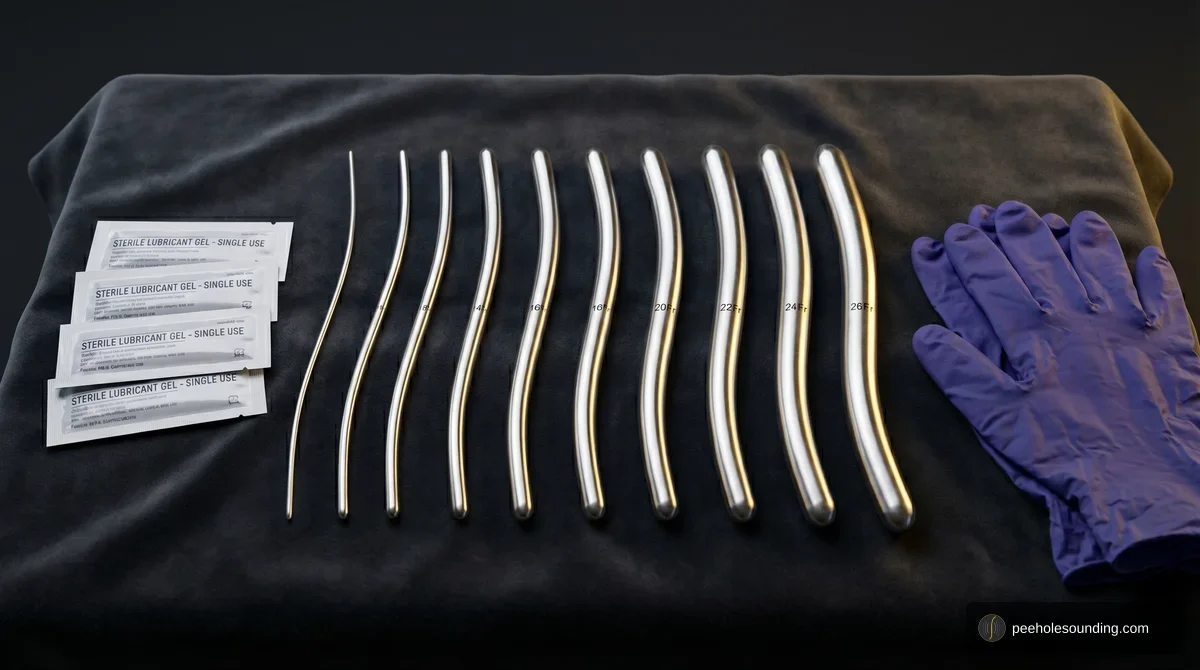
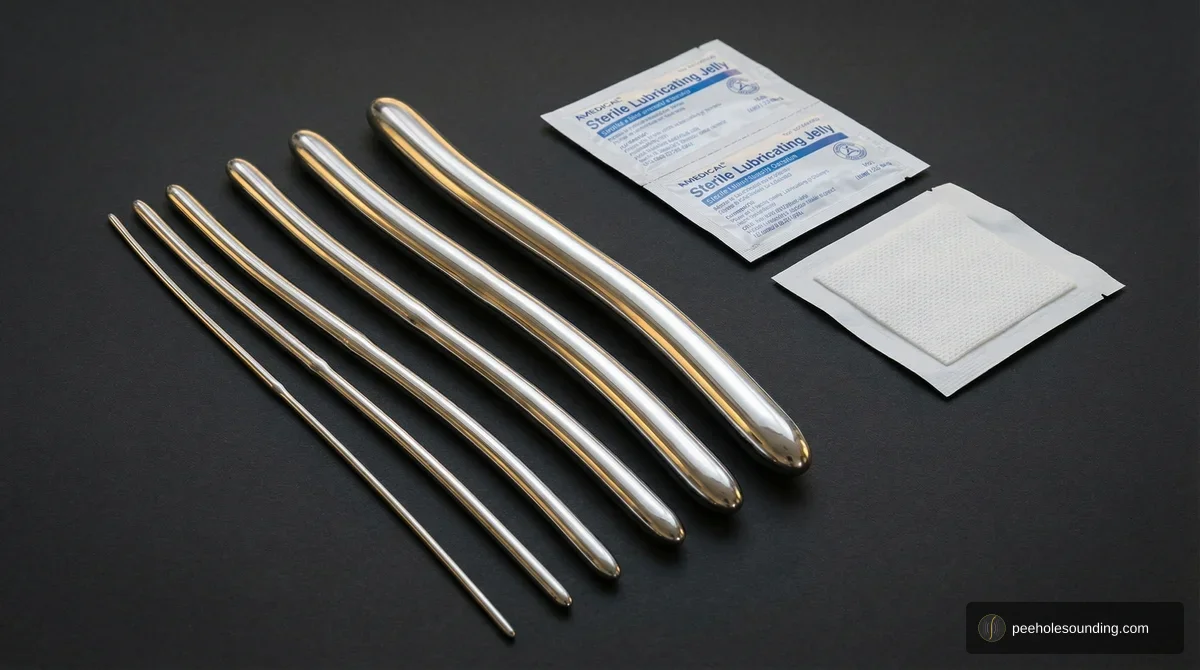
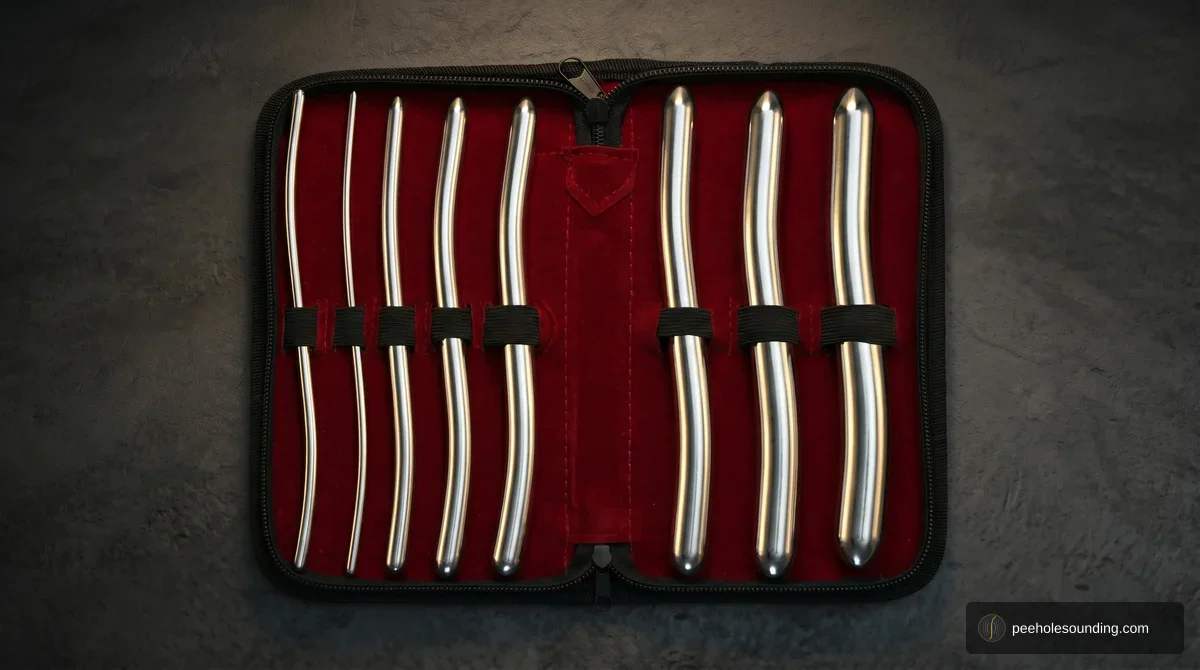
For stretching specifically, I recommend a Hegar dilator set in surgical-grade stainless steel. Hegar sounds come graduated in pairs, they're precisely machined, and the step between each size is consistent. When you know every size up is exactly the same increment, you stop guessing.
Starter sets typically cover sizes 3 through 12 or thereabouts (which, confusingly, are Hegar's own numbering system, not French gauge). For stretching past the beginner zone, you want a set that reaches at least Fr 30 equivalent.
Silicone vs. steel for stretching
Both work, and which one suits you is genuinely personal. I know experienced practitioners who swear by each.
- Silicone flexes. It's more forgiving if you move unexpectedly, and it's often cheaper for a starter set. The tradeoff is that the gauge step feels less precise; silicone at one size can feel similar to the next.
- Steel is rigid. Every gauge step is a distinct, unmistakable increment. Steel is also dead simple to sterilize and lasts forever.
For stretching specifically, I prefer silicone. The flex makes it noticeably easier to take a sound deep without fighting the natural curve of the urethra. Some people prefer steel because the precise gauge feedback helps them know exactly where they are. Try both if you can.
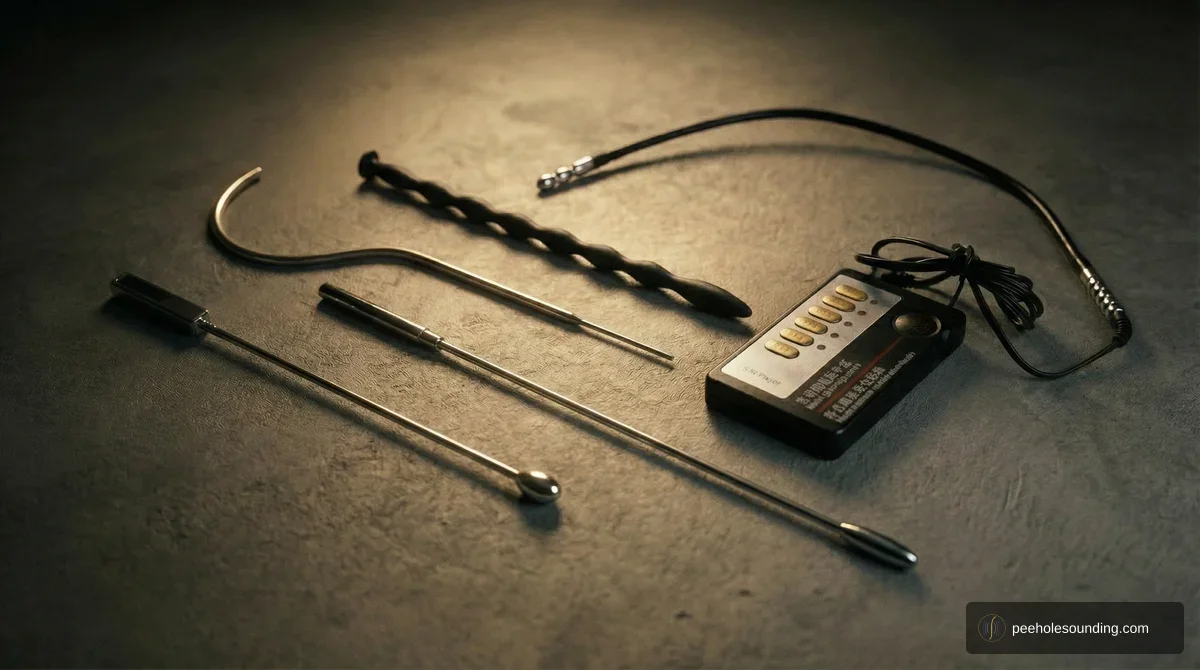
More on the materials tradeoff in types of urethral sounds.
Lubricant
Sterile, water-based, single-use packets only. Not the half-empty tube in your nightstand. Not a bottle you've had open for six months. Sterile.
Never use silicone lube on silicone sounds; it degrades the surface. Never use oil-based lube for sounding; it lingers in the urethra and can trigger irritation.
Detailed lube breakdown: best lube for sounding.
The 4-Week Beginner Progression
This is the section no competitor writes, because no retailer blog wants you going slowly, and no medical source writes stretching schedules for kink use. Here's the version I wish I'd had.
Treat this as a starting framework, not a fixed prescription. Bodies are different. Some people will need twice as many sessions at each stage; others will breeze through and want to stretch the timeline out for comfort, not necessity. The session counts and hold times below are sane defaults. Your body's signals override them every time. If a week leaves you sore, repeat it. If a session feels off, end it. The schedule is a guide, not a contract.
The plan assumes you already know how to insert a sound cleanly. If you don't, read how to insert a urethral sound first and do 2 or 3 low-gauge sessions before starting this.
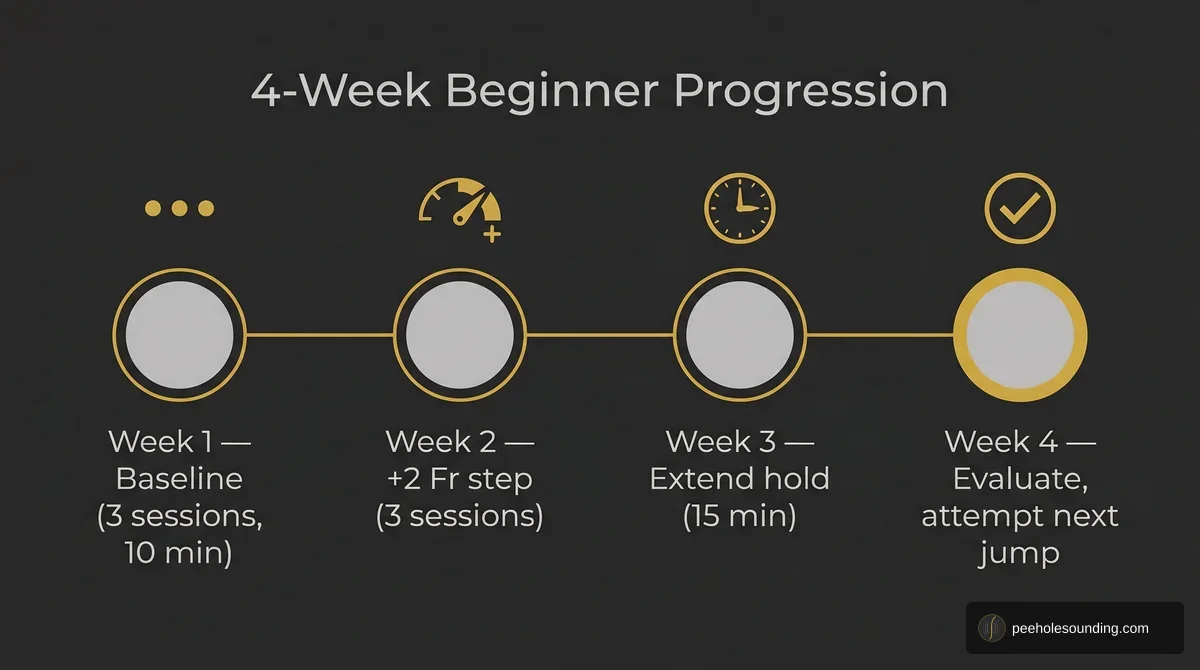
Week 1, Baseline at your starting gauge
- 3 sessions, 10 minutes each, at the same starting size.
- Space sessions at least 24 hours apart.
- Goal: insertion gets boring. Hold gets boring. You know what "normal" feels like at this size.
- Do not size up this week no matter how tempting.
Week 2, Short gauge step
- 3 sessions: session 1 at the prior size (recalibration), sessions 2 and 3 at the new size (up 2 Fr).
- Keep hold time at 10 minutes at the new size.
- Expect some novelty: slight urge to pee, a little more pressure, a perceptible stretch.
- If the new size is painful or won't go in cleanly, go back to the prior size for another week.
Week 2 is where most people rush. Don't. The difference between "this feels a little tight" and "I tore something" is thinner than it sounds.
Week 3, Extending the hold
- 3 sessions at the new size from week 2.
- Lengthen hold to 15 minutes.
- Introduce gentle, slow in-and-out movement after the first 5 minutes if hold is comfortable.
- No gauge jump this week.
Week 4, Evaluate and decide
- 2 sessions at the current gauge, 1 session evaluating a gauge-up.
- Before each session, audit: any lingering soreness from the last session? Any change in urine stream? Any pink-tinged pee more than a few hours post-session?
- If everything is clean, attempt the next 2 Fr jump, but only for 5 minutes the first time.
- If anything is off, stay where you are for another two weeks.
After week 4, cycle the pattern again at your new baseline. This is not a month-long project. Real stretching progress is a multi-month practice. Most people reach a comfortable plateau and stay there, and that's completely fine.
First Session, Step by Step
Pre-session prep
- Shower first. Warm water helps you relax.
- Wash your hands like you're about to do surgery: soap, under the nails, two rounds.
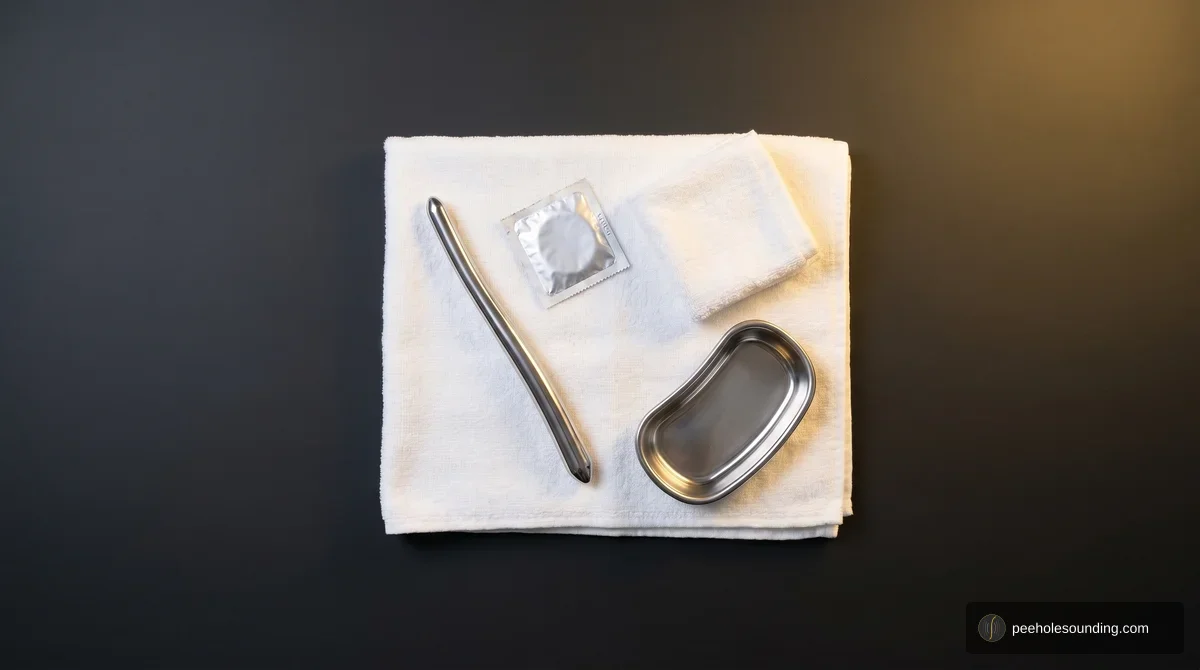
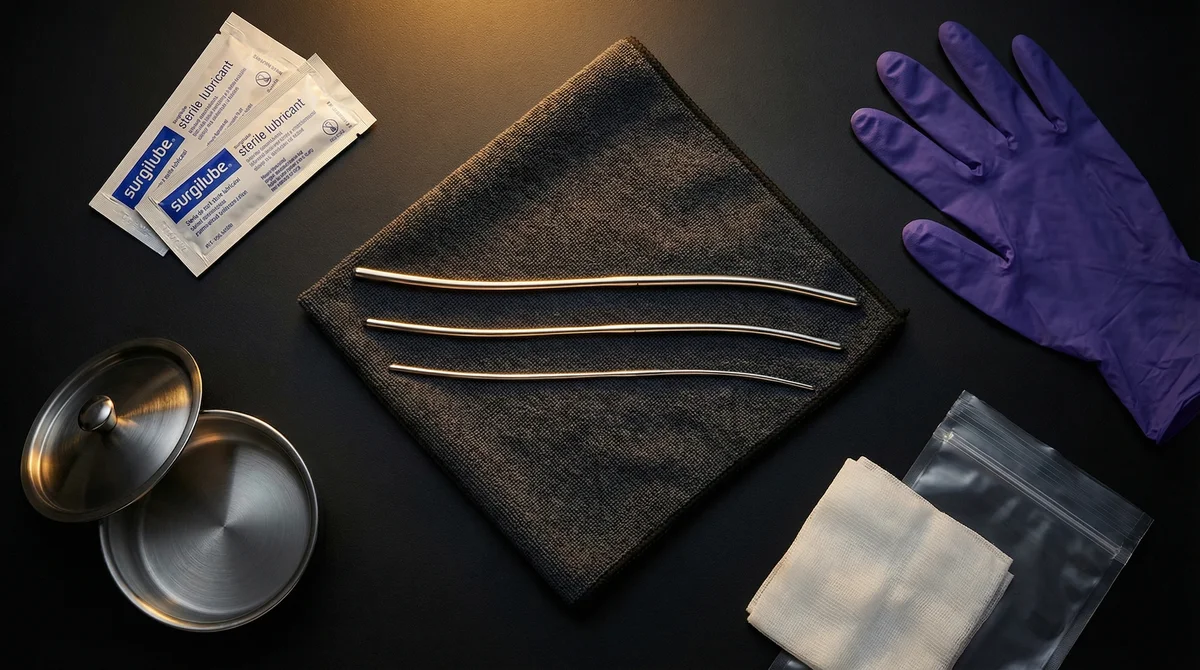
- Lay out a clean towel. On the towel: your sterilized sound, a sterile single-use lube packet, a clean washcloth, and a second towel for cleanup.
- Empty your bladder right before.
Sterilization is non-negotiable. If you're new, read how to clean and sterilize urethral sounds start to finish before your first stretching session.
Position and setup
For everyone, the right position is slightly reclined on your back with your upper body propped up on a couch armrest or a firm pillow, not flat, not fully sitting. Bend your knees and let them fall open comfortably. You want to see what you're doing, you want both hands free, and you want your pelvic floor relaxed, not clenched.
For women, add a mirror. Position it between your legs so you can clearly see the urethral opening. Solo, the reclined-plus-mirror setup is essential. The meatus is small and not always immediately obvious, and the mirror is the difference between guessing and seeing. Once you know where the opening is by feel, you'll need the mirror less. Until then, use it. The female urethral sounding guide covers this in more detail.
Erect or flaccid? Either. Erect makes the urethra a straighter line, which many people find makes insertion easier. Flaccid gives you more visual control. Pick whichever calms you down more. Honestly, I'm almost always erect by the time I start. I'm too into the anticipation for it to go any other way, and I find the straighter line helpful for the deeper part of the session.
Insertion
- Lube the meatus first. A drop at the opening, then let gravity help it seep in a few millimeters.
- Lube the sound. All the way, generously. You cannot use too much sterile lube.
- Hold the penis straight up (for men) or gently spread the labia to expose the meatus (for women).
- Let gravity do most of the work. Rest the tip of the sound at the meatus and release your grip. A well-lubed steel sound will slide in on its own weight for the first inch.
- Never force. If the sound stops moving, it's not the sound's fault and it's not your urethra's fault. It's just not ready.
What normal vs. warning sensations feel like
Normal:
- A distinct stretch at the meatus as the sound passes through
- A feeling of fullness that builds as the sound slides deeper
- A mild urge to pee (the sound is pressing against the bladder neck)
- Warmth, sometimes a slow throbbing
Warning:
- Sharp, shooting, or stinging pain
- A grinding or catching sensation: the sound has hit a fold or resistance it shouldn't be forcing past
- Sudden hot spots that feel unlike the rest of the sensation
- Any pain that persists after you stop moving the sound
Stop when you get warning sensations. Stretching is not a pain threshold exercise.
Removal and clean-up
Pull the sound out slowly and steadily. Don't yank. Inspect the tip for any pink or red residue (faint pink is within normal for a stretching session; red is a stop sign for the next session).
Sterilize the sound per your usual protocol. Don't let cleanup wait.
Aftercare and Recovery
Immediate aftercare
- Pee within 10 minutes of removal. This flushes the urethra and is your first real data point on how the session went.
- Watch the stream. A strong, unchanged stream is a green light. A weak, split, or painful stream is not.
- Drink a full glass of water.
- No sex, no penetrative play, no further urethral insertion for at least the rest of the day.
How long to rest between sessions
- 24 hours minimum between sessions at your current baseline gauge.
- 48 hours minimum after any session at a new, larger gauge.
- A full week off if anything felt wrong during a session, no matter how minor.
What soreness is normal vs. not
- Normal: faint ache at the meatus for a few hours, slight pink tinge in the first pee, awareness of the area without real pain.
- Not normal: burning that persists past 24 hours, visible red blood beyond the first pee, fever, urinary retention, discharge.
Special Considerations for Women
The female urethra is around 3 to 4 cm long, versus roughly 15 to 20 cm in men. That's not a small difference. The sphincter and bladder are much closer to the meatus, and the margin between "comfortable stretch" and "impacting the sphincter" is narrower.
Practical implications:
- Start 2 to 4 Fr smaller than the male starting recommendation.
- Jump 1 Fr at a time, not 2.
- Cap the hold time at 10 minutes even at your comfortable baseline gauge.
- Stop the whole practice at the first sign of stress incontinence (leaking when coughing, sneezing, or laughing). This is serious and often reversible only if caught early.
I'm not telling anyone not to do this. I'm telling you the sphincter risk is genuinely higher and the right response is "go slower," not "skip it." For wider context, see the female urethral sounding guide.
When to See a Doctor
See a urologist if you experience any of these after a stretching session:
- Fever or chills (possible UTI or deeper infection)
- Urinary retention (can't pee, or peeing only a trickle)
- Bleeding lasting more than 24 hours
- Pain lasting more than 48 hours
- Any discharge from the urethra
- Stress incontinence (new leaking when coughing, sneezing, lifting)
Don't hesitate and don't spin a story. Urologists know about sounding and stretching. It's not new to any of them, they're trained for exactly these situations, and the ER teams who handle retained-object cases see them often enough that yours won't register as unusual. Be straightforward about what you were doing. They need accurate information to treat you well, and you'll get better, faster care for it.
Frequently Asked Questions
Final Word, Stretch Slow, Stretch Symmetric
The people I know who have stretched successfully for years share one habit: they would rather spend an extra month at a size than skip a week of recovery. Pace beats ambition. Sterilization beats improvisation. Listening to your body beats any schedule a guide can give you, including this one.
If you're earlier in the sounding journey than this guide assumes, start with the beginner's urethral sounding guide first. If you're completely new to the practice, read what is urethral sounding? before anything else.
Go slow. Stretch symmetric. Come back in a year.
Related Guides
Urethral Sounding for Beginners: Sizes & First Session
Apr 5
How to Insert a Urethral Sound (Step-by-Step)
Mar 25

How to Clean and Sterilize Urethral Sounds
Mar 20
What Size Sounding Rod Should Beginners Start With?
Mar 15
Is Sounding Safe? Sounding Safety Protocols & Risks
Mar 5
Sounding Toy Guide: Types, Materials & How to Choose
Mar 10
Hegar Sounds: Sizes, Full mm/Fr Chart & How to Choose
Apr 12
Sounding Rods Sizes Chart: French Gauge to mm to Inches
Apr 28
Penis Sounding for Men: Sizes, Safety & Prostate Technique
May 9

Female Urethral Sounding: Beginner Techniques & Safety
Mar 30