Sounding Rods Sizes Chart: French Gauge to mm to Inches
Complete sounding rods sizes chart with French gauge, mm, and inches in one reference table. Plus per-kit-type sizing for Hegar, Van Buren, Pratt, and Rosebud sounds.
 By Kevin Voss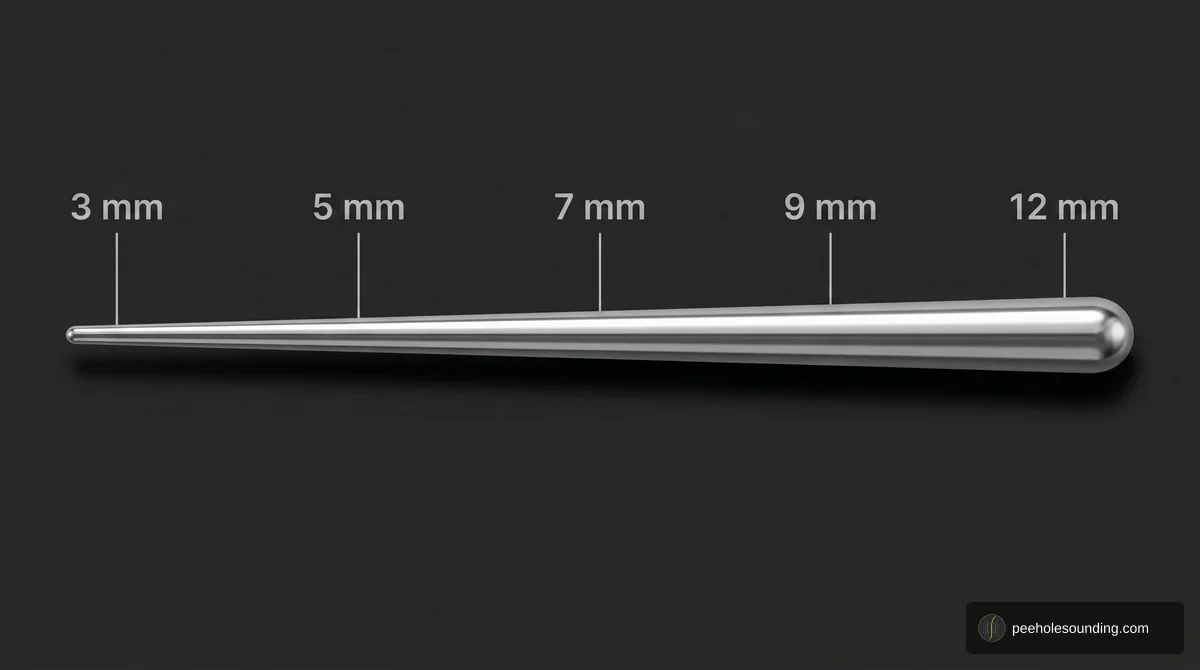
This page is the chart. Bookmark it. I built this because I got tired of switching tabs between an mm reference, a French gauge converter, and a kit-size lookup every time someone asked me "what's 24 Fr in inches?"
The conversion you came here for, in one line: French gauge ÷ 3 = millimeters. Millimeters × 3 = French gauge.
If you're looking for which size to start with, that's the beginner sizing guide. This page is the data, not the decision.
I'm not a doctor. This article is based on my personal experience and research. Always consult a healthcare provider for medical concerns.
The Master Sounding Rod Size Chart
Every common sounding rod size in one table, with all three measurement units side by side. The mm-to-French conversion is exact (1 mm = 3 Fr). Inches are approximate fractions because the metric and imperial systems don't line up cleanly.
| Millimeters | French Gauge (Fr) | Inches (approx.) | Notes |
|---|---|---|---|
| 1 mm | 3 Fr | n/a | Medical only, cystoscopy-guided |
| 2 mm | 6 Fr | ~5/64” | Medical only, cystoscopy-guided |
| 3 mm | 9 Fr | ~1/8” | Beginner range starts here |
| 4 mm | 12 Fr | ~5/32” | Common beginner size |
| 5 mm | 15 Fr | ~3/16” | Average female urethra width |
| 6 mm | 18 Fr | ~1/4” | Average male urethra width |
| 7 mm | 21 Fr | ~9/32” | Intermediate |
| 8 mm | 24 Fr | ~5/16” | Intermediate ceiling for many |
| 9 mm | 27 Fr | ~11/32” | Advanced |
| 10 mm | 30 Fr | ~3/8” | Advanced |
| 11 mm | 33 Fr | ~7/16” | Experienced practitioners only |
| 12 mm | 36 Fr | ~15/32” | Deep stretching |
| 13 mm | 39 Fr | ~1/2” | Deep stretching |
A few notes on reading this chart. Average urethral diameter is similar across anatomies (~1/4” for men, ~3/16” for women), which is why the 3/16”-to-1/4” rows are a meaningful threshold for everyone: that's roughly your urethra's natural diameter. The big difference is length, not width, and we cover that below.
How Sounding Sizes Are Measured
Three units show up depending on where you're shopping. They all describe the same thing: the diameter of the rod's widest point.
- French gauge (Fr, Ch, CH): the medical scale. 1 Fr = 1/3 mm, and larger numbers mean larger rods (opposite of needle gauge). Named after 19th-century French surgical-instrument maker Joseph-Frédéric-Benoît Charrière.
- Millimeters: what most consumer kits use. Maps directly to anatomy, so you can compare a rod's mm to your urethra's mm without math.
- Inches: fractional, US holdover. Common values: 1/8”, 5/32”, 3/16”, 1/4”, 5/16”, 3/8”. Doesn't convert cleanly to mm (1/4” = 6.35 mm, not a round 6 mm).
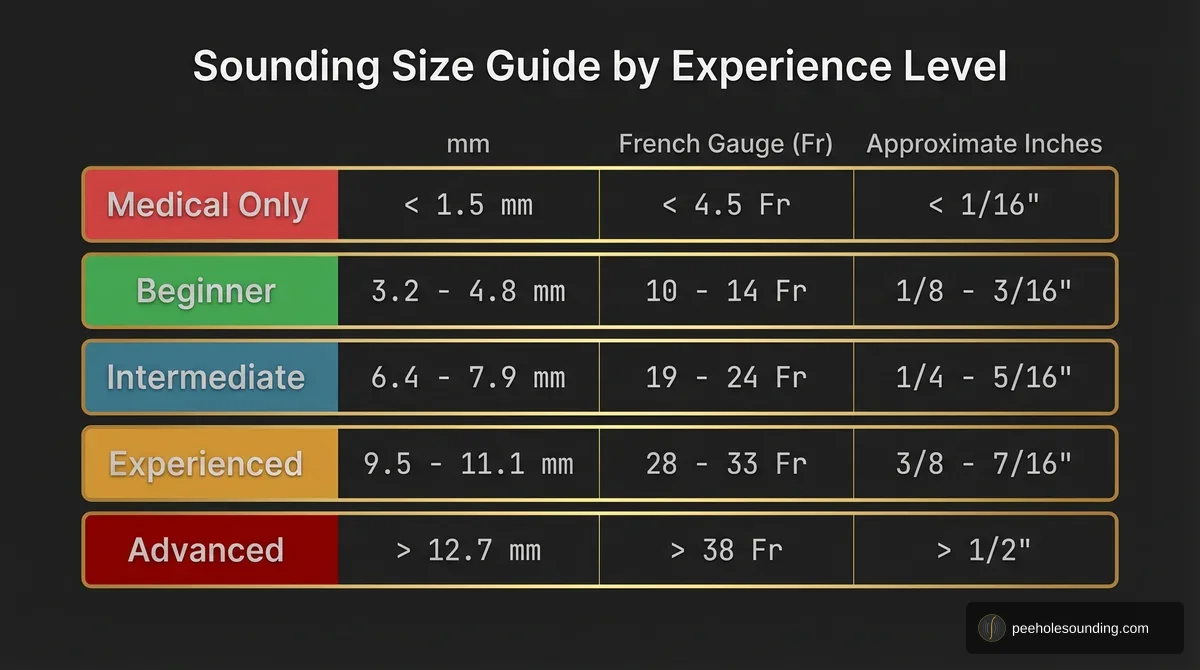
Sizes by Experience Level
The same data as the master chart, grouped by where most people fit. If you're still figuring out which tier you belong in, that's the beginner sizing guide's job. This section just labels the bands.
- Medical only1-2mm · under 1/16″
Requires camera guidance — never for recreational use
- Beginner3-5mm · 1/8″ – 3/16″
Sweet spot for most people starting out
- Intermediate6-8mm · 1/4″ – 5/16″
After months of regular practice and gradual progression
- Experienced9-11mm · 3/8″ – 7/16″
Requires gradual dilation over time
- Advanced12mm+ · 1/2″+
Deep stretching territory
| Size (mm) | French Gauge | Approx. Inches | Experience Level | Notes |
|---|---|---|---|---|
| 1-2mm | 3-6 Fr | under 1/16″ | Medical only | Requires camera guidance — never for recreational use |
| 3-5mm | 9-15 Fr | 1/8″ – 3/16″ | Beginner | Sweet spot for most people starting out |
| 6-8mm | 18-24 Fr | 1/4″ – 5/16″ | Intermediate | After months of regular practice and gradual progression |
| 9-11mm | 27-33 Fr | 3/8″ – 7/16″ | Experienced | Requires gradual dilation over time |
| 12mm+ | 36+ Fr | 1/2″+ | Advanced | Deep stretching territory |
I've been at this for about ten years and 5/16” (8 mm / 24 Fr) is still my comfortable ceiling. There's no prize for chasing bigger numbers, and anything thinner than about 1/8” (3 mm / 9 Fr) is more dangerous than you think. That's why anything under 1/16” is medical-only, not "advanced." Those tiny sounds get used by urologists with camera guidance because they're easy to misdirect.
Sizes by Sound Type
Different sound types cover different ranges. For shape and use-case differences see the full sound types guide.
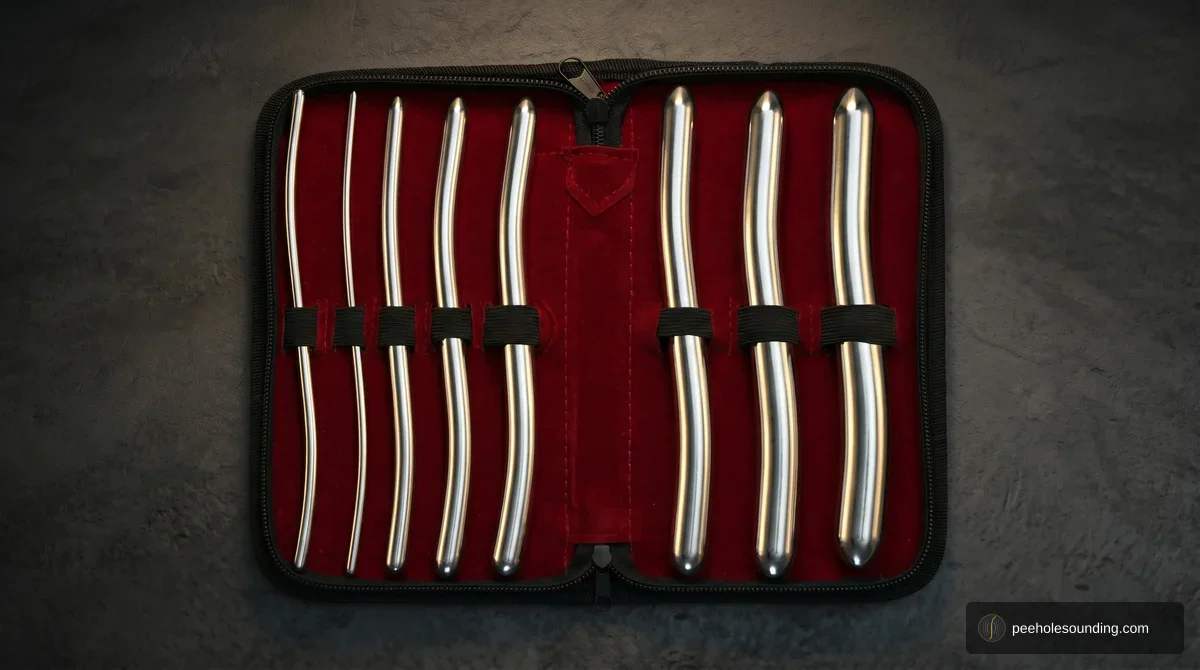
Hegar Sounds
Range: ~1/8” to 3/4” (3-18 mm / 9-54 Fr). Dual-ended rods with two different diameters per shaft, about 1/32” apart.
Sets: An 8-piece covers ~1/8” to 3/4” (3-18 mm) across its sixteen ends. A 14-piece stretches that to 1 mm through 26 mm, adding finer low-end steps and sizes well past anything recreational. Most popular kit type by a wide margin.
For a deeper breakdown, see Hegar sounds explained.
Van Buren Sounds
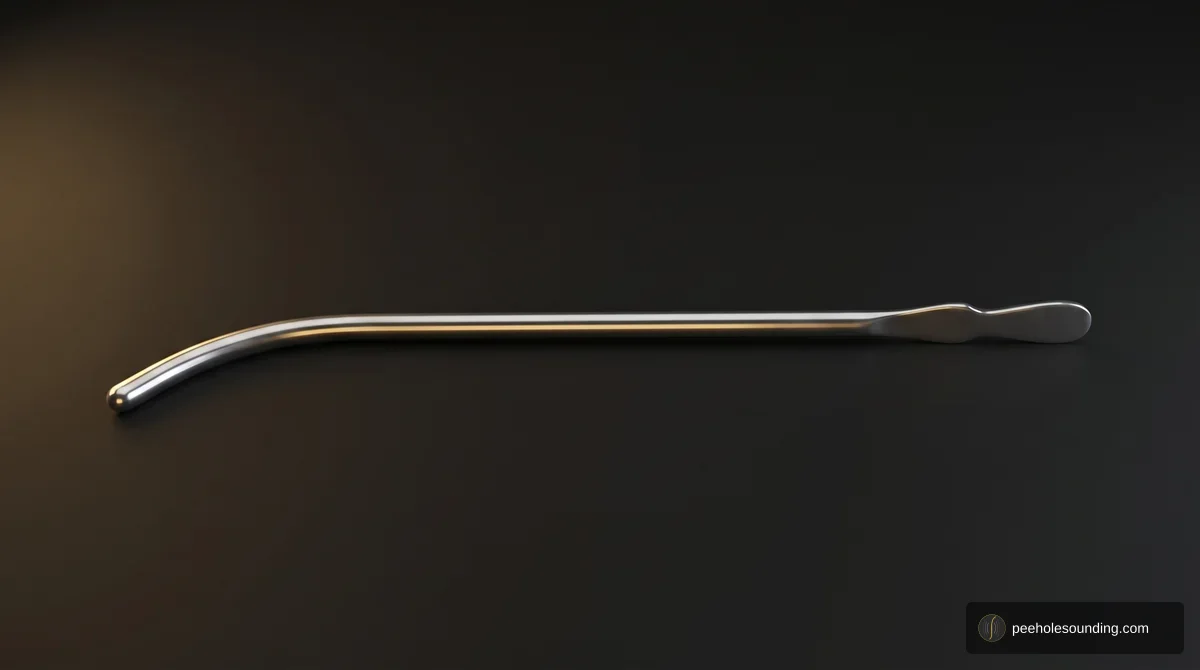
Range: ~7/64” to 1/2” (2.7-13 mm / 8-40 Fr). Single-ended with a curved tip and a long flat handle, around 10¾” to 11” long. The standard 12-piece set covers 8-30 Fr in even steps.
Notes: The curve is designed for the male urethral bend. It doesn't help female anatomy, where the urethra is short and straight. Most of the length is handle, so insertable depth is far shorter than the overall figure. See Van Buren sounds for the full breakdown.
Dittel Sounds
Range: ~1/8” to 1/2” (3-13 mm). Straight, single-ended, uniform-diameter shaft.
Notes: Simpler than Hegar (no curve to navigate). Usually sold individually rather than in sets.
Pratt Sounds
Range: ~5/32” to 1/2” (4-13 mm / 12-39 Fr). Dual-ended, longer than Hegar.
Notes: Originally designed for cervical dilation. Standard 11-piece set covers the full range.
Rosebud Sounds
Range: ~5/64” to 1/2” (2-13 mm / 6-39 Fr). Bulbed tip tapering down to a thinner shaft.
Sets: A 6-piece kit runs roughly ~3/16” to 3/8” (4.5-9.5 mm); a 12-piece runs ~5/64” to 1/2” (2-13 mm) with ~1/32” increments.
Penis Plugs
Range: varies. Short, with a flared base.
Notes: Measured by overall length and shaft diameter, not progressive sets, because they stay shallow rather than passing into the bladder. See the penis plugs guide for that category.
Length and Anatomy
Diameter isn't the only dimension. Length determines how deep a rod can go; your anatomy determines how deep it should.
Male Anatomy
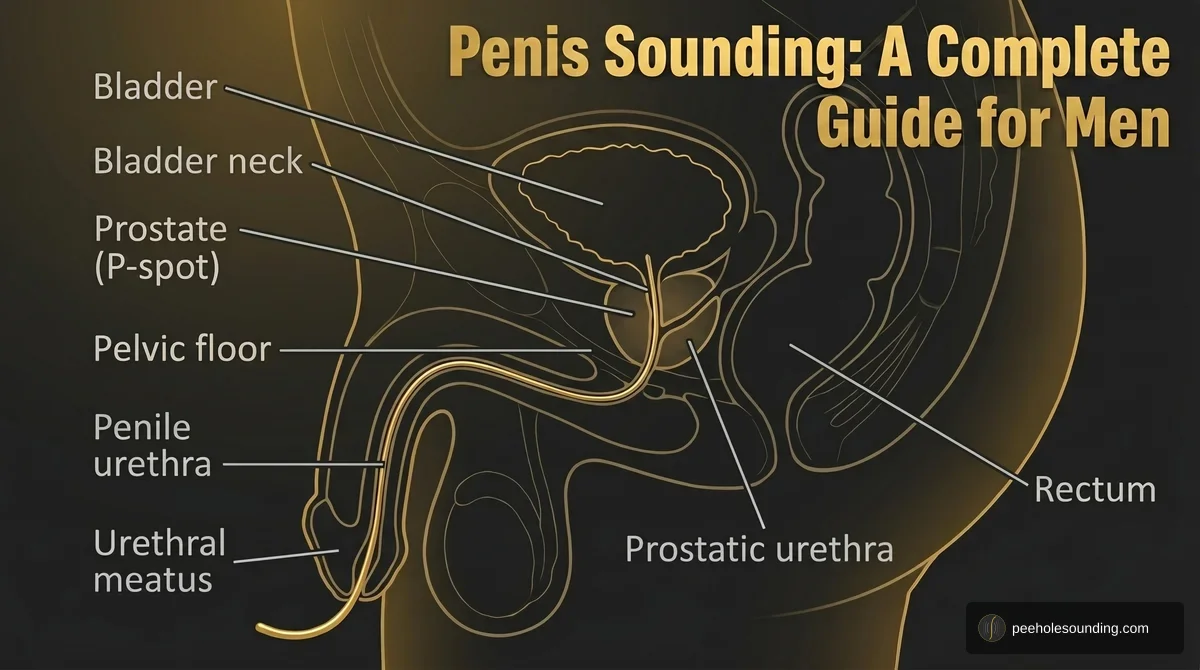
- Urethra length: ~8” (20 cm) from meatus to bladder.
- Average diameter: ~1/4” to 5/16” (6-8 mm).
- Practical depth: Most people stop around 6-7” in (past the prostate).
- Curved sounds help. Van Buren-style curves match the male urethral bend.
Female Anatomy
- Urethra length: ~1.5” (4 cm) from meatus to bladder.
- Average diameter: ~3/16” to 1/4” (5-6 mm).
- Practical depth: Full length is easily reached. Flared base matters more than rod length.
- Curves don't help. The urethra is short and straight, so a Van Buren curve adds nothing.
Listings often show "insertable length" separately from total. Insertable is the bit that actually goes in, with handle or flared base sitting outside. For shorter anatomies, the flared base is what prevents accidental full insertion. Width works the same for everyone; the diameter chart applies to both. For a female-specific walkthrough, see the female sounding beginners guide.
How to Size Up Safely
The chart goes in one direction; your body decides the pace. Two rules:
- Wait at least 2 weeks between size increases. Tissue needs time to adapt.
- Drop a size at the first sign of trouble (burning, blood, swelling, hard time peeing). Step down, wait a week, try again. Full safety read: safety protocols and risk mitigation.
I sized up too fast in year two and earned myself a UTI that took ten days of antibiotics to clear. The chart shows what's available, not what your urethra is ready for tomorrow.
Frequently Asked Questions
Related Guides
What Size Sounding Rod Should Beginners Start With?
Mar 15
Sounding Toy Guide: Types, Materials & How to Choose
Mar 10
Hegar Sounds: Sizes, Full mm/Fr Chart & How to Choose
Apr 12

Female Urethral Sounding: Beginner Techniques & Safety
Mar 30
Is Sounding Safe? Sounding Safety Protocols & Risks
Mar 5
Urethral Stretching Guide: Safe Progressive Dilation for Beginners
Apr 24
Penis Sounding for Men: Sizes, Safety & Prostate Technique
May 9
Van Buren Sounds: Why They Curve, Sizes & How to Use Them
Aug 7