Does Sounding Hurt? An Honest Answer About Pain and Pressure
Does sounding hurt? It should not. Here is what each sensation means, why it hurts when it does, how long the sting afterwards lasts, and when to stop.
 By Kevin Voss
Sounding should not hurt. Done at the right size, with enough sterile lube and a relaxed pelvic floor, it feels like pressure and fullness, strange before it feels good. Sharp pain, burning, or resistance that doesn't ease means stop, not push. Mild stinging on the first urination afterwards is common and should fade within a day.
That's the whole answer. Everything below is how to tell those things apart while they're happening to you.
I've been sounding for about ten years, and this was the question I couldn't get a straight answer to when I started. The medical pages told me what injuries exist. The store blogs told me pain was normal and then sold me something. Neither told me what I actually wanted to know, which was whether the specific thing I was feeling right then was fine.
So this guide is organized around when it hurts, rather than what it is. Before, during, after. That's how you experience it, so that's how I'll explain it.
Medical Disclaimer: This content is for educational purposes only and is not a substitute for professional medical advice, diagnosis, or treatment. Always consult a qualified healthcare provider before starting any new practices.
Does Sounding Hurt? The Honest Answer
No, not when it's going right. Pain isn't the price of admission. It's not something you push through to reach the good part, and anyone who tells you otherwise is describing a session that went wrong.
What sounding does feel like is pressure. Fullness. A stretch at the opening that announces itself and then settles down. Most people describe their first session as strange rather than sore. The sensation is so unfamiliar that the brain files it under alarming before it has anywhere better to put it.
That gap between unfamiliar and painful is the single most useful thing you can learn. It's also the thing almost nothing on the internet bothers to explain.
What "It Should Not Hurt" Actually Means
Here's the thing: your urethra has no useful vocabulary. It can't tell you too big or not enough lube or you're clenching. It has one signal, and that signal is discomfort, dialed up until you listen.
So pain is information. It means a variable is wrong (size, lubrication, angle, tension, speed), and every one of those is fixable. It doesn't mean you're broken, and it doesn't mean sounding isn't for you.
Things that aren't evidence of damage: a sudden urge to pee on an empty bladder. A warm, heavy ache low in the pelvis. A stretch at the opening as the sound first passes. Mild stinging the first time you urinate afterwards. All of that's normal, all of it settles, and none of it needs a doctor.
There's another side to this: what it feels like when it goes well, and why people keep doing it. I wrote about that separately in what sounding actually feels like.
What It Feels Like When It Is Going Right
Before you can spot wrong, you need a baseline for right.
Pressure, Fullness, and the Urge to Pee
The dominant sensation is internal pressure. Not friction, not scraping. A fullness that runs the length of the urethra and presses outward against walls that have never been pressed on from the inside before.
A few inches in, most people get a strong urge to urinate, even on an empty bladder. This is normal and it alarms almost everyone the first time. You're putting pressure on tissue whose entire job is to tell you your bladder is full. It obliges. The feeling passes as your body recalibrates.
Why the First Inch Is the Loudest
The meatus (the opening itself) is densely supplied with nerve endings, and it's the narrowest part of the whole path. So the first centimeter is the most sensationally noisy part of the trip, and beginners routinely mistake loud for bad.
Past the opening there's a wider stretch where the sound has room to shift around. Then the walls close in again and grip it. That handoff, from loose to held, is the moment my body usually stops bracing.
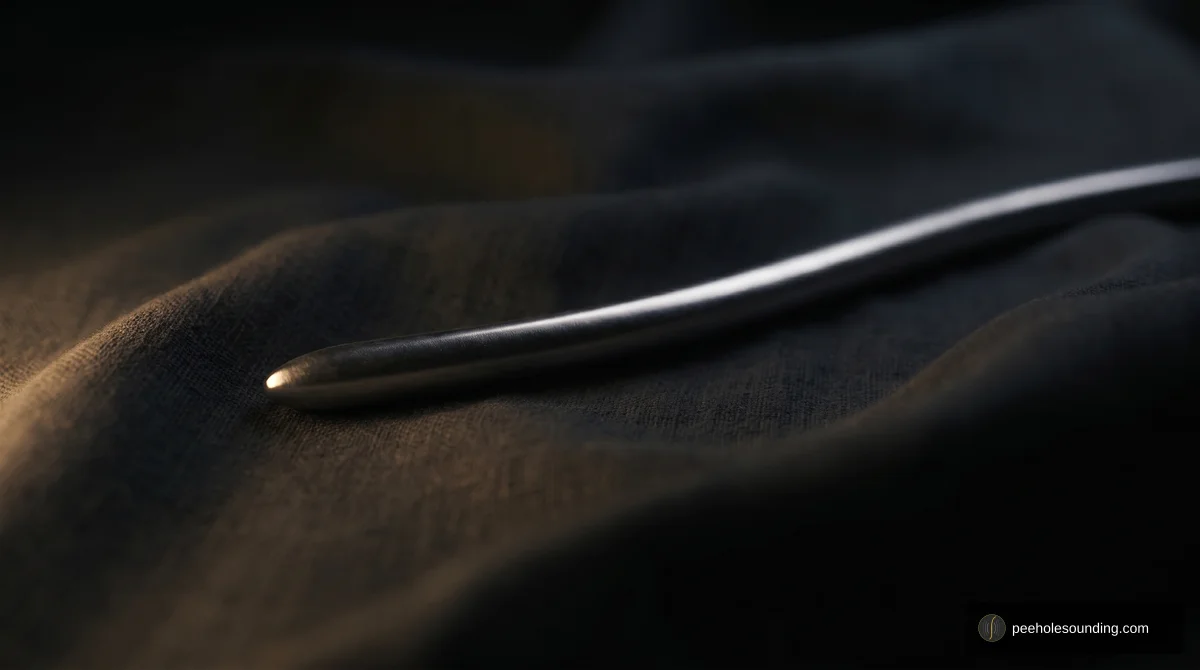
When I first tried this, nothing hurt. I was just so tense that I pulled out after about thirty seconds and decided I had done something wrong. I hadn't. I was clenched from my jaw to my pelvic floor and my body was fighting an object that wasn't actually causing a problem. Tension was the whole story.
The Pain Scale: Reading What You Are Feeling
This is the part I wish someone had handed me on day one. Not is there pain, but what kind, and what does it want from me.
| What you feel | What it usually means | What to do |
|---|---|---|
| Stretch at the opening, fading in seconds | Normal: meatus accommodating | Continue slowly |
| Fullness, weight, internal pressure | Normal: the core sensation | Continue |
| Sudden urge to urinate | Normal: pressure on bladder-signaling tissue | Pause, breathe, continue |
| Warmth spreading through the pelvis | Normal: usually arousal and relaxation | Continue |
| Sound stops moving, won't advance | Resistance: angle, tension, or a natural curve | Stop. Do not push |
| Dryness, dragging, a squeaking feeling | Lube has run out or broken down | Stop. Withdraw, re-lube |
| Stinging during insertion | Too large, too fast, or irritation starting | Stop. Withdraw, reassess |
| Sharp or stabbing pain | Tissue is being injured | Stop. End the session |
| Burning during the session | Not normal during: irritation or reaction | Stop. End the session |
| Any visible blood | Tissue damage | Stop. End the session, monitor |
| Cannot urinate afterwards | Possible obstruction or swelling | Seek medical care |
Green: Keep Going
Pressure, fullness, the urge to pee, a stretch that settles, warmth. The sound glides. Nothing catches. You can breathe normally and hold a thought. If you can relax your jaw and your stomach at the same time, you're in green.
Yellow: Stop and Reassess
The sound stops advancing. Something feels dry or draggy. A sensation arrives that's not quite pain but is definitely not comfortable, and it's not fading.
Yellow means stop moving. It doesn't necessarily mean end the session. Withdraw slightly. Add lube, properly, not a token amount. Breathe out and let your pelvic floor go. Check your angle. If yellow becomes green, continue slowly. If it stays yellow after one honest attempt to fix it, you're finished for today. That's not a failure. That's the system working.
Red: Stop and Get Help
Sharp pain. Burning during the session. Blood. A sound that won't move in either direction. Inability to urinate afterwards.
Red means the session is over now. Remove the sound gently, unless it genuinely won't move, in which case leave it and get medical help rather than forcing it. For the full stop-and-escalate protocol, including what to do about a stuck sound, see my sounding safety guide.
Why Sounding Hurts When It Does
Every painful session I've had traced back to one of six things. None of them are mysterious, and all of them are yours to control.
Size, and the Sizing Mistake Almost Everyone Makes
Too big hurts. Everyone knows that one.
Too small also hurts, and almost nobody warns you. A sound much narrower than your urethra doesn't glide. It skids. It catches on the mucosal folds, tips off-axis, and concentrates its force on whatever edge happens to be touching. A properly matched sound spreads pressure evenly around the whole circumference, which is why it feels smoother despite being larger.
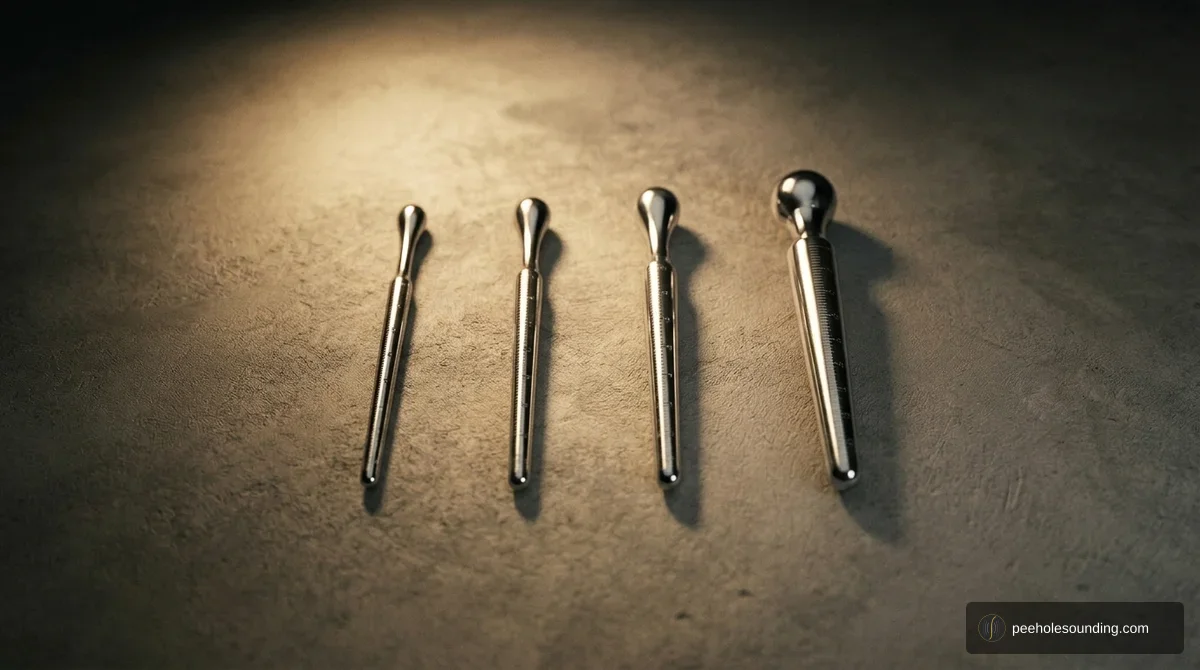
Most beginners should start between 9 Fr and 15 Fr (3mm to 5mm), and specifically not at the thinnest rod in the set. A very thin rod concentrates force on a small area, which is what makes it easier to scrape or puncture rather than glide. Move up slowly from there, over sessions rather than within one. If you're guessing, you're going to be wrong in one direction or the other. What size sounding rod to start with walks through it properly, and the sizes chart handles the French-gauge-to-millimeters conversion.
Lube: Amount, Type, and Drying Out Mid-Session
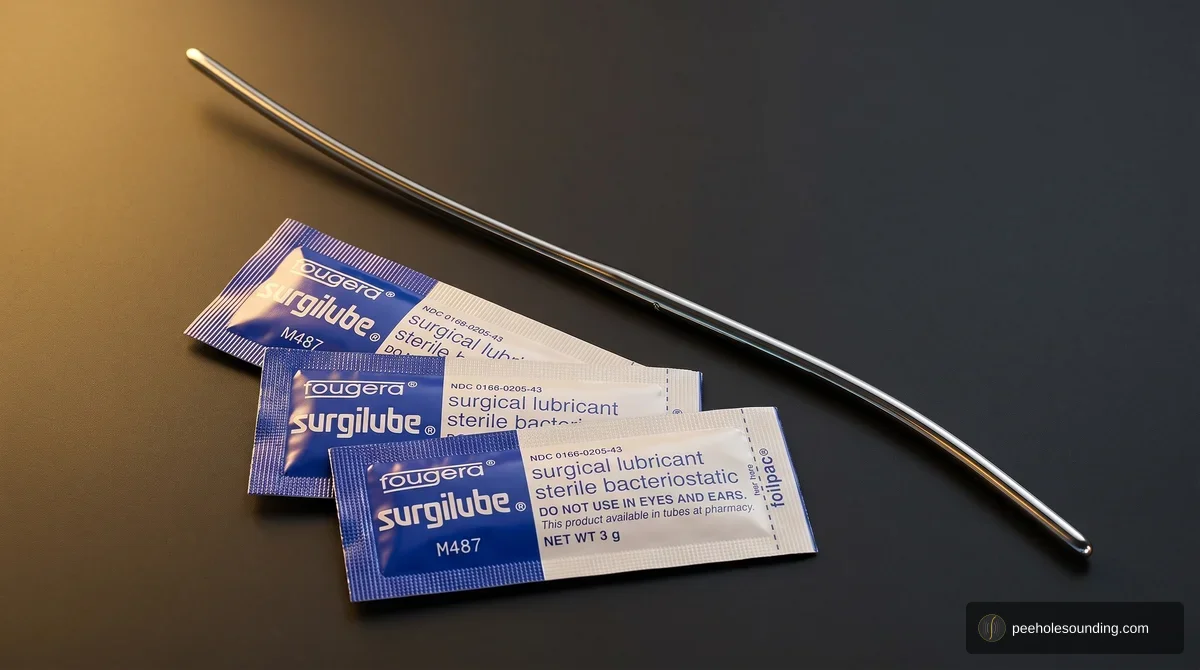
Use sterile, water-based lubricant, and use far more than feels reasonable. Lube the sound along its whole insertable length and put some at the opening itself so the first contact is already wet.
The failure nobody mentions: water-based lube dries out. On a longer session it can thin and go tacky while the sound is still inside you, and the first sign is usually a dragging or squeaking sensation that wasn't there ten minutes ago. That's a yellow. Withdraw, re-apply, carry on. Don't try to push through a dry passage. That's how irritation starts. My full breakdown of what to use and what to avoid is in the best lube for sounding guide.
Tension and the Pelvic Floor
This is the one that catches beginners hardest, and it's a loop: you tense, the sphincter tightens, the sound meets resistance, that resistance registers as pain, and the pain makes you tense harder.
The way out isn't force. Breathe out slowly and let your stomach go soft. Change position; lying back is easier than standing for most people. Being genuinely aroused helps more than any technique, because arousal relaxes the pelvic floor for you. If your body is fighting, stop and come back another day. It's remarkable how much of "this hurts" is really "I'm braced".
Texture: Ribs, Ridges, and Beads
Textured sounds have no business in a first session. Not the ribbed ones, not the ridged ones, not beads.
The reason is mechanical. A smooth sound distributes pressure across its whole contact surface. A ribbed one concentrates that same force onto each raised edge in turn, dragging those edges across delicate mucosa that has never been touched before. That's more sensation, which is exactly why they're sold. It's also more opportunity to abrade tissue when you have no baseline yet for what normal feels like.
You will find beginner kits marketed with texture as a selling point. Skip it. Start smooth, learn what your body does, and add texture later once you can tell the difference between intense and injurious. If you're curious about how bead toys work as a category, I covered them in urethral beads, including who should wait.
Erect or Flaccid? Arousal State and the Shifting Endpoint
This comes up constantly and almost nobody answers it.
Most people find insertion easier while erect. The urethra is straighter and more supported, so lining things up is simpler and the path has fewer surprises. Being aroused also does the pelvic-floor relaxation for you.
There is a catch worth knowing about in advance. If you lose your erection with a rigid sound already inserted, the geometry changes around it. The urethra shortens and curves while the steel doesn't, so the tip ends up somewhere it wasn't a moment ago, and that shift can be genuinely uncomfortable. It's not dangerous if you respond to it, but it startles people.
If your erections are unreliable, for any reason at all (and there are many), flexible silicone is the more forgiving choice, because it moves when your body moves.
Depth, Speed, and the Two Places It Catches
"Go slowly" is useless advice if you don't know where the resistance lives. There are two predictable spots.
The first is the curve where the urethra bends as it passes under the pubic bone. A straight sound has to negotiate a bend, which is precisely why curved sounds exist. The second is the external sphincter, a ring of muscle under voluntary control. Being muscle, it responds to relaxation rather than force.
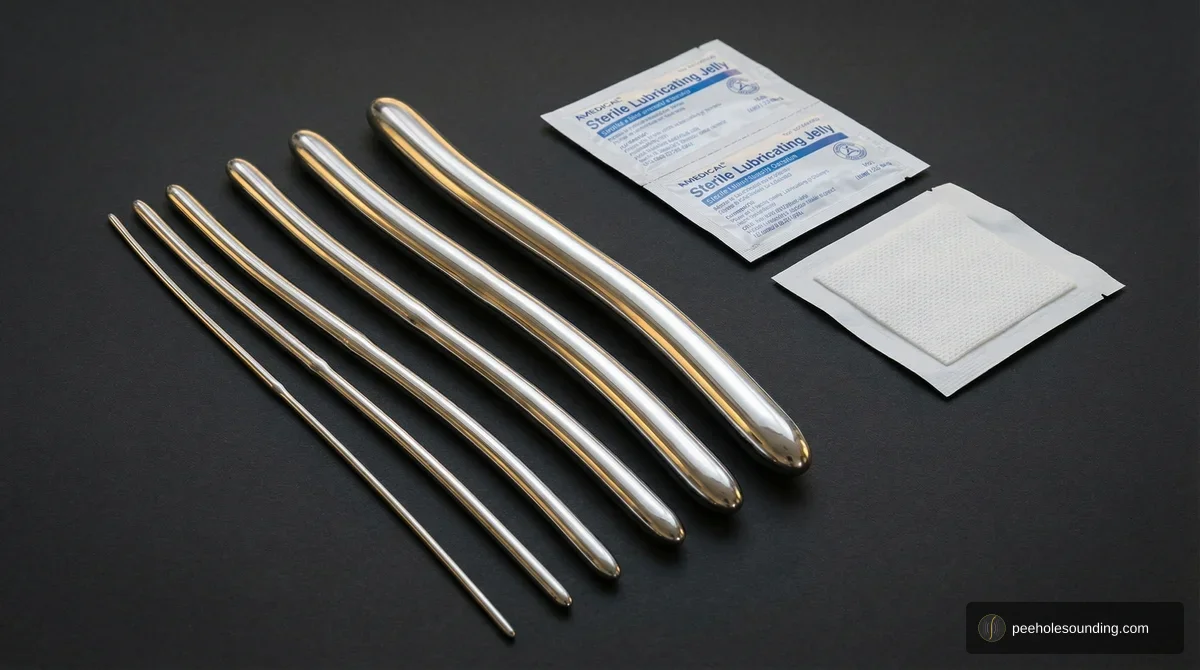
Both are places to slow down, breathe, and let the sound find its own way. Neither is a place to push. If a sound stops at a landmark like this, pressure is the wrong tool; patience is the right one. How to insert a urethral sound covers the technique in detail.
Does a Sounding Rod Hurt More Than a Plug or a Dilator?
They hurt differently, and the difference is contact area and time.
A sounding rod is a long insertion with a lot of moving contact. Most of the sensation happens during travel, and most of the discomfort risk is in that movement, which also means the risk ends when the session does.
A penis plug is short, sits shallow, and stays put. Less travel means less chance of a rough passage, but wear time introduces its own problem: sustained pressure on one spot, plus every extra minute is extra time for bacteria to be somewhere they should not be. A plug is less likely to hurt going in and more likely to cause trouble by being left in.
A dilator used for medical stretching is a different intent again, usually larger and used deliberately at the edge of what the tissue will accommodate.
In my experience the rod is the gentler introduction, precisely because you're in control of every second of it and nothing is left inside you unattended. If you want the full comparison of what each type is for, types of urethral sounds breaks the categories down.
The Sting Afterwards: What Is Normal, and For How Long
Here's the gap in every other page on this subject. Almost all of them treat pain as one thing. It's two, and they mean completely different things.
Pain during a session is a stop signal. Mild stinging afterwards usually isn't. They are different events with different causes, and confusing them is why people either panic over something ordinary or ignore something that matters.
Why It Stings When You Pee
You have just run a smooth object along a mucosal surface. Even a flawless session leaves that lining slightly irritated. Not injured, just sensitized, the way the roof of your mouth is tender after very hot food.
Then you urinate, and urine is mildly acidic. Acid across freshly sensitized tissue stings. That's the entire mechanism, and it's why the first urination after a session is reliably the worst one.
The Timeline: Hours, Not Days
The pattern I've seen in myself and heard from most people I've talked to over the years: the first urination stings noticeably, the second is milder, and by the third or fourth it's essentially gone. Call it a few hours. Some sensitivity for the rest of the evening is unremarkable.
Drinking plenty of water genuinely helps, because it dilutes your urine and gives the tissue less to react to. Urinating within about half an hour of finishing is worth doing anyway: it flushes the urethra, which is one of the more effective things you can do to reduce infection risk after any activity that introduces bacteria. The NHS guidance on urinary tract infections makes the same point about staying hydrated and emptying the bladder promptly.
Treat half an hour as the outside limit rather than the target, though. The earlier the better. I urinate first thing once the sound is out, before cleanup, before anything else, and I'd put that near the top of the list of habits worth building. Anything that got carried in has less time to settle the sooner it gets flushed back out, so those first few minutes are the ones doing the most work. Yes, that first one is also the one that stings most. Do it anyway.
The number that matters is 24 hours. Stinging that fades over an evening is ordinary. Stinging still there tomorrow isn't, and duration alone is enough to make it worth a phone call.
When "Afterwards" Becomes a Warning Sign
Get medical advice if you've any of these:
- Burning or stinging that lasts more than 24 hours
- Cloudy, foul-smelling, or persistently bloody urine
- Blood beyond a small amount on the first wipe
- Fever, chills, or lower back pain
- Difficulty starting to urinate, or a weakened stream
- Pain that gets worse over the following day instead of better
Each of those deserves its own conversation, and I will link out to them properly as I write them. For now, the safety guide has the full monitoring protocol for the 24 to 72 hours after a session.
I learned the duration rule the hard way. A few years in, feeling confident, I went up two sizes in one session instead of one. Nothing dramatic happened at the time. But the sting was still there the next morning, which had never happened before, and I spent that day rereading advice I had written myself. It settled by evening and there was no harm done, but I've never skipped a step since.
Does Sounding Hurt the First Time?
Usually not. Usually it's just odd.
The most common first-session report isn't pain but disorientation: a sensation with no reference point, which the brain treats as threatening because it has nothing to compare it to. Add the nerves everyone has the first time, and you get a lot of people who tense up, feel resistance, and conclude that sounding hurts, when what actually happened is that they braced against it.
Session One, Two, Three: What Actually Changes
Your anatomy doesn't change between the first session and the third. Your prediction does.
By the second session your body has a reference point, so it stops treating pressure as an emergency. By the third, most people stop bracing entirely, and that's usually when the sensation reorganizes itself from strange into something they actually want. That curve is consistent enough that I would treat one uncomfortable first attempt as almost meaningless data.
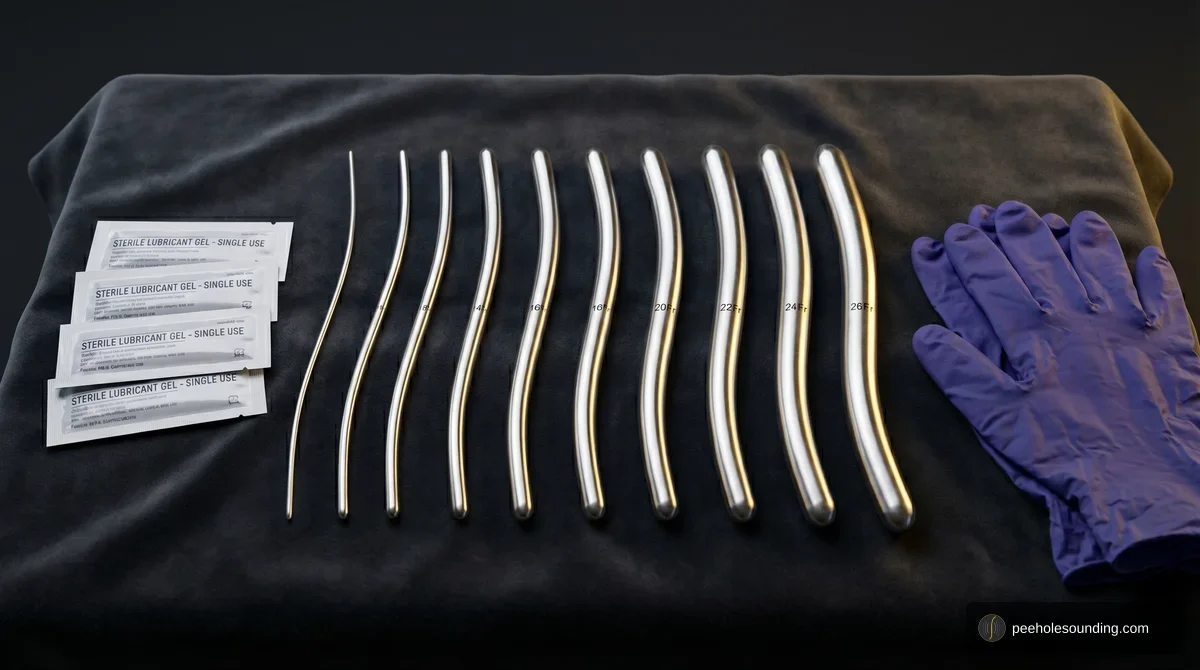
Go slower than you think you need to, stop earlier than you think you should, and let there be a next time. My beginner guide walks through a first session start to finish.
Does It Hurt Differently With a Vulva?
The rules are identical. The geography isn't.
The female urethra is much shorter, roughly an inch and a half against seven to eight inches for the male urethra. That means less distance to travel, fewer curves to negotiate, and a shorter session overall. Many women find insertion easier for exactly that reason.
The trade-off is that everything is more concentrated. Bladder-pressure sensation arrives quickly and strongly because there's so little distance between the opening and the bladder, and the pelvic floor involvement can feel more immediate. Sizing is a different conversation too, not simply a scaled-down version of the male one.
Same pain rules, same triage table, same stop signals. But the practical detail deserves more room than a section here. The female sounding guide covers anatomy, sizing, and technique properly.
How to Make It Not Hurt
Almost all sounding pain is prevented before you start, not managed once it begins.
- Start inside the 9 to 15 Fr band, nearer its lower end, and not with the thinnest rod you own. Sizing down is not a safety move once you are below that floor.
- Sterilize everything, every session, no exceptions. See cleaning and sterilizing your sounds.
- Wash your hands thoroughly, and the genital area too.
- Use sterile water-based lube, generously. More than feels sensible. Lube the sound and the opening.
- Empty your bladder first, but don't arrive parched; drink water so you can flush afterwards.
- Get comfortable and warm. Cold rooms and cold hands make everyone tense.
- Be aroused, not rushed. Arousal is a technique, not a mood.
- Nothing textured. Smooth only, until you have a baseline.
- Decide your stopping rule before you start, while you're still calm enough to make a good decision.
- Urinate as soon as you finish, ideally straight away and within half an hour at the outside, then clean and store your sounds properly.

One hard rule sits outside that list. Never use numbing agents. Not lidocaine gel, not anything sold as a desensitizer. Pain is the only feedback channel you have during a session, and anesthetizing it doesn't make sounding safer. It removes the thing that tells you to stop. Every injury I've read about that turned serious involved someone who couldn't feel what was happening, or chose not to. I cover this and a few other persistent bad ideas in sounding myths and misconceptions.
When Pain Means Stop and Call Someone
Don't let embarrassment run this decision. Urology and emergency staff have seen this before. Genuinely, routinely, without drama. The thing that turns a small problem into a serious one is almost always the delay, not the injury.
Seek medical care promptly if:
- You can't urinate, or urination is severely restricted
- Bleeding is more than light and doesn't stop quickly
- A sound is stuck and won't move in either direction
- Pain is severe, or is escalating rather than settling
- You develop a fever, chills, or back pain in the days afterwards
Two specific things worth naming. A false passage is what happens when force creates a new channel through the urethral wall rather than following the existing one. It's the main reason "never push against resistance" is a rule rather than a suggestion. And a retained sound isn't a DIY problem: don't fish for it, don't use anything else to reach it. Leave it, and go.
If you take one thing from this page, make it this. Pain during sounding isn't an obstacle between you and a good session. It's the only channel your body has to tell you something is wrong, and a practice built on ignoring it has no brakes at all. Learning to read it isn't the boring part of this hobby. It's the skill that makes everything else possible.
Frequently Asked Questions
Related Guides
Sounding Pleasure: What It Feels Like & Why People Chase It
Feb 22
Is Sounding Safe? Sounding Safety Protocols & Risks
Mar 5
What Size Sounding Rod Should Beginners Start With?
Mar 15
Best Lube for Sounding: Sterile Picks That Actually Work
Apr 20
Urethral Sounding for Beginners: Sizes & First Session
Apr 5
How to Insert a Urethral Sound (Step-by-Step)
Mar 25
How to Clean and Sterilize Urethral Sounds
Mar 20
Female Urethral Sounding: Beginner Techniques & Safety
Mar 30