Urethral Beads: What They Feel Like and Who Should Skip Them
Urethral beads explained: how the pop-and-stretch sensation differs from a smooth sound, what size to start with, how to get them back out, and who should wait.
 By Kevin Voss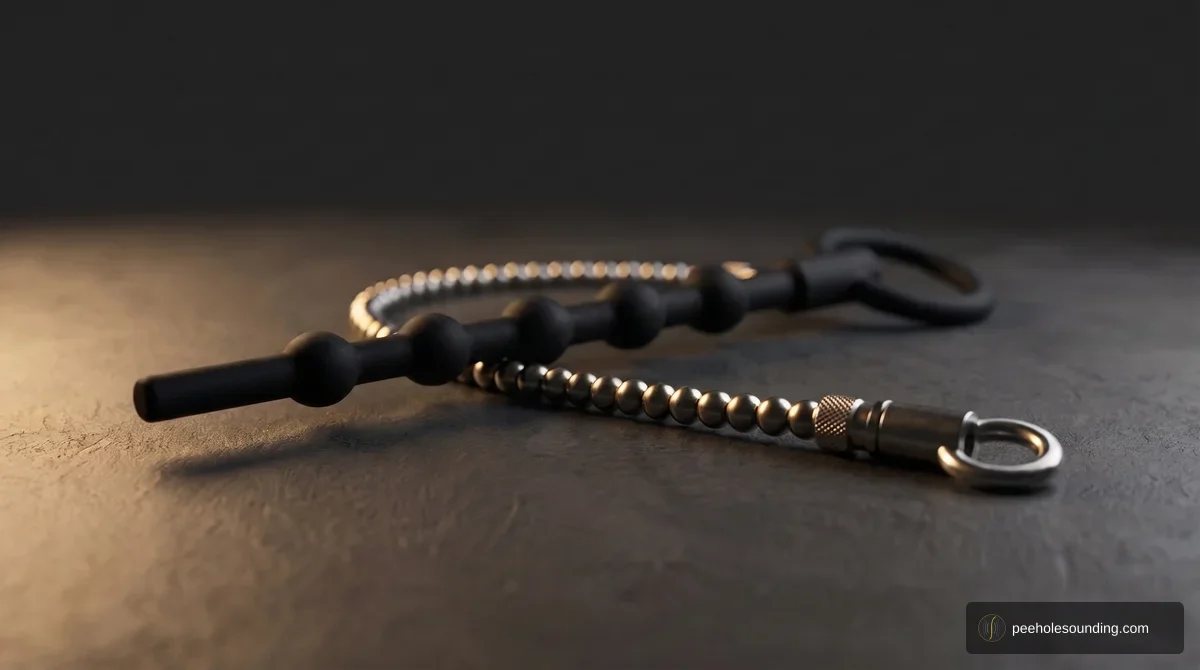
Urethral beads are a flexible shaft with a series of graduated spheres spaced along its length. Unlike a smooth sounding rod, which delivers steady pressure, each bead creates a distinct stretch-and-release moment as it passes the meatus: a rhythmic pop rather than a continuous glide.
A bead toy is not a sound with bumps on it. It's a different mechanism. A smooth rod is one event. A beaded sound is eight or ten events in a row, and then all of them again on the way out.
I like these. I also don't think they're a first toy, and I'll explain why further down.
Medical Disclaimer: This content is for educational purposes only and is not a substitute for professional medical advice, diagnosis, or treatment. Always consult a qualified healthcare provider before starting any new practices.
What Are Urethral Beads?
The short answer
Urethral beads are a sounding toy built as a slim shaft with rounded spheres spaced along it, usually widening as they go. You'll see the same product sold as sounding beads, beaded sounds, urethral sound beads, or beaded sounding rods. Those are all the same category of toy. Nobody in the industry has settled on one name.
Most are moulded silicone. Some are stainless steel. Nearly all of them have a flared base, a ring, or a wide stopper at the end that stays outside your body, and that piece is not decorative.
How they are built
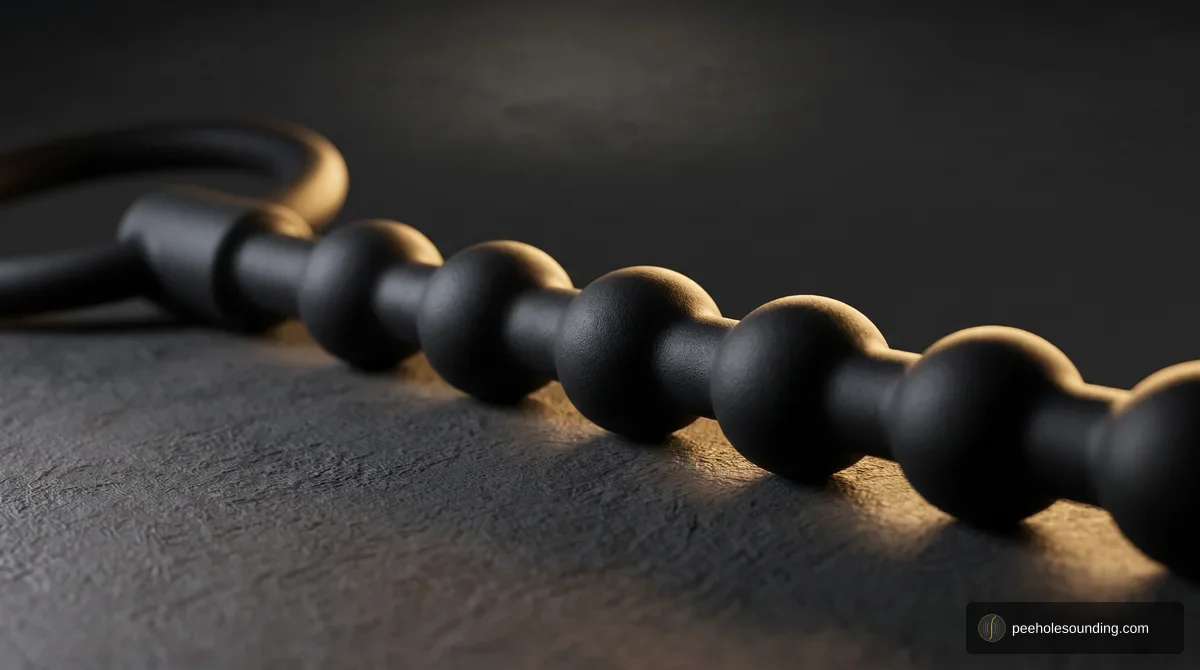
The three things that actually vary between bead toys are the bead count, the spacing, and whether the beads are uniform or graduated.
Graduated designs start small at the tip and widen toward the base, so the toy trains you upward across a single insertion. Uniform designs repeat the same diameter, so the sensation is a steady rhythm instead of a ramp.
Some beaded sounds are solid. Some are hollow, bored through end to end so urine and semen can still pass. Listings don't always say which, so check if that matters to you.
What they are not
They are not anal beads. The comparison gets made constantly and it's misleading. Anal beads have a retrieval loop, they sit in far more forgiving tissue, and losing one is a different order of problem. The urethra is narrower, more delicate, and much less tolerant of a mistake.
They are also not the same as a ribbed or textured sound. Ribbing is a continuous texture, a ripple that runs the length of the shaft. Beads are discrete. Each one is its own separate event, with a gap between them where nothing is happening. That gap is the whole point.
If you want the full landscape of shapes and materials before you commit to this one, the complete types of urethral sounds guide covers every style side by side.
Urethral Beads vs Sounds: The Real Difference
One long sensation versus a run of them
A smooth sound gives you one thing: fullness that builds as it slides deeper, then settles and stays there. Steady the whole way.
A beaded sound makes you do it over and over. Pressure builds, you stretch around the bead, it drops through, and there's a beat of nothing. Then the next one starts it again.
That's a fundamentally different experience, and it's why people who find smooth sounds a bit monotonous often love beads, and why people who love the deep steady fullness of a Hegar sometimes find beads fussy and interrupted.
Rigid steel versus flexible silicone
With a steel bead, the bead does not deform. Your urethra does all the accommodating. The stretch is sharp, precise, and unmistakable.
With a silicone bead, both sides give a little. The bead squashes slightly as it passes, so the stretch is softer and more forgiving. For a first beaded toy this matters more than almost anything else.
Side by side
| Smooth sound | Urethral beads | |
|---|---|---|
| Sensation | Steady pressure and fullness | Pop-and-stretch rhythm |
| Insertion | One continuous glide | One event per bead |
| Removal | Largely uneventful | Every bead repeats on the way out |
| Lube demand | Moderate | High (each bead is a fresh friction point) |
| Difficulty | Beginner-friendly (Hegar, smooth silicone) | Intermediate |
| Cleaning | Simple, smooth surface | Crevices between beads trap residue |
What Urethral Beads Actually Feel Like
The pop-and-stretch cycle
Most of it happens at the meatus, your urethral opening. It's the tightest part of you and the most densely wired, so that's where every bead lands hardest.
You feel the bead coming. The pressure builds, the opening has to widen to let it through, and for a second it resists. Then it gives, the widest part slips past, and you close up behind it.
Then nothing. Then the next one.
It's rhythmic in a way no other sounding toy is. If you've read what sounding actually feels like and thought the descriptions sounded a bit uniform, this is the type that breaks that pattern.
Why removal feels different from insertion
Here's what surprises most people, and it's the thing I wish someone had told me.
Coming out is more intense than going in. On insertion, gravity and lube are helping you, and the bead approaches the narrow point from the wide side. On removal, the bead has to re-stretch the meatus from the inside, and you're pulling against it rather than letting it settle.
There's also a mechanical trap with silicone: the shaft is flexible, so when a bead catches, pulling harder stretches the shaft instead of moving the bead. Then the shaft snaps back and the bead comes through all at once, faster and harder than you wanted.
Steel beads and temperature
Steel conducts temperature in a way silicone doesn't, and beads change how you feel it. A smooth rod gives you one continuous cold line down the canal. A beaded one gives you distinct cold points at intervals, each one arriving as its bead passes.
A steel beaded sound also carries more metal than a plain rod of the same length, and that mass holds temperature longer. Run it under cool water before a session and the chill is still there well after insertion. That's the appeal, and it's the main reason to reach for steel beads over silicone.
Cool water, not the freezer. Chilled metal against the inside of your urethra is a different proposition from chilled metal against skin, and at freezer temperatures metal can stick to moist tissue. A simple test: if it's too cold to hold comfortably in your hand, it's too cold to put inside you.
There's an honest trade-off here that nobody mentions. Cold makes tissue contract. A chilled bead meets a tighter opening, and with beads you need that opening to relax for every single one, not just once. If insertion starts fighting you, let the toy come back toward body temperature and try again. You lose some of the effect, but you get the passage back.
The first time I used one
I'd been sounding for a good while before I tried a beaded one, and I went in expecting a texture variation, something close to a ribbed silicone sound, which I already rated highly.
The one I tried was steel, and it was nothing like that. A ribbed sound ripples. This one hits. Each bead stretches you open, drops through, and then there's a beat of nothing before the next one does it all over again. By the third or fourth I'd stopped comparing it to anything.
Years later a steel beaded sound is still my favourite thing to use. It reaches deep enough to press on the prostate, it holds the cold, and the fullness keeps stacking instead of just sitting there. Get all three going at once and it builds into something no other sound I own gets close to.
The catch is hygiene, and it's a real one. Some metal beaded sounds are genuinely awkward to clean properly, and that's the single thing that stops me recommending them without qualification.
Who tends to like them, and who does not
You'll probably enjoy beads if you like rhythmic, cyclical sensation, if smooth sounds feel a bit flat to you, or if the stretch at the opening is the part you like most.
You'll probably not enjoy them if what you want is deep steady fullness, if you're still building comfort with insertion at all, or if you find you tense up at unpredictable sensation.
Are Urethral Beads Safe?
Used sensibly, by someone with existing sounding experience, on a toy with a proper flared base? Yes, about as safe as any other sounding toy. But beads add specific risks a smooth rod doesn't have, and they're worth naming plainly.
The risks beads add
Retrieval. This is the big one. A flexible beaded shaft with no external stopper can migrate inward, and the urethra has no natural stopping point until the bladder. Never use a bead toy without a flared base, ring, or stopper wide enough that it physically cannot pass the meatus. This is not a preference. If a toy doesn't have one, it isn't finished.
Excessive length. The other half of the same problem. There are beaded sounds sold long enough to pass the bladder neck, and once enough shaft is inside you it can coil up in the bladder instead of coming back out the way it went in. Steel does not save you here. The very long beaded ones are usually strung on a flexible core, and flexible is exactly what coils. Those extreme lengths are mostly made for partner play between two men, sharing one sound. Using one alone, you do not need anything like that much length.
Sharp edges, mostly on cheap steel. Bead transitions are where the machining gets skipped. Budget beaded sounds off Amazon and the marketplaces often carry a burr or a hard lip where each bead meets the shaft, and that edge drags on the urethral wall as it passes. It is not common, but when it happens you get a cut you cannot see, and a cut is an open door for bacteria. That is how a cheap toy becomes a UTI. Run a fingernail over every bead and every join before it goes anywhere near you. If it catches on your nail, it will catch on you.
Texture and microtears. Even a well-finished toy concentrates force at each bead in a way a smooth rod never does. Moulded silicone with a visible seam line is the other usual suspect. More lube and more patience is most of the answer.
Infection risk. More surface area and more crevices means more places for bacteria to survive a lazy clean, so this one scales directly with how well you clean the thing. Hollow metal beads are the worst case by a distance. See below.
Beads are an intermediate toy, not a starting point
Start with a smooth sound. Beads are worth owning. They're just not worth owning first.
Every bead is a separate stretch at the narrowest part of your urethra, and two things want settling before you take that on: your own sizing, and how your body reacts to having anything inserted at all. A smooth rod teaches you both with one variable instead of ten.
This site has classified beaded silicone as intermediate since the types of sounds guide was written, and that's where ten years of my own practice lands too. You'll find beaded sets sold as first toys. I wouldn't buy one as a first toy.
Start at 9 Fr to 15 Fr
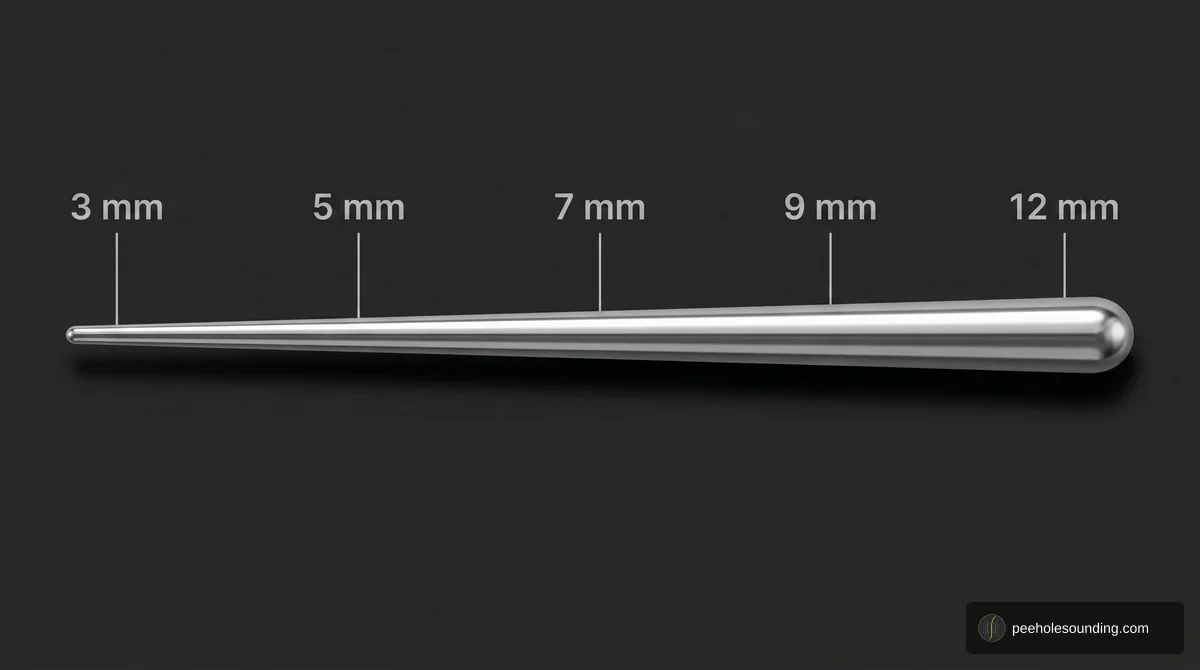
The beginner range is 9 Fr to 15 Fr, or 3 mm to 5 mm. For a first beaded toy, stay at the bottom of it, and size on the widest bead rather than the shaft.
You will find retailer copy telling beginners to start at 6 mm to 8 mm instead, on the logic that this is the width of the average male urethra. That works out at 18 Fr to 24 Fr. Check it against the sounding rod size chart: 6 mm is listed there as average male urethra width, and 8 mm as the intermediate ceiling for many people.
Starting at the width of your own urethra leaves you no margin at all, in a toy category that stretches you at every single bead. Ignore it.
When to stop, and when to see a doctor
Stop immediately for sharp or localised pain, for bright red blood, or if a bead will not clear the opening.
See a doctor for bright red bleeding that doesn't settle quickly, for burning that hasn't started easing after about 24 hours, for fever, for difficulty urinating, or for anything you cannot retrieve. Go the same day for that last one.
On that burning, the useful thing to watch is not the clock. It's the direction.
If it's fading, you're probably fine. Sore right after the session, noticeably less sore that evening, gone or nearly gone by the next morning. That downward slope is your body settling, and it's the normal pattern after a session that went well.
If it's burning just as hard a day later, that's not settling. Something is still irritated or getting worse, and another day of waiting won't change which. That's the point to call someone.
You will read elsewhere that burning for “a few hours or a few days” after a session is completely normal. A few hours, sometimes, on the way down. A flat few days is a different thing, and it isn't one to wait out. The full picture is in the sounding safety guide.
What Size Urethral Beads Should You Start With?
Bead diameter versus shaft diameter
Two numbers decide whether a beaded toy is usable, and they are not the same number.
The shaft diameter is what sits in your urethra between beads. The bead diameter is the widest point, and it's what determines whether the toy is comfortable or impossible.
A toy with a slim 4 mm shaft and 8 mm beads is not a 4 mm toy. It's an 8 mm toy with rests built in. Always size on the bead.
What to do when the listing doesn't say
It usually doesn't. Listings give you length (10 inches, 14 inches), which is close to useless, and leave out the bead diameter entirely, or bury it behind a spec tab that never loads.
So measure it yourself when it arrives, before it goes anywhere. A cheap pair of calipers is worth owning; a ruler against the widest bead will do. Convert with the chart: 1 mm equals exactly 3 Fr. If the widest bead comes out above 5 mm and this is your first beaded toy, put it aside for later.
Length matters too, and it's where anatomy genuinely differs. A 14-inch beaded sound is built around a male urethra of roughly 7 to 8 inches. If you have a vulva, your urethra runs about 1.5 to 2 inches, so a toy like that isn't scaled for you at all. You'd be using two or three beads of it at most.
That doesn't mean beads are off the table. Short silicone beaded sounds made for female anatomy exist, proportioned for a shorter canal the same way short straight sounds and tapered dilator sets are. Buy one of those rather than trying to use a fraction of something built for a penis. Silicone is also the better material here for the same reason it's the better first sound generally: it flexes instead of pressing where it shouldn't. Anatomy, landmarks and technique are covered properly in the female sounding guide.
How to Use Urethral Beads
Lube, and then more lube
Beads need a lot more lubricant than a smooth rod, because every bead transition scrapes some of it away. You're not lubricating a surface, you're re-lubricating eight of them in sequence.
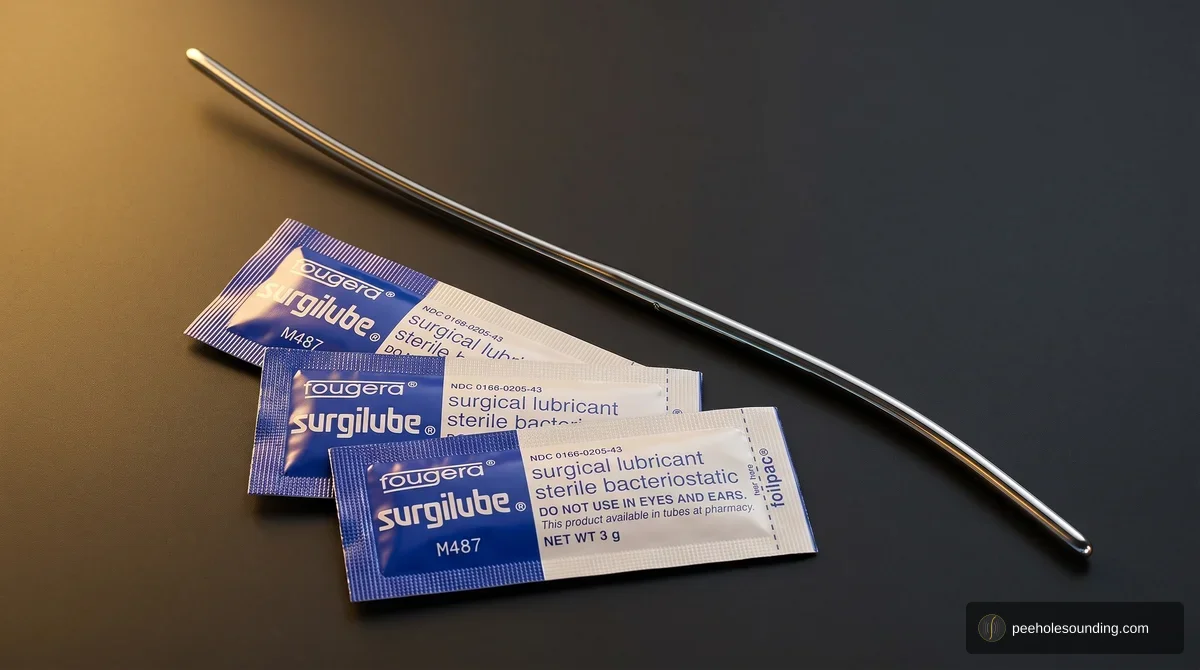
Use sterile, water-based lube. Coat the whole toy, coat the opening, and reapply during the session rather than relying on what you started with. If you're unsure what to buy, the lube guide covers what's safe to put in a urethra and what isn't.
Insertion, bead by bead
Sterilise the toy and wash your hands. Get comfortable and unhurried. Tension in the pelvic floor makes every bead harder.
Hold the toy upright over the opening and let gravity do the work. Don't push. When a bead reaches the meatus you'll feel the pressure build; wait there rather than forcing it. The opening will widen on its own timeline, and rushing it is how the tissue tears.
Pause after each bead. There is no prize for speed and no requirement to insert all of them. Three beads with control beats the whole toy with a fight. General insertion technique carries over from the how to insert a sound guide; the difference here is purely the stop-start rhythm.
Getting them back out
Nobody writes about this part, and it's the part that actually needs the instruction.
Remove one bead at a time, and never in a single continuous pull. Draw slowly until you feel a bead reach the opening, then stop and let it stretch through at its own pace, exactly as you did going in.
If a bead won't clear: stop pulling. With a flexible shaft, more force stretches the shaft rather than moving the bead, and stores up energy that releases all at once. Instead, relax your pelvic floor, add more lube at the opening, wait a few seconds, and try again gently. Bearing down slightly, as if urinating, helps more than pulling does.
If it still won't come out, don't escalate to force. That's the point at which you call a doctor, and they have genuinely seen this before.
Silicone Versus Steel Beads
Silicone flexes, so beads deform slightly as they pass and the stretch is gentler. It's warmer to the touch and much less intimidating. The trade-offs: more friction, so more lube, and it can't be boiled.
Steel doesn't give at all. The stretch is precise and considerably more intense, the weight helps it settle, it holds a temperature the way silicone never will, and it can be fully sterilised. It's also completely unforgiving of a bead that's too large.
For a first beaded toy, buy silicone. The forgiveness is worth more than the precision at that stage. Steel beads are a genuinely good experience once you know your sizing, and a bad surprise before you do.
Cleaning Textured Sounds
The crevices between beads are the entire problem. A smooth rod you can wipe down; a beaded one has eight recessed rings that hold onto residue and lube.
Wash with warm soapy water and work the gaps with your fingers or a soft brush, not just a wipe along the length. Rinse thoroughly. Leftover soap in the recesses is its own irritant. Steel can be boiled. Silicone cannot, so it needs a proper toy cleaner or a medical-grade disinfectant instead, and it needs to dry completely before storage.
Hollow steel beads are the hard case
A metal beaded sound with a through-bore is the worst cleaning job in this whole category, and it's worth knowing before you buy rather than after.
You have two problems at once. The recesses between beads on the outside, and a narrow channel running the length of the toy that you cannot see into and cannot reach with an ordinary brush. Fluid goes through that bore during use. Rinsing it under a tap does not clear it.
If you own one, flush the bore with soapy water until it runs clean, pass something through it that actually fits (a pipe cleaner or a small bore brush), and then boil it. Steel tolerates boiling, which is the one advantage this design has over hollow silicone.
If you are not going to do that every time, buy solid. A solid steel beaded sound gives you nearly the same sensation with half the cleaning risk, and an unclean bore sitting against your urethra is exactly how a straightforward session turns into a UTI.
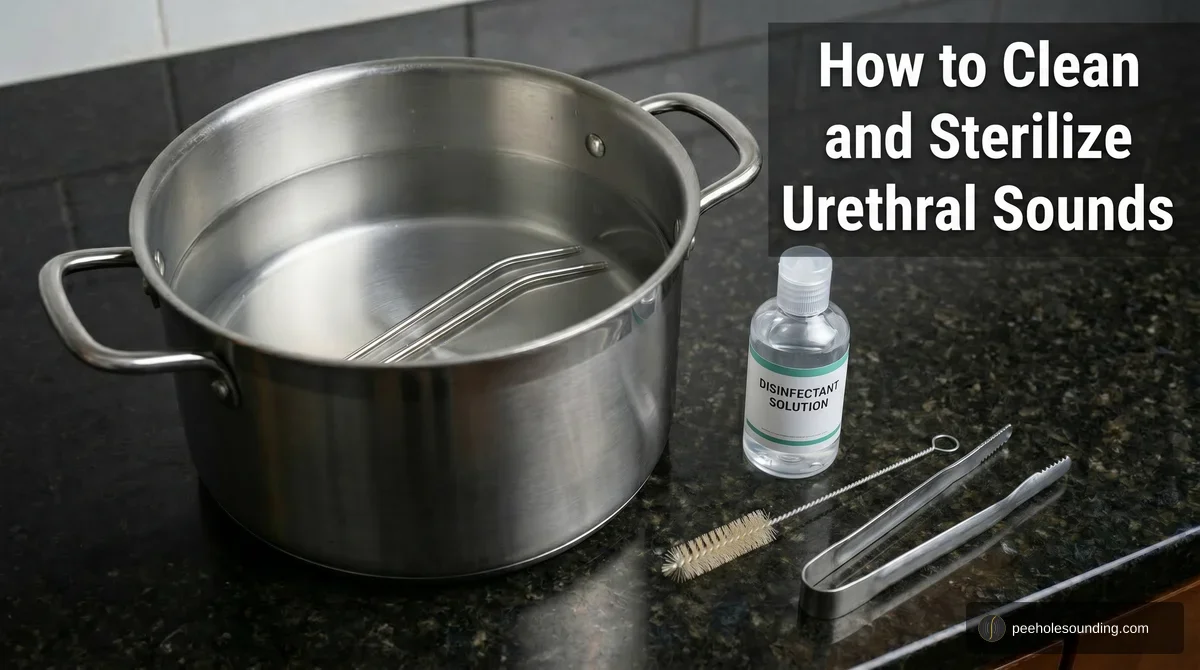
Full method, including what actually counts as sterile, is in the cleaning and sterilising guide.
Frequently Asked Questions
Related Guides
Sounding Toy Guide: Types, Materials & How to Choose
Mar 10
Sounding Pleasure: What It Feels Like & Why People Chase It
Feb 22
Sounding Rods Sizes Chart: French Gauge to mm to Inches
Apr 28
How to Insert a Urethral Sound (Step-by-Step)
Mar 25
Is Sounding Safe? Sounding Safety Protocols & Risks
Mar 5
How to Clean and Sterilize Urethral Sounds
Mar 20
Best Lube for Sounding: Sterile Picks That Actually Work
Apr 20

Female Urethral Sounding: Beginner Techniques & Safety
Mar 30