Van Buren Sounds: Why They Curve, Sizes & How to Use Them
Van Buren sounds explained: why the curve matches male anatomy, the full 8 to 30 Fr size chart, safe insertion technique, and the false passage risk.
 By Kevin Voss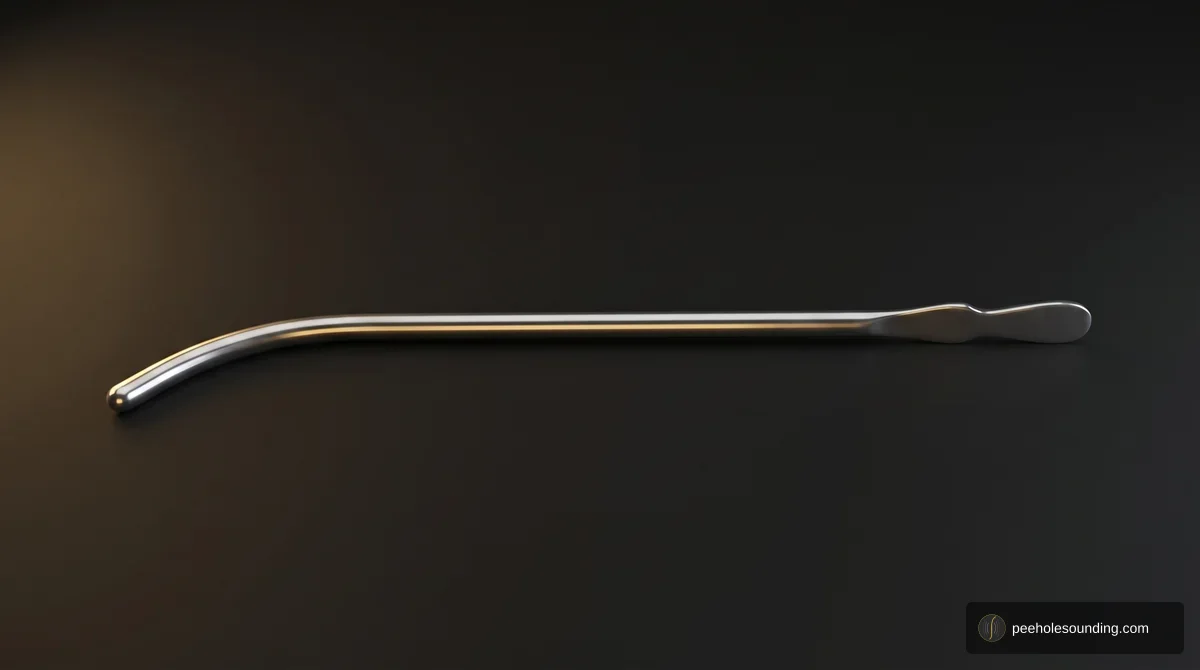
A Van Buren sound is a curved stainless-steel urethral dilator, roughly 11 inches long, with a single working tip and a long flat handle stamped with its size. The curve matches the fixed bend in the male urethra below the pubic bone. Standard sets run 8 Fr to 30 Fr.
Here's the part nobody sells you: the curve isn't there to reach further. It's cut to match one bend in your anatomy that you physically cannot straighten out, and understanding that is the difference between a Van Buren being the most controlled sound you own and the one that hurts you.
I've used these plenty of times over the years, and I'll be honest: they're not my favourite type. What they are is a good balance between a silicone sound and a Hegar when what you actually want is to reach the prostate. That's the job they do better than anything else, and it's the reason to own one.
What follows is ten years of practice plus the urology literature, and I'll tell you where the two disagree.
Medical Disclaimer: This content is for educational purposes only and is not a substitute for professional medical advice, diagnosis, or treatment. Always consult a qualified healthcare provider before starting any new practices.
What Are Van Buren Sounds?
The short answer
A Van Buren sound is a single rigid rod of polished stainless steel with one rounded working tip, a pronounced curve near that tip, and a long flat handle at the other end with the size stamped into it. Most are 11 inches long overall. They're sized in French gauge, and they're sold individually or in graduated sets.
They are single-ended, which is the first thing that trips people up coming from Hegars. A Hegar sound is double-ended: one rod, two diameters about 1 mm apart, so an 8-piece set gives you sixteen sizes. A Van Buren gives you one size per instrument. You buy the ladder rung by rung, and that changes both the cost and the way you progress.
Who William Van Buren actually was
William Holme Van Buren was an American surgeon who in 1866 took the chair of a brand-new genito-urinary department at Bellevue Hospital Medical College, the first urologic ward in the United States.
So this is a 150-year-old clinical instrument the kink world borrowed, not a sex toy dressed up as medical. The design is old because it works, and it works because a surgeon spent a career looking at the inside of the male urethra.
What they were built to do
Van Burens were made to dilate urethral strictures (scarred narrowings that restrict urine flow) and to find where a narrowing sits by feel. That's still their clinical job.
So we're using a diagnostic tool for pleasure. That's fine, but worth saying out loud: it wasn't designed for us. It was designed for someone who trained for years, working on someone anaesthetised.
Why Van Buren Sounds Are Curved
This is the section every other page on this topic skips, and it's the one that actually makes you safer.
The male urethra has two bends, not one
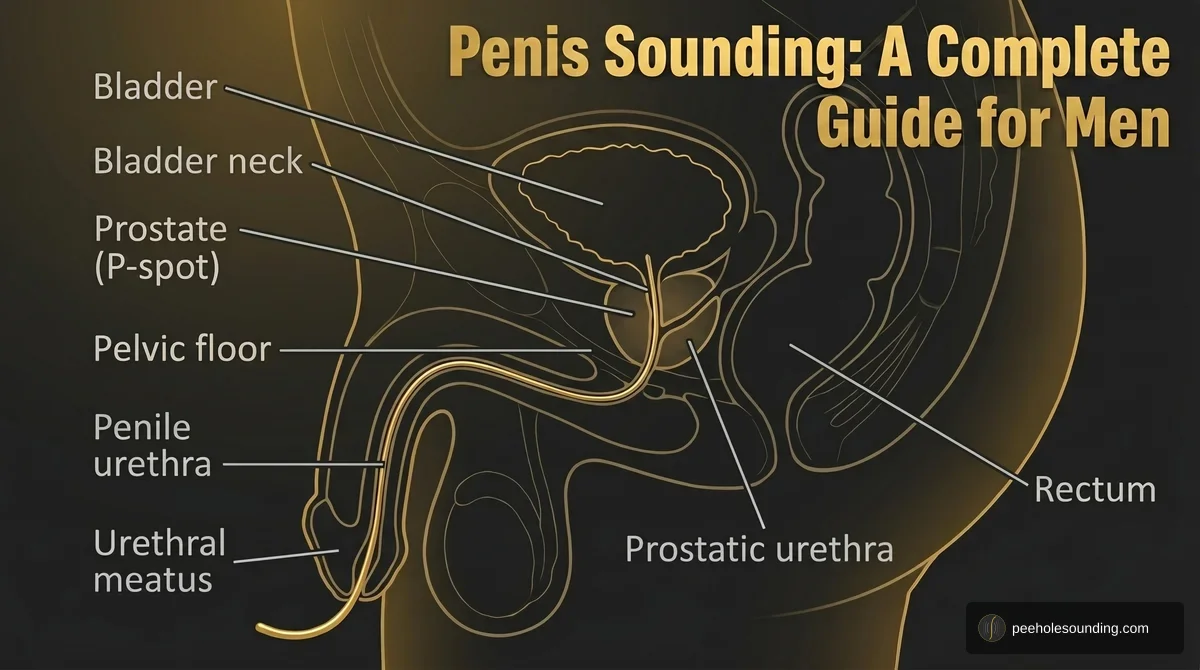
Your urethra isn't a straight tube. From the outside in, a sound passes the navicular fossa (the widened bit just inside the tip), the penile urethra, the bulbar urethra, the short membranous section, the prostatic urethra, and finally the bladder.
Along that route there are two distinct angles: the prepubic angle, out toward the front, and the infrapubic, or subpubic, angle, sitting underneath your pubic bone. Viewed from the side, the whole thing makes a lazy S.
One bend you can straighten. One you cannot.
Here's the mechanical heart of it.
Hold your penis up and out at roughly 90 degrees to your body, which is the standard advice everywhere, and you flatten the prepubic angle. Gentle traction pulls that front curve nearly straight, which is why straight sounds work at all for the first few inches.
The subpubic curve does not straighten. It's held in place by your pubic bone. You can pull all day and it stays exactly where it is, because it's anatomy, not slack tissue (TeachMeAnatomy).
That fixed curve is precisely what a Van Buren's shape is cut to match. Not "to reach deeper". To travel a bend that a straight rod has to be forced through. The instrument isn't doing something clever. It's doing something obvious that took a 19th-century urologist to draw properly.
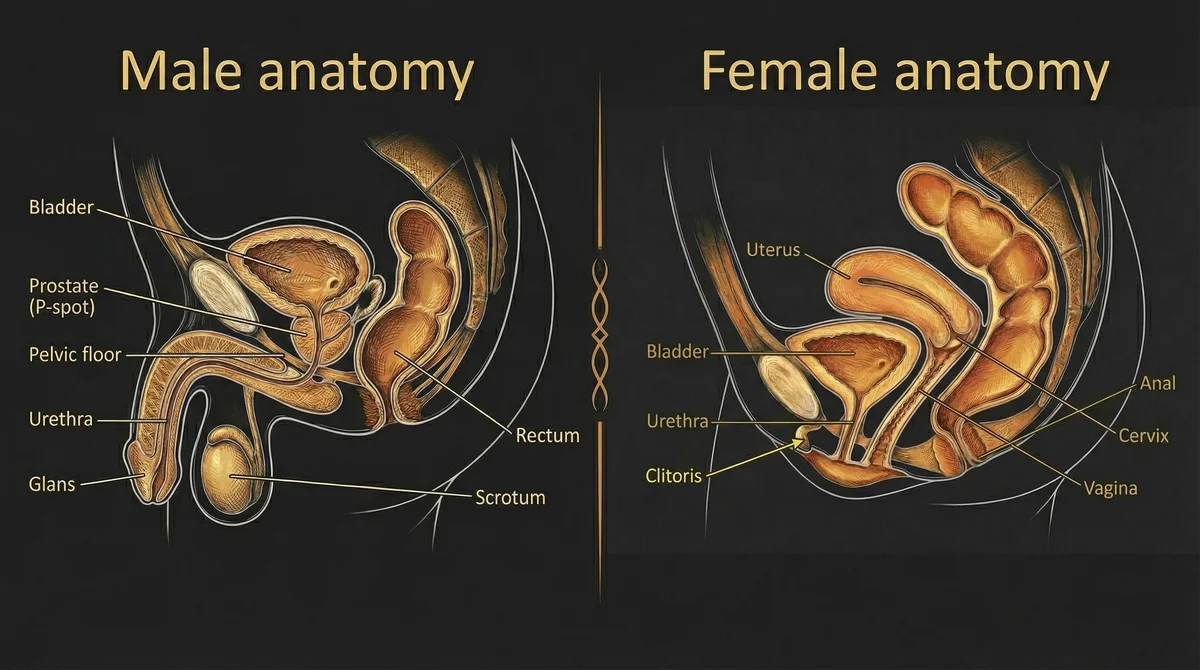
Trace the male urethra from the tip inward. The dip under the pubic bone, just before it turns up toward the bladder, is the bend in question. Picture a straight rod making that turn and you have the argument for a curved sound in one image. The female side is worth a glance for contrast: short and essentially straight, which is why the curve buys nothing there.
Why the curve is both the feature and the hazard
Follow that one step further. If the curve exists to negotiate the bulbar bend, that bend is also where the instrument does the most work, and where getting it wrong does the most damage. The same J-shaped stretch of anatomy that makes a Van Buren feel controlled is the stretch where a false passage is most likely to start (StatPearls).
The curve is the feature. The curve is the hazard. Same curve. More on that below.
Van Buren Sizes: The Full Fr Chart
Most pages on this topic tell you to "choose an appropriate diameter for your experience level" and then give you no numbers. So here are the numbers.
Van Buren sizes in Fr, mm and inches
Fr, French and Charrière are one scale with three names, and surgical suppliers love writing "Charr" without ever explaining it. French gauge ÷ 3 = millimetres. An 18 Fr sound is 6 mm across. Same system as every other sound type in the sounding rods sizes chart.
| French | Millimetres | Approx. inches |
|---|---|---|
| 8 Fr | 2.7 mm | ~7/64” |
| 10 Fr | 3.3 mm | ~1/8” |
| 12 Fr | 4 mm | ~5/32” |
| 14 Fr | 4.7 mm | ~3/16” |
| 16 Fr | 5.3 mm | ~7/32” |
| 18 Fr | 6 mm | ~1/4” (just under) |
| 20 Fr | 6.7 mm | ~1/4” (just over) |
| 22 Fr | 7.3 mm | ~9/32” |
| 24 Fr | 8 mm | ~5/16” |
| 26 Fr | 8.7 mm | ~11/32” |
| 28 Fr | 9.3 mm | ~3/8” (just under) |
| 30 Fr | 10 mm | ~3/8” (just over) |
Catalogues run to 36 Fr and 40 Fr, and those are surgical sizes. For context, the average male urethra is about 6 mm to 8 mm, or 18 Fr to 24 Fr. A 40 Fr sound is 13.3 mm. Not a recreational number.
What is in a standard 12-piece set
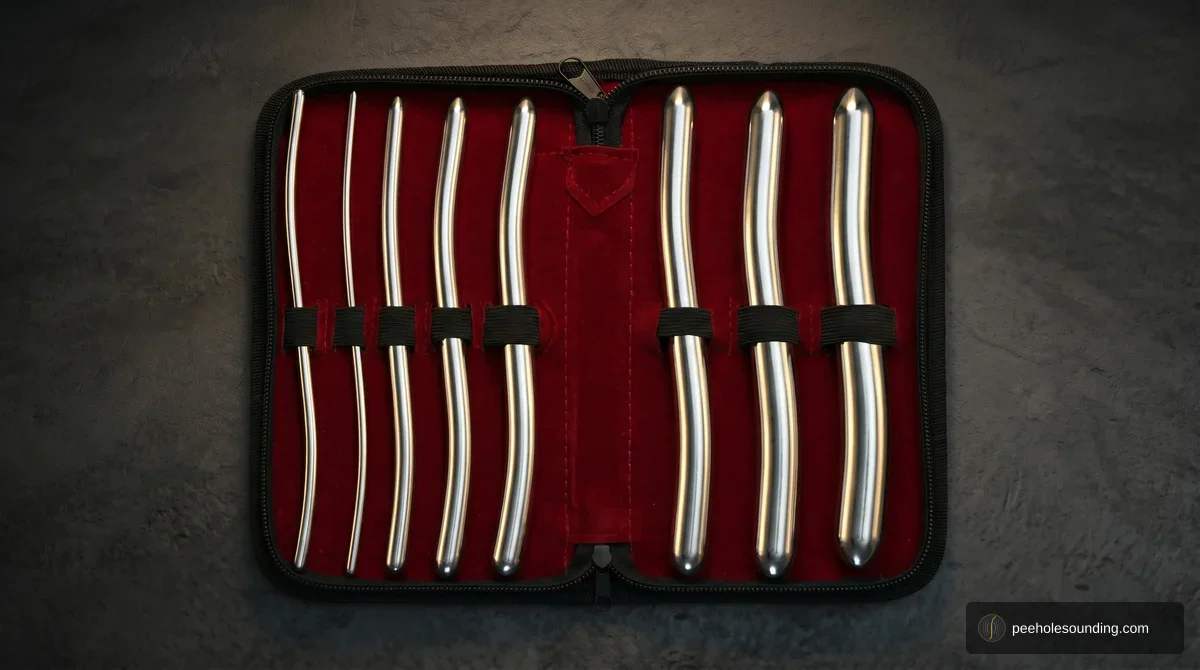
The common set is twelve sounds covering 8 Fr to 30 Fr in even steps: 8, 10, 12, 14, 16, 18, 20, 22, 24, 26, 28, 30.
Each step up is 2 Fr, about 0.67 mm. That sounds tiny. It isn't: it adds roughly 2 mm of circumference, and your urethra notices circumference. Hegar rods actually step further apart, around 1 mm, but you own both ends of every rod and they're far more forgiving to back out of. Smaller rungs, less forgiving climb.
The curve itself doesn't change as you go up the sizes. Only the diameter does.
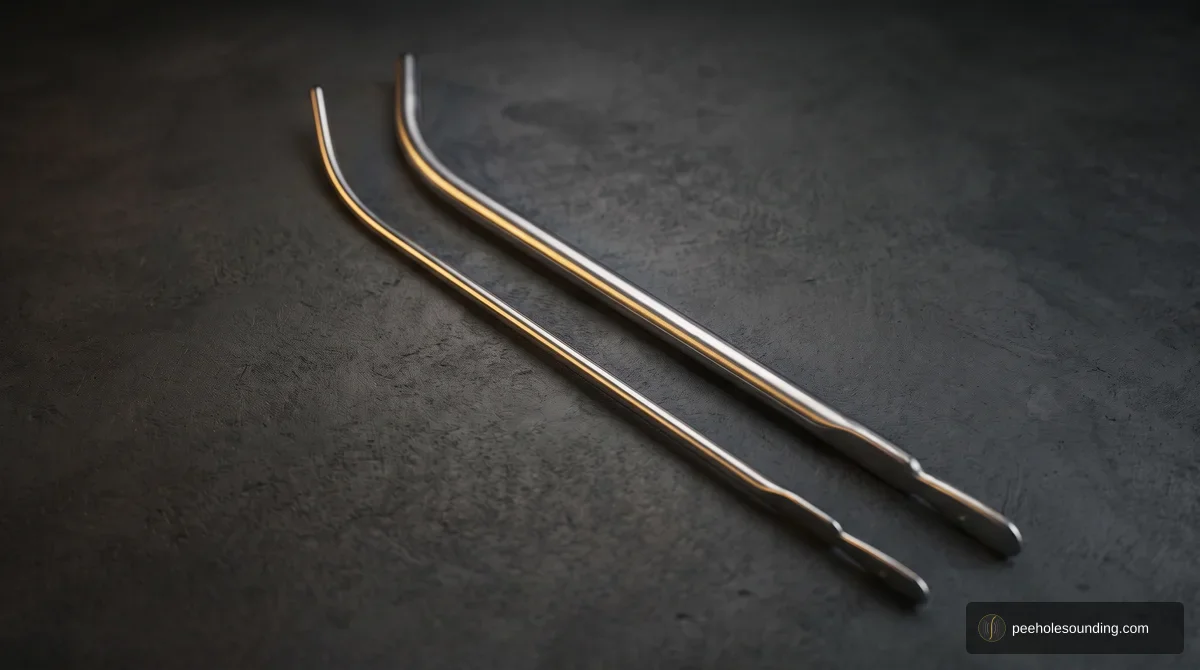
How long is a Van Buren sound?
Between 10¾ and 11 inches (27.3 to 27.9 cm), depending on the manufacturer. Most catalogues list 11 inches; some list 10¾.
That surprises people, so head off the obvious misunderstanding: most of that length is handle. The long flat grip is there so a surgeon has purchase and a clear view. An 11-inch sound is not an 11-inch insertion.
What a set actually costs
Individual sounds from surgical suppliers run roughly $48 to $57 each, so a twelve-piece 8 to 30 Fr set lands around $570 to $680. An 8-piece Hegar set costs a fraction of that and covers sixteen sizes. If you're still deciding whether curved sounds are for you, buying the whole ladder is an expensive way to find out. Start with a couple of sizes near where you already play.
Who Should Not Use a Van Buren
Plainly:
- Beginners. If you haven't spent real time with a straight set and gotten genuinely comfortable, start there. The Hegar guide is where I'd point you.
- Women, and anyone with a short urethra. The female urethra is roughly 1.5 inches and essentially straight. There is no subpubic bend to negotiate, so the curve isn't a safety feature. It's an awkward shape solving a problem you don't have. The female sounding guide covers what actually suits that anatomy.
- Anyone with a known stricture, an active UTI, or symptoms right now. Pain, burning, blood, difficulty urinating: see a doctor before you play, not after.
- Anyone planning to use one erect. More on that below, and it isn't negotiable.
How to Use a Van Buren Sound Safely
The short version, focused on what's different about a curved sound. The full walkthrough (position, hygiene, pacing, aftercare) lives in how to insert a urethral sound, and you should read that first.
Before you start
Sterilised sound. Clean hands. Sterile, water-based, single-use lubricant, and more of it than you think you need (why sterile is non-negotiable). An hour where nobody knocks on the door.
The handle drop, and why it works
The move follows directly from the anatomy above.
- Start with the curve pointing up, toward your belly, with your penis held up and out at roughly 90 degrees. You've now flattened the prepubic angle, and the tip has a straight run down the penile urethra.
- Let it descend under its own weight. Steel is heavy. Do not push.
- As the tip reaches the bulbar urethra, around the base of the penis, begin lowering the handle down and forward, toward the space between your legs. The tip pivots on the curve and rides the subpubic bend instead of pressing into the roof of the urethra.
That third step is the whole technique. The clinical equivalent during difficult catheterisation is to pull "inferiorly towards the feet to straighten the passage as much as possible" (StatPearls). Same physics.
Gravity and geometry do the work. If you are pushing, you are doing it wrong. When it's going well it feels like guiding something that's already moving. The one time I got it badly wrong, I'd tried to "help" at exactly the point where the tip needed to rotate on its own. It didn't injure me, but it hurt in a sharp, specific way I've never forgotten, and it taught me the difference between resistance and a bend.
Flaccid only, in and out
Insert soft. Remove soft. If you get erect while the sound is in, and you probably will, wait it out before removing.
An erection changes both the length and the internal geometry of the urethra, and a rigid curved rod that fit a soft urethra does not fit an erect one. Consensus for good reason. Don't improvise here.
Warning signs to stop on
Stop immediately, and don't try again that day, if you get:
- Blood at the tip. A pink tinge in urine afterwards happens. Bright red blood means done.
- Resistance that doesn't yield to patience. Not "yields to more force". Yields to waiting, relaxing, and more lube.
- Sharp, localised pain, as distinct from the pressure and fullness you're expecting.
The urology literature is blunt about the failure mode: "extreme pressure should be avoided as it will only cause false passage formation and bleeding" (StatPearls).
What a Van Buren Actually Feels Like
It gets to places a straight sound simply doesn't, the prostate being the one people are usually after. That's the headline. A straight rod reaches the subpubic bend and stops, not because it has run out of length but because it has run out of angle, and the only way past is force you should not apply. The Van Buren goes round the corner. Everything below is downstream of that one fact.
A Hegar gives you even, uniform fullness: the same sensation distributed along whatever length is inside you. A Van Buren gives you something more located. As the curve seats against the subpubic bend there's a distinct moment where the pressure changes character: deeper, heavier, more internal. It's the difference between a sensation you're having in your penis and one you're having in your pelvis.
That moment is what the instrument is for. It's a deep, weighted pressure that surface stimulation genuinely cannot reproduce, and it builds rather than spikes. I don't reach for a Van Buren most sessions, but when prostate depth is the goal, nothing else in the drawer does the job as cleanly.
The middle ground between silicone and straight steel
A silicone sound gets past the bend by giving up. It deforms and follows wherever your anatomy sends it: forgiving, and the gentler introduction to depth. But it's light, so nothing works for you, and you lose most of the feedback. You feel that it's in, not where.
A straight steel sound gives you all of that feedback and none of the reach. Weight, glide, and a direct sense of where the tip is, right up until the bend.
A Van Buren is the middle ground. Rigid steel, so you keep the weight and the feedback; pre-shaped, so it makes the turn. Silicone negotiates the bend by bending. A Van Buren negotiates it by already being the right shape, which feels entirely different: a solid object tracking a path it was cut for.
The failure modes differ too. Silicone's softness is a safety margin; steel's rigidity is not, and the curve doesn't restore it. Right shape, no forgiveness.
It's also not for everyone, and that's a normal outcome rather than a failure of nerve. Some people find the depth overwhelming instead of pleasurable. If that's you after a few honest attempts, you've learned that straight sounds suit you better, which cost you one evening. Does sounding feel good covers sensation across the whole range.
False Passage: The Risk the Curve Creates
This is the one risk that's specific to curved sounds, and no other page on the topic seems to mention it. It's worth two minutes.
A false passage is a tunnel that isn't your urethra. If you keep pushing against something that isn't giving, the tip can lift the lining and burrow a new channel alongside the real one. It doesn't take much force, and you probably wouldn't know it had happened until you tried to pee (StatPearls).
The curve makes it likelier, not less. A steeper bend means the tip is more inclined to press into the wall than follow the channel, which is exactly why urologists prefer a gentler-angled sound, and why they advise against passing one of these blind even in a hospital, with training and anaesthesia and a camera (Furr & Gelman, 2020).
At home, blind is the only mode there is. That's not a reason to skip it. It's the reason the method above is what it is. Gravity instead of force, the handle drop, stopping on resistance: all of it exists because you can't see where the tip is going. The safety protocols guide covers the wider risk picture.
Van Buren vs Other Sounds
| Sound type | Shape | Best for | Ends | Notes |
|---|---|---|---|---|
| Van Buren | Pronounced curve | Depth past the subpubic bend | Single | Not a first set. Buy sizes, not the ladder |
| Hegar | Gentle curve | Beginners, progression | Double | Buy this first |
| Guyon | Extreme curve | Expert bladder work | Single | More curve than a Van Buren. Later, if ever |
| Dittel | Straight | Simple uniform insertion | Single | No bend to negotiate |
| Pratt | Long, gentle curve | Depth without diameter jumps | Double | Between Hegar and Van Buren |
Pick a Hegar if you're starting, or if you stay in the first few inches. Pick a Van Buren once you want reliable depth past the bulbar bend and you've earned the patience for it. Guyon sounds are further along the same road and I'd treat them as a separate decision entirely.
For the full picture across every family and material, the types of urethral sounds guide is the reference.
Cleaning and Storage
The general protocol is the same as any steel sound, and how to clean and sterilize urethral sounds covers it properly. Two things are Van-Buren-specific.
Inspect the curve. It's the hardest part of the instrument to see and the easiest place for pitting or surface damage to hide. Run it under good light and check the outside of the bend, where wear concentrates.
Store it straight and separated. Solid steel resists a lot, but a curved rod tossed in a drawer with other hardware can pick up nicks along the bend, and a nick on the working surface of a curved sound sits exactly where it will drag.
Frequently Asked Questions
Related Guides
Hegar Sounds: Sizes, Full mm/Fr Chart & How to Choose
Apr 12
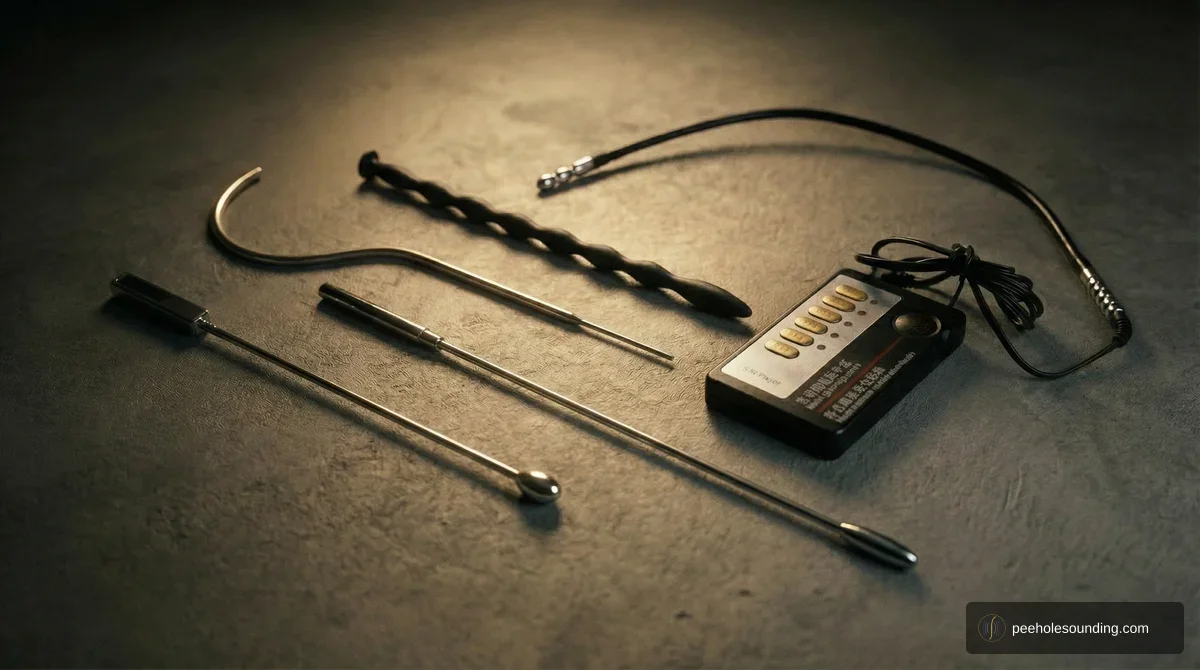
Sounding Toy Guide: Types, Materials & How to Choose
Mar 10
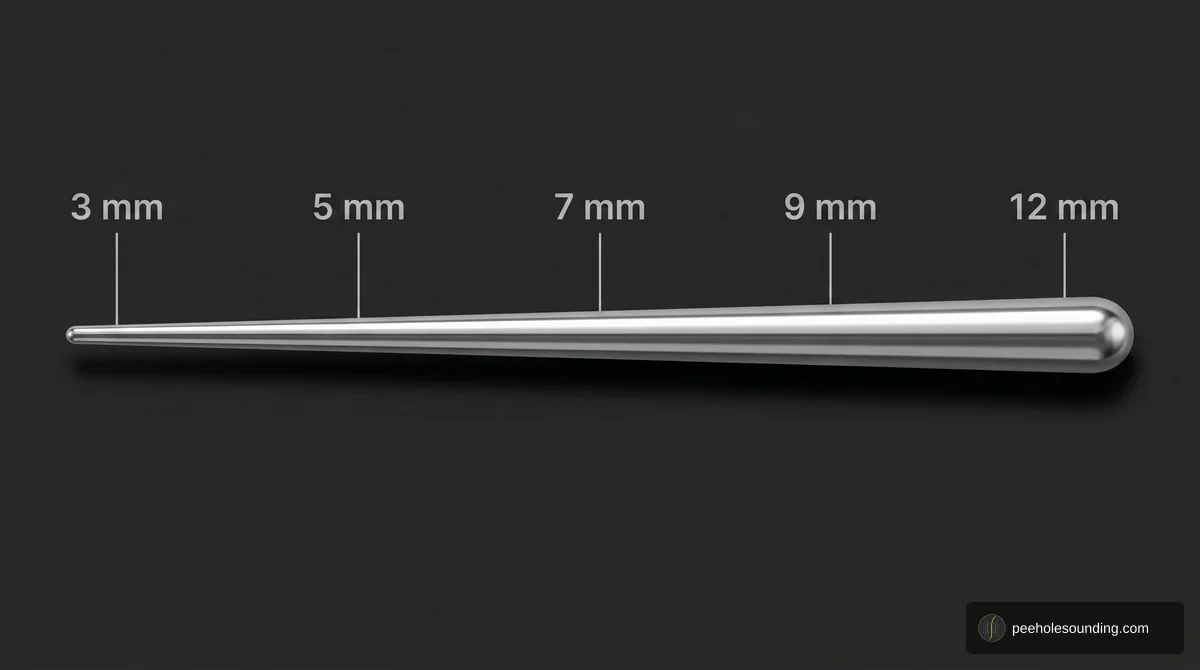
Sounding Rods Sizes Chart: French Gauge to mm to Inches
Apr 28
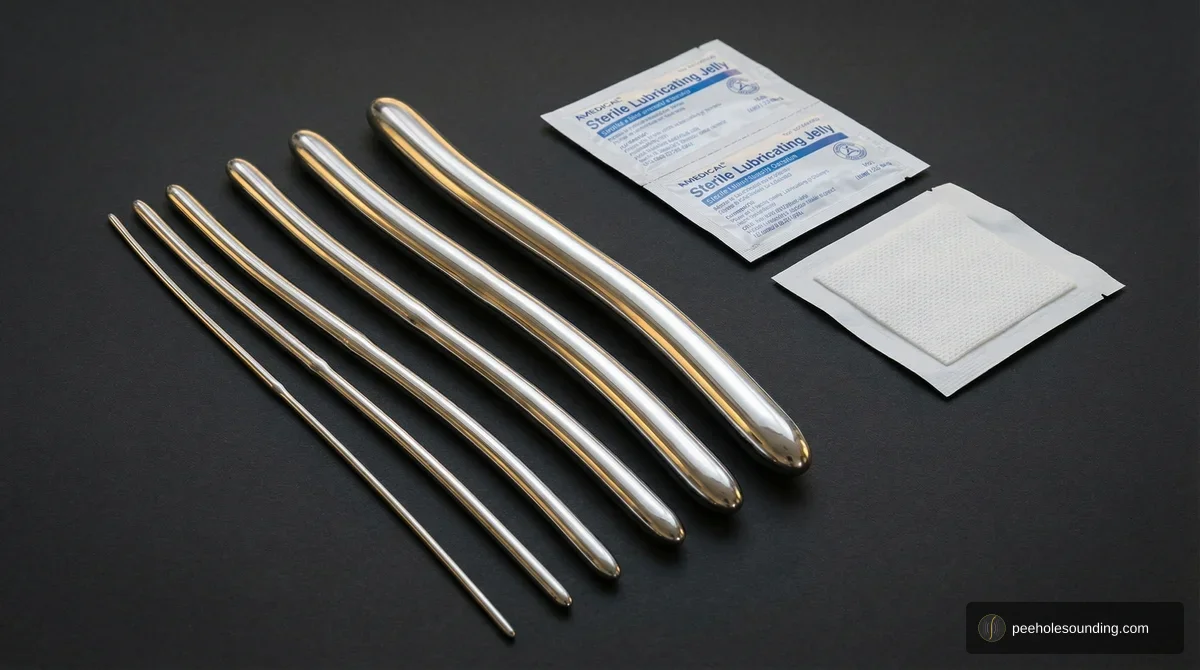
How to Insert a Urethral Sound (Step-by-Step)
Mar 25
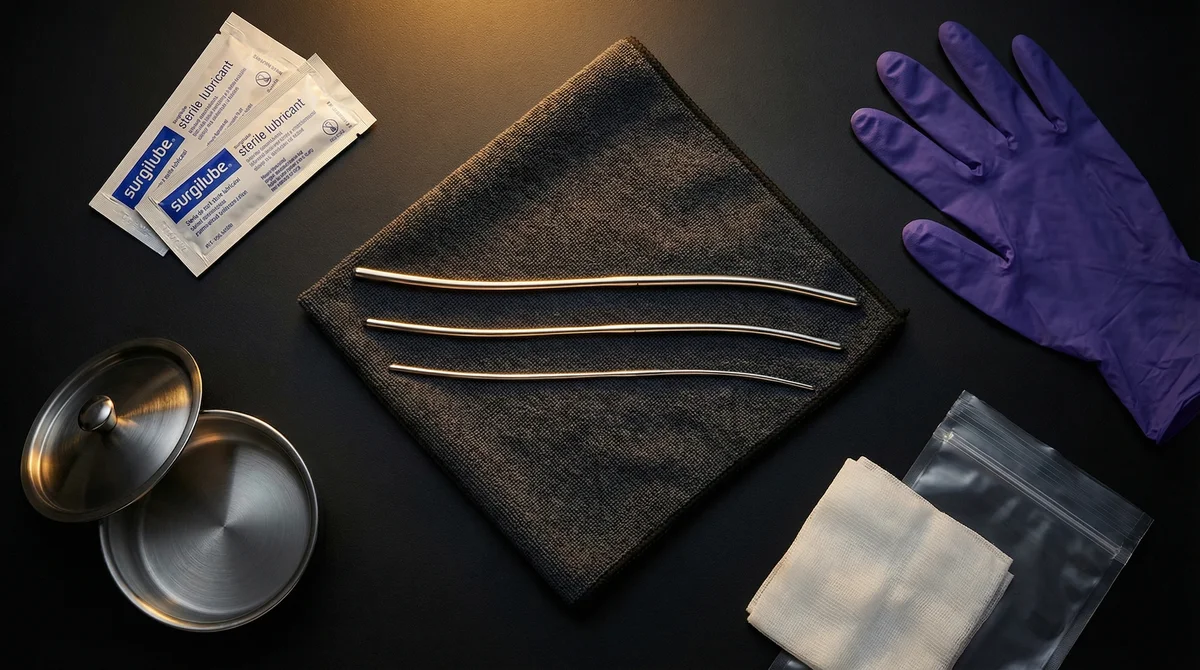
Is Sounding Safe? Sounding Safety Protocols & Risks
Mar 5

How to Clean and Sterilize Urethral Sounds
Mar 20
Penis Sounding for Men: Sizes, Safety & Prostate Technique
May 9