Your First Sounding Kit: Exactly What to Buy Before You Start
What to buy for your first sounding kit: a graduated set, sterile single-use lube, sterilization gear. Start at 3-5mm (9-15 Fr). What to skip, and why.
 By Kevin Voss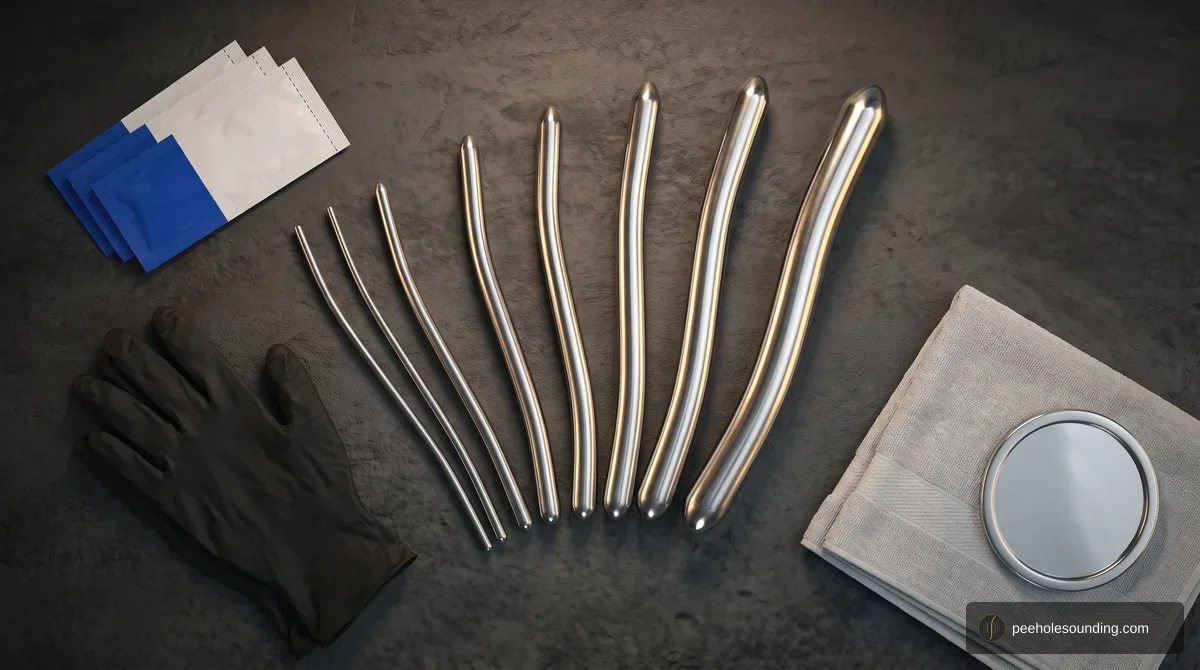
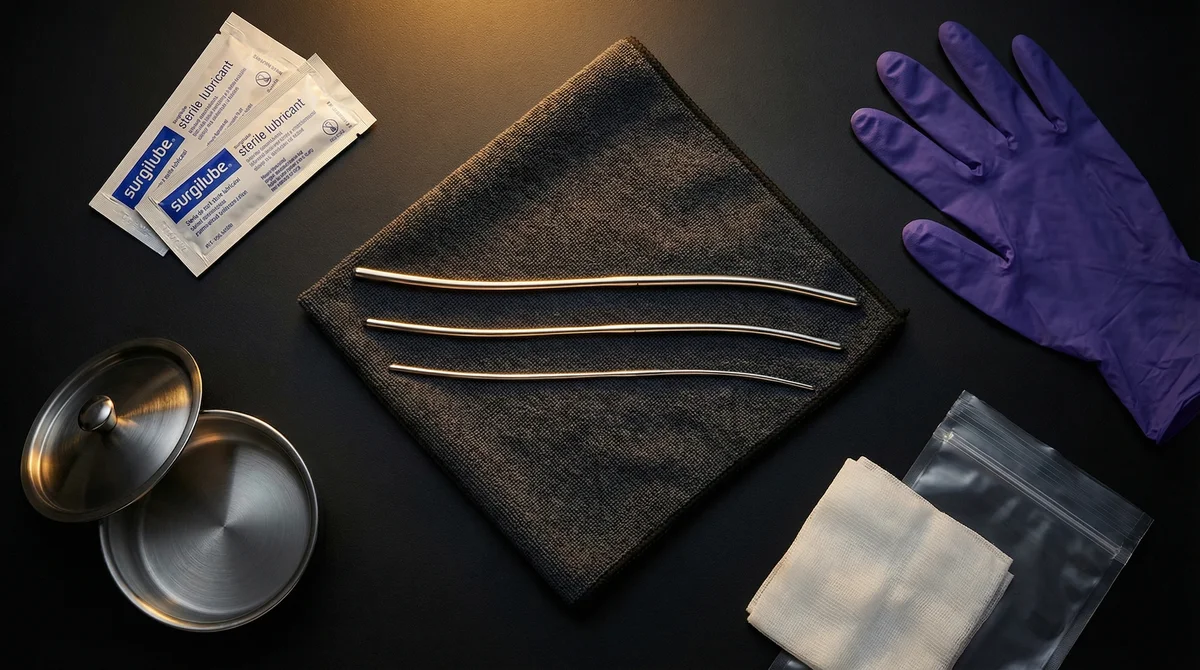
A first sounding kit is four things: a graduated set of surgical stainless steel or silicone sounds, sterile single-use water-based lubricant, a way to sterilize the sounds, and clean gloves. Start at 3-5mm (9-15 Fr), not the thinnest rod in the set. Everything else is optional.
Your First Sounding Kit
I've been sounding for about ten years, and I sell nothing. No affiliate links on this page, no discount codes, no brand I get paid to like. That's the whole reason this article exists: every page currently ranking for “sounding kit” is either a shop trying to sell you a set or a health site that won't tell you which one to buy.
Medical Disclaimer: This content is for educational purposes only and is not a substitute for professional medical advice, diagnosis, or treatment. Always consult a qualified healthcare provider before starting any new practices.
What actually goes in a first sounding kit
You buy a kit rather than a single sound for one reason: you cannot know your size in advance. Urethras vary, and the only way to find the diameter that feels snug without straining is to have a few adjacent sizes in front of you. A set gives you that. A single rod gives you a coin flip.
The sounds themselves: what set to actually buy
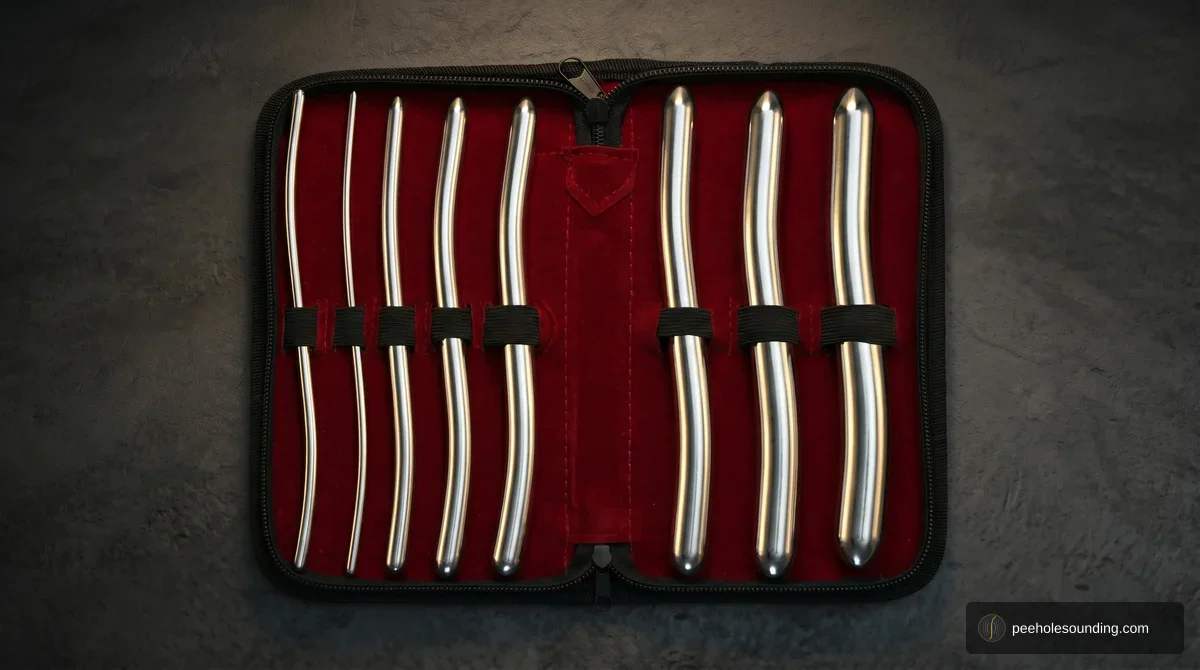
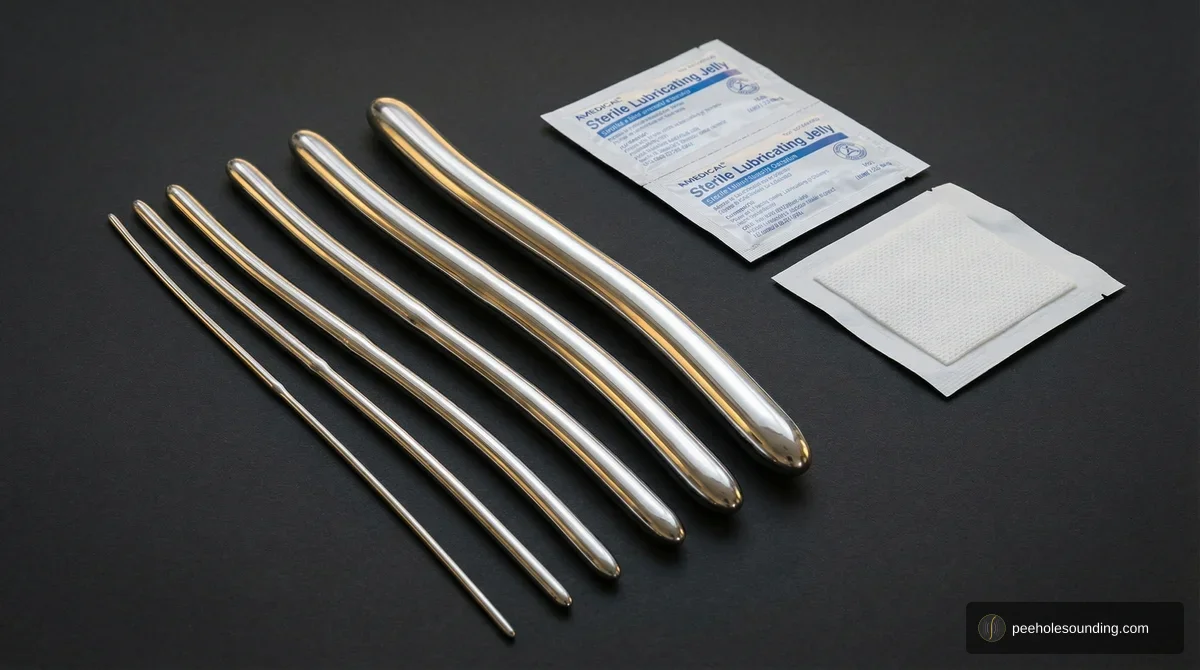
If you're buying one thing, buy a Hegar set in surgical stainless steel. Hegar sounds are dual-ended, with a different diameter at each end, and the sizes step up in small increments of roughly 1/64 inch. That means an 8-piece set gives you 16 usable diameters in fine gradations, far more resolution than the piece count suggests.
The alternative is a silicone tapered set, and it's a genuinely good first choice if steel intimidates you. Silicone flexes. If you catch a bad angle, it bends instead of pressing into the urethral wall.
Here's the honest trade-off on each:
- Hegar steel. Precise, fully sterilizable, heavy enough to slide in under its own weight. Unforgiving of a bad angle, and cold until it warms up.
- Silicone taper. Forgiving and less intimidating. Compresses slightly under pressure, so the stated diameter feels a bit larger going in, and some silicone can't be boiled.
One thing to know before you compare piece counts: steel and silicone are not sold in the same sizes. Steel Hegar sets routinely come in 8 pieces. The name-brand silicone sets, the ones that actually state their material, are mostly 3-piece. The 6-, 7- and 8-piece silicone kits I can find come from dropship shops whose listings usually will not say what the silicone is. So for steel, look for 8 or more pieces. For silicone, take the 3-piece set that names its material over the 8-piece set that does not.
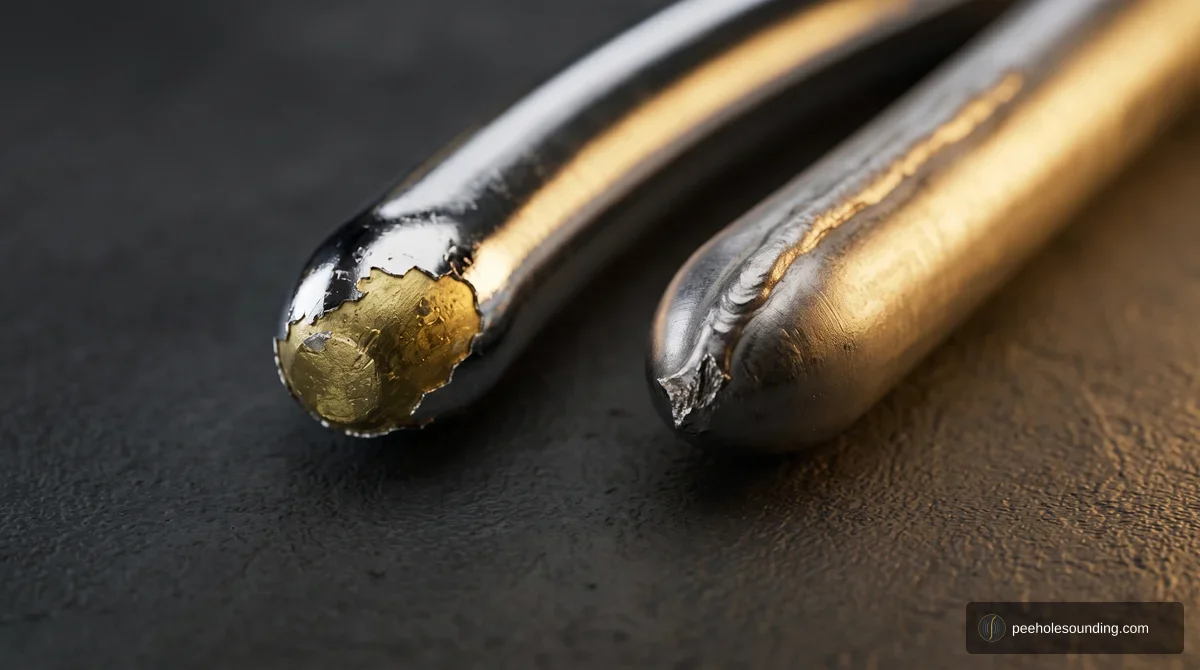
Then check the finish. Run your fingertip along the whole length of every rod before it goes anywhere near you. Any burr, seam, ridge, or plating chip you can feel with a fingertip is a rod you don't use. For the full breakdown of every sound type and material, see my guide to sounding toy types, and for the Hegar family specifically, Hegar sounds explained.
What diameter to start with
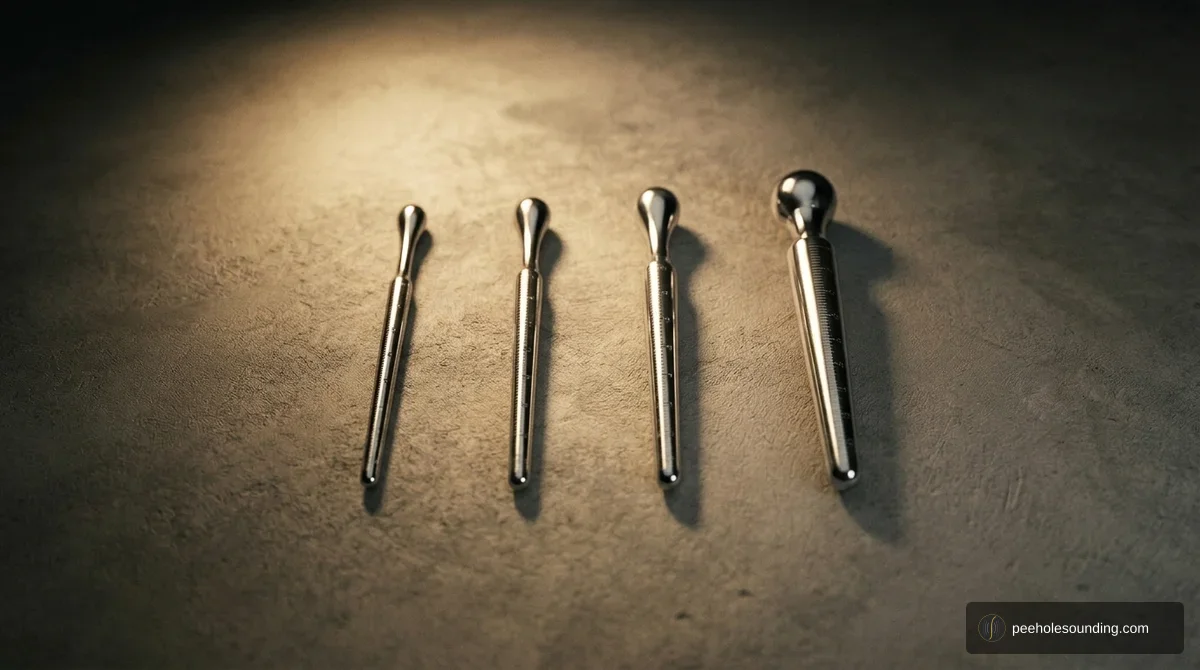
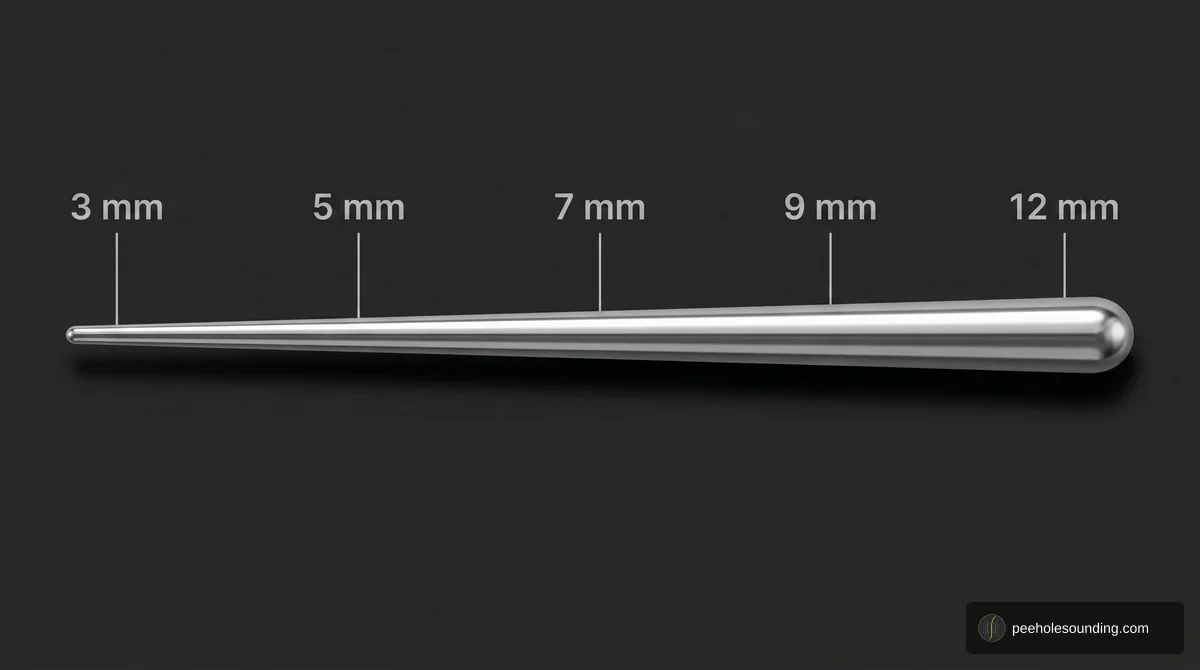
Start at 3-5mm, which is 9-15 Fr, or roughly 1/8 to 3/16 of an inch. French gauge (Fr) is the sizing system stamped on most sounds. It's simply the diameter in millimetres multiplied by three, so 9 Fr is 3mm and 15 Fr is 5mm. Higher number, thicker rod.
Now the part almost nobody selling you a kit will tell you: do not start with the thinnest rod in the set.
It feels like the cautious choice. It isn't. A very thin sound concentrates all of its force onto a tiny contact area, which makes it far easier to scrape the urethral wall or push into it rather than through it. A slightly thicker sound spreads that same pressure around the full circumference of the urethra and practically guides itself along the channel. Below about 3mm (9 Fr) you're into diameters that are used medically with camera guidance, and they have no place in a recreational first session.
You're looking for snug but sliding: a clear sensation of fullness, smooth movement with plenty of lube, and no sharp pressure or straining anywhere. If you have to push, the rod is too thick. If it rattles around, it's too thin.
I bought my first Hegar set off Amazon with no idea what size to start with. I went straight for the rod that roughly matched my urethral diameter, figuring that was the logical move. It was way too much, and I shelved the whole kit for a month before coming back to the smaller end of rod 2. The mistake I nearly made next was the opposite one: assuming that if too thick was that unpleasant, the skinniest rod in the tray must be the safe bet. It isn't, for the reason above. Somewhere in the middle is where you want to be, and a graduated set is what lets you find it without buying twice.
For a walkthrough of picking your specific starting size, see what size sounding rod to start with. For every Fr to mm to inch value in one table, use the sounding rods sizes chart.
Sterile, single-use lubricant
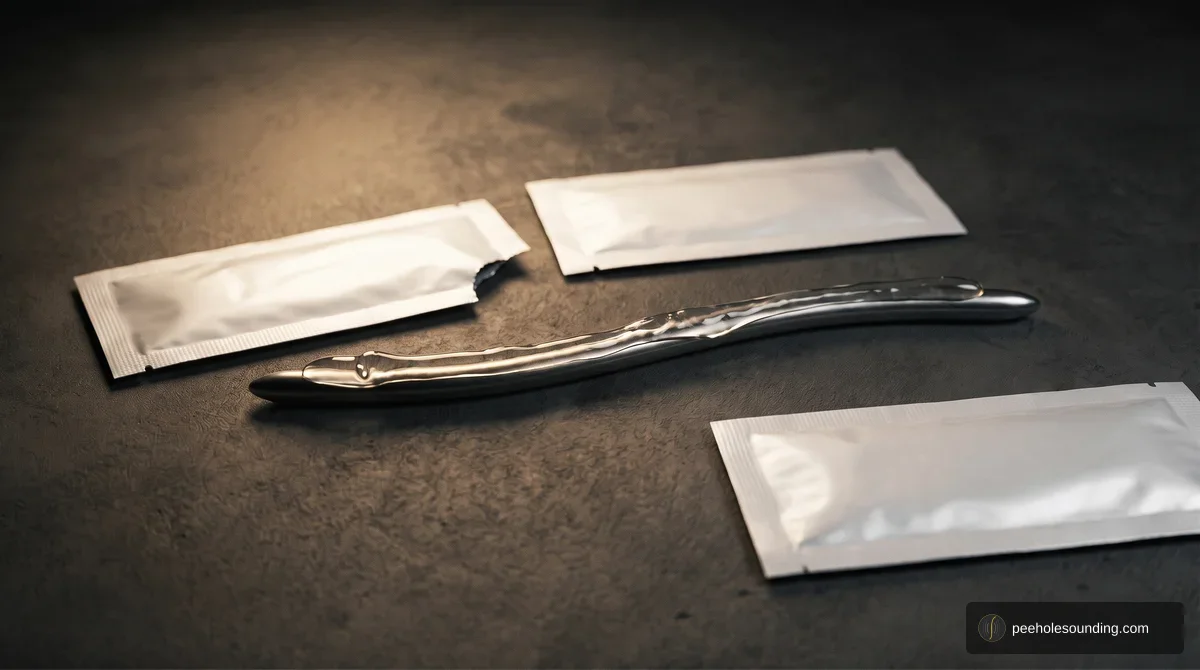
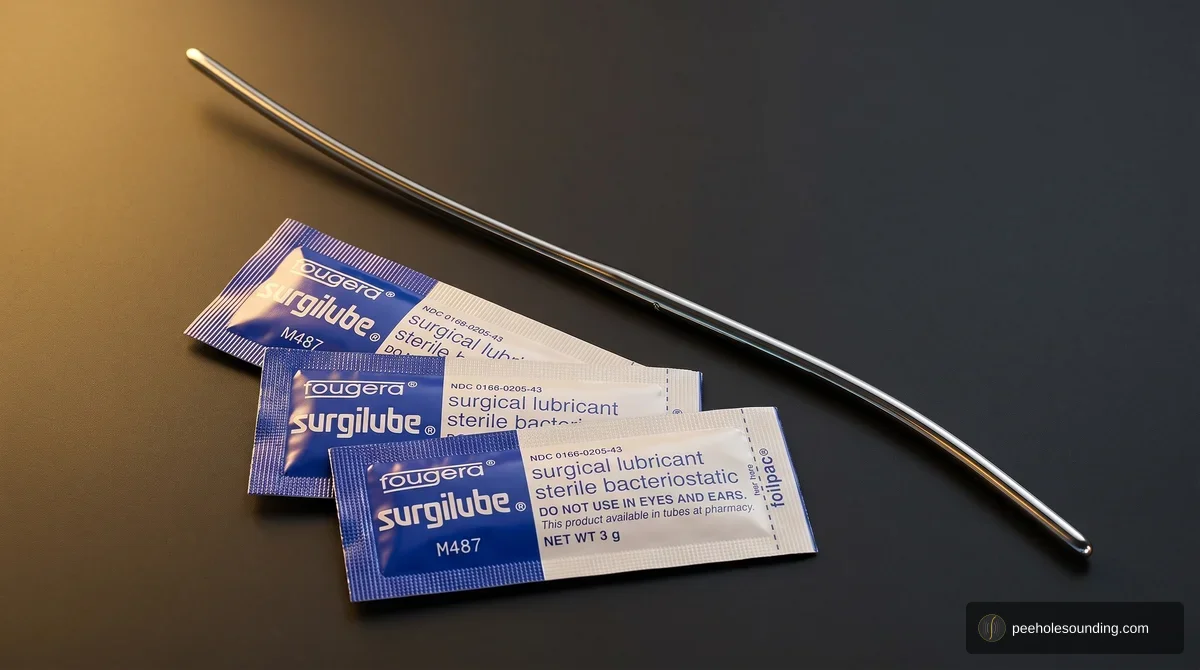
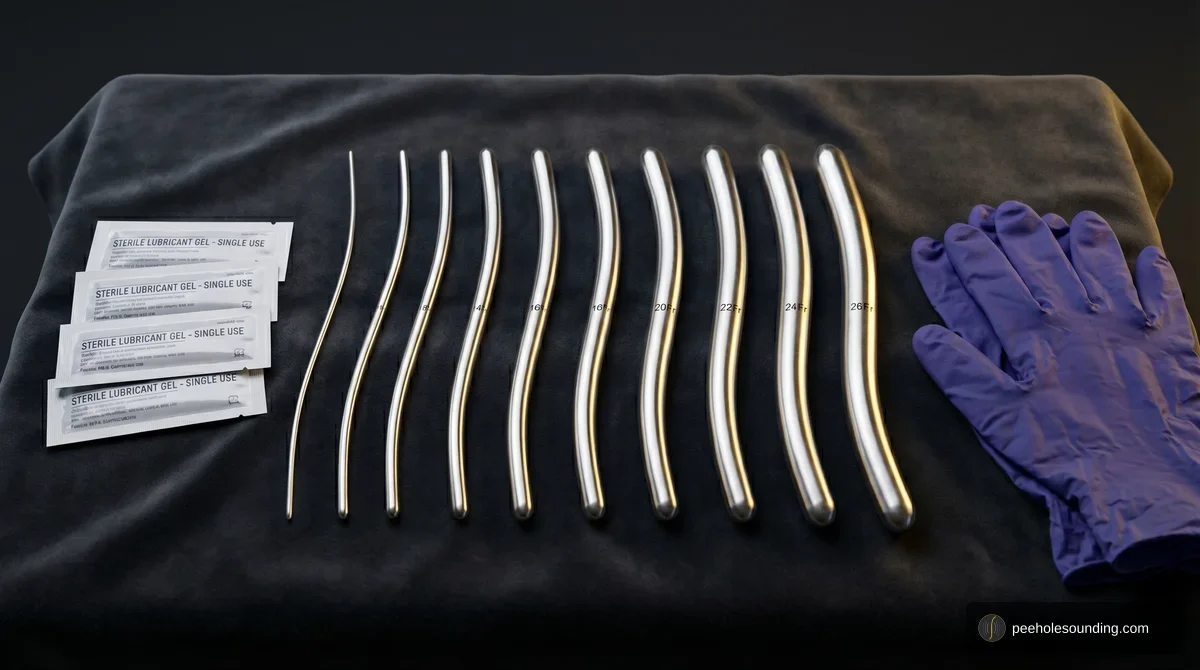
Buy sterile, single-use, water-based lubricant in individual packets. All three words matter, and the packets matter as much as the contents.
Sterile rules out every bottle of personal lube in your bedside drawer. Those aren't sterile, and the urethra runs directly to your bladder. Water-based keeps it compatible with both steel and silicone. Single-use is the one people skip: the moment you uncap a tube, air and surfaces get in, and it stops being sterile for every session after the first. Sachets sidestep that entirely.
Disqualify anything containing glycerin, fragrance, flavouring, or a numbing agent. Numbing is the genuinely dangerous one. Pain is the feedback telling you to stop, and switching it off means you find out about the damage afterwards instead of during.
Watch for one pricing trap here. Both of the kink shops I checked sell sterile lube in tubes only, and a 2oz tube at around $12 looks cheaper than a $19 box of sachets. It is not the same product. The tube stops being sterile the moment you open it, so you are comparing one sterile session against 144 of them.
You cannot use too much. Coat the full insertable length of the rod, put some at the urethral opening, and then add more. My picks and the reasoning behind them are in best lube for sounding.
How you will sterilize it
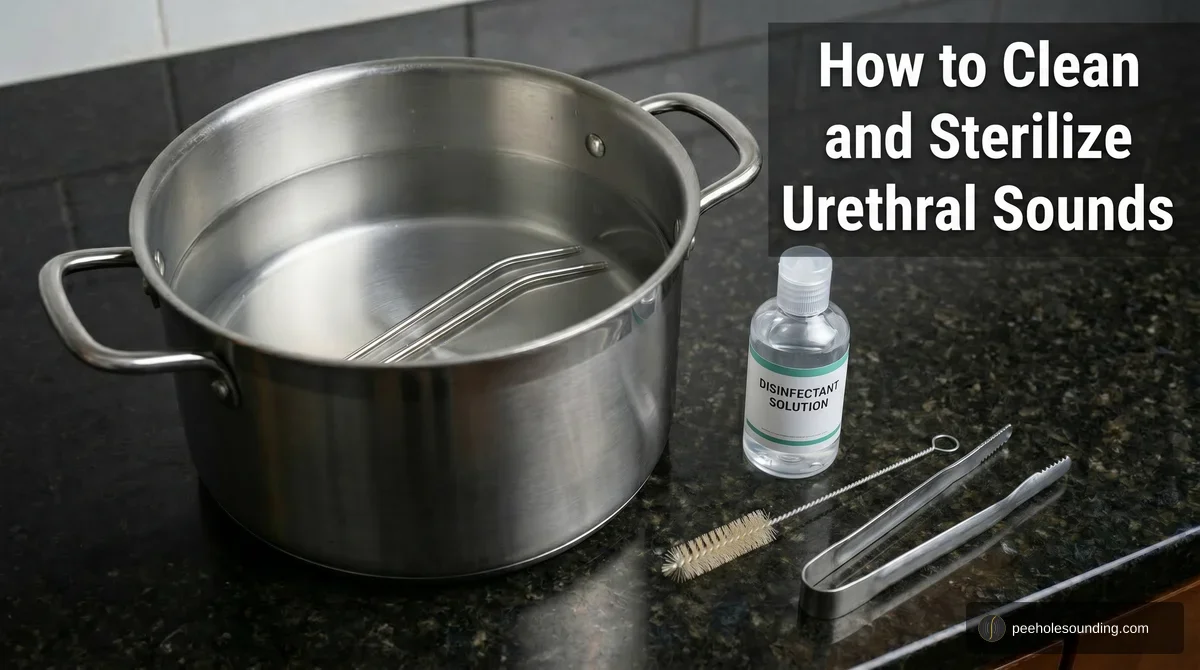
This is the part every competing page skips, so here it is plainly. Soap and water is cleaning. It is not sterilizing. You need both, and you need them before every single session.
- Steel: boil for 10 minutes in a dedicated pot, or pressure cook at 15 PSI for 15 minutes.
- Silicone: check the manufacturer's instructions. Some silicone boils fine and some degrades, and there's no universal answer.
The reason to hold your kit to that standard: the CDC classifies instruments that contact mucous membranes as semicritical devices requiring high-level disinfection at minimum before reuse (CDC guideline on disinfection and sterilization). Your urethra is a mucous membrane. That's the bar. Every method in detail, including chemical options, is in how to clean and sterilize urethral sounds.
The gear itself is cheap: a small stainless pot you use for nothing else, or a pressure cooker if you already own one. That's the entire purchase.
The cheap things people forget
None of these cost much, and they're the difference between a smooth first session and a fumbling one:
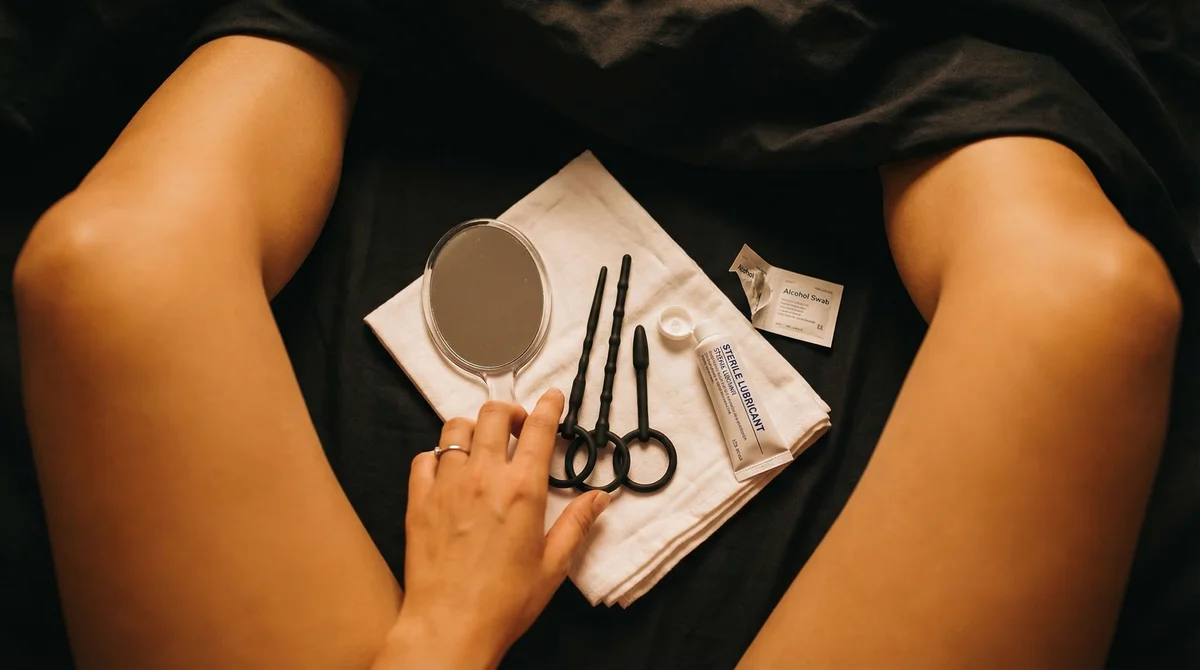
- Nitrile gloves. Keep your hands' bacteria off a sterilized rod, and make a lubricated sound much easier to hold.
- A freshly laundered towel. This is your sterile field. Lay everything out on it before you start.
- A handheld mirror. Not optional if you have a vulva. The urethral opening is small and genuinely hard to locate the first few times.
- Somewhere to pee afterwards. You'll want to urinate soon after, and that means being somewhere you can.
Set all of it out before you begin. Once your hands are lubricated and a rod is sterile, you don't want to be opening drawers.
Sounding kit, sounding rod kit, sounding set: what the labels mean
These are all the same product under different names. “Sounding rod kit”, “sounding set”, “urethral sounding kit”, and “sounding starter kit” are retailer vocabulary, not distinct product categories. Don't pay more for a word.
What genuinely differs between sets, and what's worth checking before you buy:
| What to check | Why it matters |
|---|---|
| Piece count | 8+ gives you room to progress without buying twice |
| Diameter range | You want your starting size comfortably inside the range, not at its edge |
| Dual-ended or single | Dual-ended doubles your usable diameters for the same piece count |
| Material and grade | Surgical stainless steel or body-safe silicone. If the listing won't say, that's your answer |
| Finish quality | Seams, burrs and plating are where injuries come from |
The instrument-family names you'll see on listings are worth knowing, because they describe shape rather than quality:
- Hegar. Dual-ended, gently curved, fine increments. The default first set for good reason.
- Dittel (spelled “Dittle” in some shop listings). Short and straight, uniform diameter. Easy to control, limited depth.
- Hank. Longer, with a tapered tip and a raised stop collar that physically limits how far it can travel. A reasonable step up once you know what depth you want.
- Pratt. Longer and more curved. Not a beginner shape.
- Van Buren. Pronounced curve, designed to reach the prostate. Definitely not a first purchase.
- Rosebud. Bulbed, textured. An experienced-user toy.
If a set is described only as “urethral dilators” with no family name and no material spec, treat it as unverified.
What to skip, and why
Knowing what not to buy saves more money, and more urethras, than any recommendation I can make.
Chrome-plated or brass sets. The plating chips and pits, and a lifted plating edge inside the urethra is exactly the injury you are trying to avoid. You often cannot see the damage until it is already sharp. These are not cheap fringe products: chrome-plated brass Hegar and Pratt sets sit on major kink retailers' shelves at around $70 and $100, described as premium. Buy solid surgical stainless or silicone instead.
Any set that will not name its material. No stated grade means no way to verify the finish, and finish is the whole safety story on a metal rod. Seams and burrs cause injuries, mystery alloys cause reactions. As above, price is not a proxy for a spec. See safety protocols and risk mitigation for what to inspect.
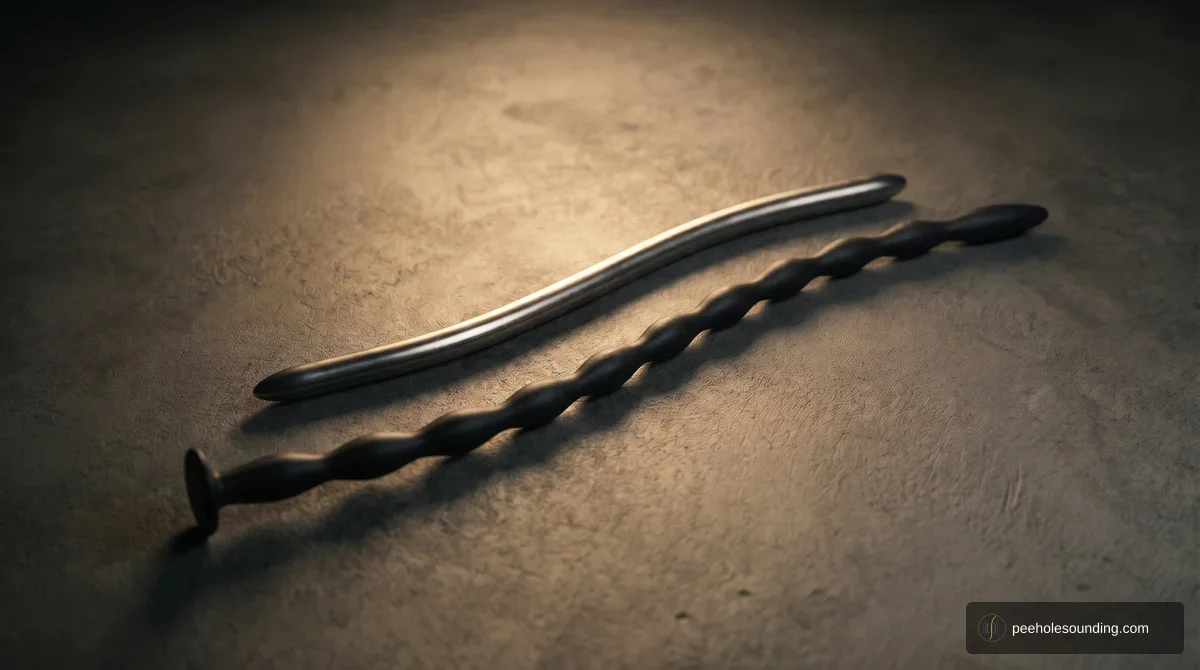
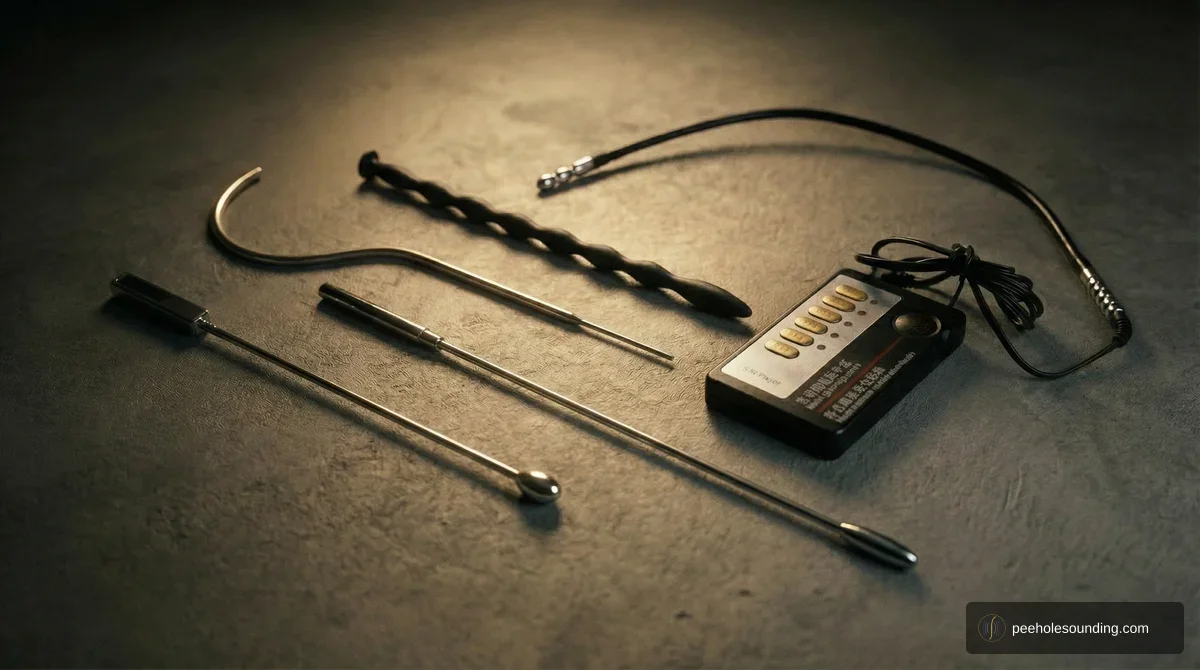
Ridged, beaded, spiral or screw-shaped sounds. Texture concentrates pressure at every raised point instead of distributing it.
Aggressively curved sounds. Van Buren and similar shapes are built to reach specific internal structures. Reaching for one before you know how your own anatomy responds is how people end up explaining themselves in an emergency room.
Vibrating or e-stim sounds as a first buy. Two unfamiliar variables at once, and neither is the one you should be learning. My own first sounding toy was a thick silicone vibrating one I grabbed off Amazon with no research, and it went badly: too thick, too much stimulation, no real idea what I was doing. Even ElectraStim, a company that exists to sell e-stim gear, tells beginners on its own site to start without it and buy a traditional set first. When the vendor says wait, wait.
Numbing or desensitizing lube. You need the feedback.
Household objects. Pens, thermometers, cutlery, cables and improvised rods share three problems: unfinished ends you cannot deburr, porous or unknown surfaces you cannot sterilize, and no flare or safe length, which is how objects get lost inside the urethra and become a surgical problem. A basic set costs less than the copay.
That vibrating sound was not the only money I wasted in year one. There was also a textured “progressive” set I used exactly twice, scented lube that had no business near a urethra, and a storage case I did not need. The plain Hegar set I bought once I knew better is the one I still use.
What a complete first kit costs
The useful thing to understand isn't the exact figure, it's the proportion. Almost all of the money should go into the sounds themselves. They're the item touching mucous membrane, they're the item where finish quality determines whether you get hurt, and they're the item you'll still own in ten years.
| Component | Where it sits in the budget |
|---|---|
| Graduated sound set | The large majority of the total. Spend here. |
| Sterile lube sachets | Small, recurring. Buy a box, not a handful. |
| Sterilization pot | One-off and cheap, or free if you dedicate a pot you own. |
| Gloves, towel, mirror | Trivial. Don't optimize this. |
| Branded “toy cleaner” | Skip entirely. It doesn't sterilize, and boiling does. |
| Storage case | Optional. A clean sealed container works. |
Here is what the four things actually cost, checked across kink retailers, medical suppliers and general retail in July 2026. Treat these as bands, not quotes, because stock and sales move constantly.
| Component | Typical band (USD) |
|---|---|
| 8-piece steel Hegar set, kink retailer | $63 to $140, most sitting $63 to $80 |
| 8-piece steel Hegar set, surgical-instrument supplier | $22 to $44 |
| Graduated silicone set | $29 to $53 |
| Sterile single-use lube sachets, box of 144 | $19 to $37, about $0.13 to $0.26 each |
| Small stainless pot for boiling | under $30 |
A minimum viable first kit lands between roughly $60 and $130. The low end is a surgical-supplier steel set, a box of generic sterile sachets, and a cheap dedicated pot. The high end is the same kit bought entirely from a kink retailer with brand-name lube.
Three sensible tiers: a minimum viable kit is one silicone or steel set plus a box of sterile sachets plus a pot you already own. A comfortable kit adds gloves, a mirror, and a second set in the other material once you know which you prefer. A long-term kit is a pressure cooker and a wider steel set, and that's a purchase for year two, not week one.
Price tells you nothing about material
This is the part that surprised me when I went and checked current listings, and it is the single most useful thing in this section.
The most expensive 8-piece set I could find anywhere does not state its material at all. It is comfortably the priciest option on the market and the listing simply never says what the metal is. Meanwhile a set sold around $70 as a premium Hegar kit at a well-known retailer is chrome-plated brass, not stainless steel, which puts it on the skip list below. The two shops I found selling genuinely specified 316 or 316L stainless sit in the low $60s, cheaper than both.
It gets worse with silicone. The same set, same manufacturer, same UPC, is about $29 at one shop and about $53 at another.
So the rule is not "spend more" and it is not "spend less". Read the spec. A stated alloy grade of 316 or 316L is the thing worth paying for, and it does not correlate with price. If a listing will not name the material, the price is irrelevant, because you do not know what you are buying.
Steel or silicone for your first kit
If you're nervous, buy silicone. If you want precision, buy steel. Both are legitimate first kits and the failure modes are simply different.
Silicone flexes. Angle it wrong and it bends rather than pressing into tissue, which is a real safety margin while you're still learning where your own urethra goes. The costs: it compresses slightly under pressure so a given diameter feels thicker going in, it has more surface friction so you'll use more lube, and sterilization depends on the specific product.
Steel is rigid and honest. The stated diameter is exactly what you feel, it's heavy enough to descend under its own weight so you never have to push, and being non-porous it sterilizes completely by boiling. That rigidity is also the risk: it doesn't forgive a bad angle.
Most people I know landed on steel eventually, and I did too. The gravity-fed insertion and the precise feedback are hard to give up once you've felt them. But I'd still hand a nervous first-timer silicone, because the mistake silicone lets you make is one you recover from in seconds.
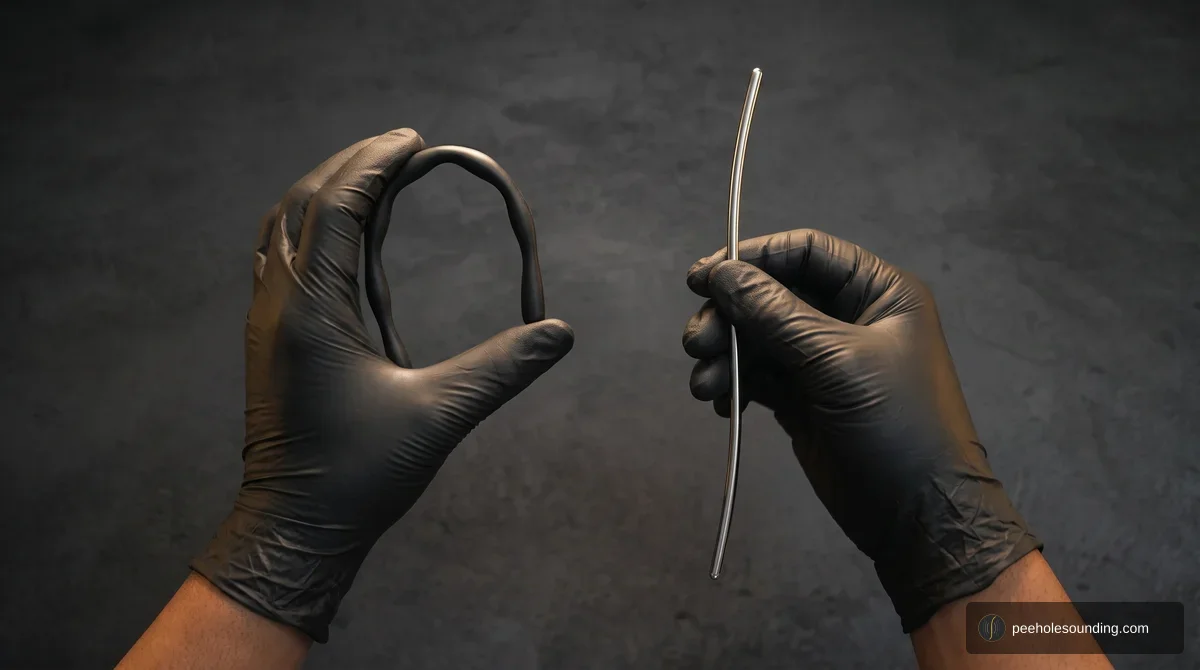
What to use for female sounding
The kit is nearly the same, with three adjustments. The female urethra is much shorter, so length stops mattering and control starts mattering more.
- Choose shorter sounds. Length you can't use is length that gets in the way. Dittel-style short straight sounds suit this better than long curved instruments.
- Start at the lower end of the beginner band. Same 3-5mm (9-15 Fr) range, lower end first.
- The mirror is essential, not optional. Locating the urethral opening is the genuine difficulty of the first few sessions, and it sits between the clitoris and the vaginal opening. Good light helps as much as the mirror.
Everything else is identical: sterile single-use lube, sterilization protocol, gloves, going slow. The full anatomical walkthrough is in my female urethral sounding guide.
Before your first session: the five-minute run-through
This is a kit-readiness check, not a technique lesson. If you can do all seven of these with what you bought, your kit is complete. The actual insertion mechanics live in how to insert a urethral sound, and the full first-session walkthrough is in my beginner sounding guide.
- Sterilize the sounds you plan to use, by the method your material requires.
- Lay out your sterile field: the clean towel, with everything you need on it.
- Wash your hands thoroughly, then put on nitrile gloves.
- Empty your bladder. Do this before, not during.
- Lubricate generously: the full insertable length of the rod, plus the urethral opening.
- Pick the smallest appropriate size, which is inside the beginner band and not the thinnest rod you own.
- Stop at resistance. Never push through it. Resistance means back off, add lube, or size down.
Then urinate afterwards. It helps flush the urethra, and a little stinging on that first pee is common.
When to stop, and when to see a doctor
Stop immediately if you hit sharp pain, resistance that doesn't yield, bright red blood, or if you lose your grip on the sound. None of those are “push through it” signals. A small amount of pink-tinged urine after a first session isn't unusual; bright red blood means you're finished for the day.
See a doctor if you have bleeding that doesn't stop, a fever, an inability to urinate, or burning that's still there after 24 hours.
Go to an emergency room if a sound is retained and you cannot retrieve it. Tell them exactly what happened. It feels mortifying and it is genuinely the right call. They have seen it before, they will not be surprised, and delay is what turns this into a serious problem. Retrieval is straightforward when it's early.
I'm not a doctor, and when something feels wrong the answer is always to see one. But almost nothing on that list happens to people who bought a graduated set, stayed inside the beginner band, used sterile lube, and stopped at resistance. The kit is most of the safety.
Frequently Asked Questions
Related Guides
What Size Sounding Rod Should Beginners Start With?
Mar 15
Sounding Rods Sizes Chart: French Gauge to mm to Inches
Apr 28
Best Lube for Sounding: Sterile Picks That Actually Work
Apr 20
How to Clean and Sterilize Urethral Sounds
Mar 20
Sounding Toy Guide: Types, Materials & How to Choose
Mar 10
Hegar Sounds: Sizes, Full mm/Fr Chart & How to Choose
Apr 12
Urethral Sounding for Beginners: Sizes & First Session
Apr 5
Female Urethral Sounding: Beginner Techniques & Safety
Mar 30
Is Sounding Safe? Sounding Safety Protocols & Risks
Mar 5
How to Insert a Urethral Sound (Step-by-Step)
Mar 25