Chastity Sounding: How a Cage and a Urethral Insert Actually Work Together
Chastity sounding explained: the three insert types, how you urinate with one locked in, how long it can safely stay, and the risks that rarely get spelled out.
 By Kevin Voss
Chastity sounding combines a chastity cage with a urethral insert (a solid plug, a hollow tube, or a catheter-style rod) so the wearer is locked out of erection and occupied internally at the same time. The insert type decides everything practical: whether you can urinate without unlocking, and how long the device can safely stay in.
The practical question, how do I pee, is a hard one to get answered. Most of what is written about it explains the appeal (an insert deepens submission, hands your keyholder another layer of control) and then stops. What happens at three in the morning is left to you to work out.
So this is the practical half: the three device types, how urination works with each, how long one can stay in, and what goes wrong. Why the kink appeals at all is covered in the sounding kink guide.
Medical Disclaimer: This content is for educational purposes only and is not a substitute for professional medical advice, diagnosis, or treatment. Always consult a qualified healthcare provider before starting any new practices.
What Chastity Sounding Actually Is
A chastity cage stops erection and access from the outside. A urethral insert occupies the urethra from the inside. Together you get control the wearer cannot undo, from two directions at once.
The three device classes
Almost every argument about chastity sounding is really about which of these three you have. They behave differently, carry different risk, and suit different people.
The difference that decides everything practical is where urine can go. In each diagram below, the bladder is on the left and the meatus on the right:
Solid. No channel through it: maximum sensation, and no path for urine. It comes out every time you need the bathroom.
Hollow and cum-through. An open lumen runs the length, so urine and semen pass through. This is what makes wear, as opposed to a scene, possible at all. Slower flow: sit down.
Catheter-style. A longer, thinner tube that drains continuously, so it never needs unlocking. Fine for a session, different once it stays in, so it gets its own section below.
How this differs from an ordinary sounding session
Two things. Continuous occupancy: a normal session has an end you choose, and locked wear removes the ending. The device stays in through work, sleep and showering, so time becomes the main variable.
And you can't take it out on impulse. In ordinary sounding, the response to this feels wrong is to stop. Locked, your response time depends on where the key is. Everything below is downstream of that.
How You Actually Urinate With an Insert in a Locked Cage
It depends entirely on which of the three you have, which is why this matters more than material, price or looks when you buy.
Solid inserts: why they force a schedule
A solid insert has no channel, so no urine gets past it. That's not a design flaw; for a lot of people it's the entire appeal, because being unable to pee without permission is the dynamic they want.
But it has a consequence that usually goes unsaid: a solid insert must come out every time you need the bathroom. Not "should", not "ideally". Which means it isn't a wear device at all, but a scene device that happens to live in a cage. If you're picturing a locked-away week with a solid plug in, the picture is wrong.
Hollow and cum-through inserts
A hollow insert has an open lumen, so you can urinate with it in. That is what makes extended wear possible at all.
Flow is slower and less predictable. You're passing urine through a narrow tube, and the stream goes wherever the device points. Sit down.
Bore diameter matters and nobody lists it. A wider channel flows better, clogs less, and is easier to clean. Between two hollow inserts, take the one with the bigger hole.
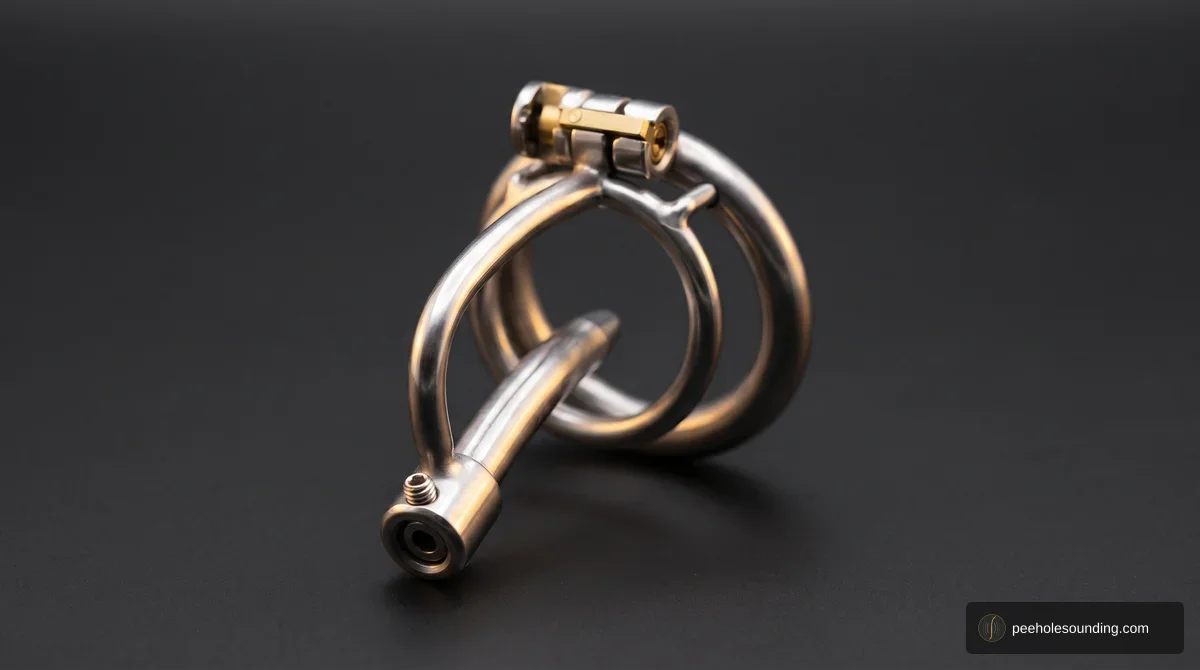
Catheter-style and continuous drainage
These drain continuously instead of being something you urinate through on demand. That removes the bathroom problem entirely, which is why people want them for long wear. For a session they behave much like deep sounding; it is continuous wear that changes the picture, and that section covers why.
| Insert type | Can you urinate? | Realistic wear window | Cleaning access | Suits |
|---|---|---|---|---|
| Solid | No, must be removed | A scene, not a wear | Full, on removal | Scenes with a present keyholder |
| Hollow / cum-through | Yes, sitting, slower flow | Hours to overnight | Limited while locked | Most people wanting genuine wear |
| Catheter-style | Continuous drainage | Session fine, continuous is the risk | Very limited | Experienced, and informed about indwelling risk |
For the hardware itself, the penis plugs guide covers shapes and materials. This page is about what happens after it's in.
How Long Can You Actually Wear One?
The honest answer first: nobody has studied this practice specifically, and anyone who gives you a confident number is guessing. There is no clinical trial of recreational inserts worn under chastity devices, and never will be. Any page telling you "up to X days is fine" invented X. What we have is the mechanism.
Why time is the variable that matters
Put an object in the urethra and bacteria begin colonising its surface, building a structured layer called a biofilm. This isn't slow. In a study of patients with indwelling urinary catheters, biofilms were detected as early as several hours of indwelling time. Once established, a biofilm is substantially harder to clear than free-floating bacteria, and it doesn't care whether the device is a hospital catheter or a steel plug.
For indwelling urinary catheters, duration of catheterisation is the single most important risk factor for infection, with a daily urinary tract infection risk of roughly 3 to 7 percent. In one cohort, 15% of patients catheterised for three days developed a UTI, against 68% of those catheterised for eight days.
Now the caveat, because those numbers shouldn't do work they can't support. That data comes from ill, often elderly hospital patients with a closed sterile drainage system in place. You are not that patient, and the absolute percentages do not transfer to you. A healthy adult wearing a clean insert overnight is not running 3 to 7 percent odds of infection.
What does transfer is the shape of the curve. Risk from an indwelling device is a function of time, and it isn't linear: three days to eight was far more than double. That's why "a few days to weeks" is a bad answer. Not because I have a better number. Because nobody does.
Session wear, under an hour
This is the ordinary case, and where I'd point almost everyone. The rules are those of any sounding session (sterile equipment, generous lube, nothing forced), all in the safety protocols guide. At this duration technique is the concern, not infection.
Overnight
The first real threshold, and where "several hours" stops being academic. Overnight should be hollow only: a solid insert means either you don't urinate for eight hours or you get up and unlock.
Go in scrupulously clean, drink enough to flush the system, and pay attention to how you wake up. Mild awareness is expected. Burning, urgency, or pain that wasn't there when you went to sleep means it comes out and stays out.
Continuous and multi-day wear
I have done this, so here is what it was actually like. My longest stretch ran five or six days, with a hollow insert, taken out every day to clean properly and give the tissue a rest before it went back in. No infection, nothing that needed a doctor.
What I did get was soreness. Nothing dramatic, but by the third day there was an irritation that hadn't been there on the first, and it built rather than settled. That is the thing to watch, and it is why the daily removal isn't optional: it is the only moment you can see what is happening before it becomes a decision made for you.
A chastity retailer publishes the same rule I arrived at on my own: if you're wearing continuously, the device comes out at least once a day. They publish it without the reasoning. Daily removal interrupts the biofilm clock and gives you a checkpoint where you'd notice a problem developing. If your arrangement makes that impossible, change the arrangement.
One person coming through it fine is not a safety guarantee. It is a single data point, and the part worth attention is the soreness, not the absence of infection.
What the shops get wrong about this
The most-read answer anywhere says "anything from a few days to weeks at a time can be too long", hedged straight back to your body and your tolerance. I don't think that's malicious, but it frames weeks of continuous occupancy as an upper bound rather than a different category of risk, offers no mechanism, cites nothing, and has not been updated since 2018. On the single question people most want answered, that is not enough to go on.
Does It Hurt, and How Risky Is It Really?
Does it hurt? Done properly, no. Pressure, fullness, a distinct awareness of being occupied, not pain. For a lot of people that constant awareness is the point; it's arousing precisely because it doesn't let up. How risky is it? More than an ordinary session, and the extra risk comes almost entirely from duration rather than insertion.
What it should not feel like: sharp pain, burning, stinging when you urinate, or anything that worsens rather than settles. Discomfort that escalates is your signal to stop, and being locked is not a reason to wait it out.
The real risks, roughly in order of likelihood
Urinary tract infection. By far the most likely, and the one that grows with wear time.
Irritation and micro-trauma. A rigid object against the same tissue for hours creates pressure points. Usually soreness or a spot of blood, resolved with rest, but it stacks up.
Migration and retention. An insert without a flared base or retaining ring can move inward. This is the one that ends in an emergency room, and it's preventable at purchase: never wear anything internally without a secure external stop.
False passage. Rare, and a risk of forcing during insertion rather than of wear. The safety protocols guide covers it.
The erection problem nobody warns you about
You get erections in your sleep, several times a night, and you have no say in it. A chastity cage is designed to prevent erection. Now put a rigid insert inside the urethra of a penis trying to become erect inside a cage that won't let it.
That plays out while you're unconscious, and it's the most common reason a first overnight ends badly. It argues for a shorter, less rigid insert, a cage that fits properly rather than tightly, and treating your first night as an experiment you might abandon at 2am.
What Size, and How Deep
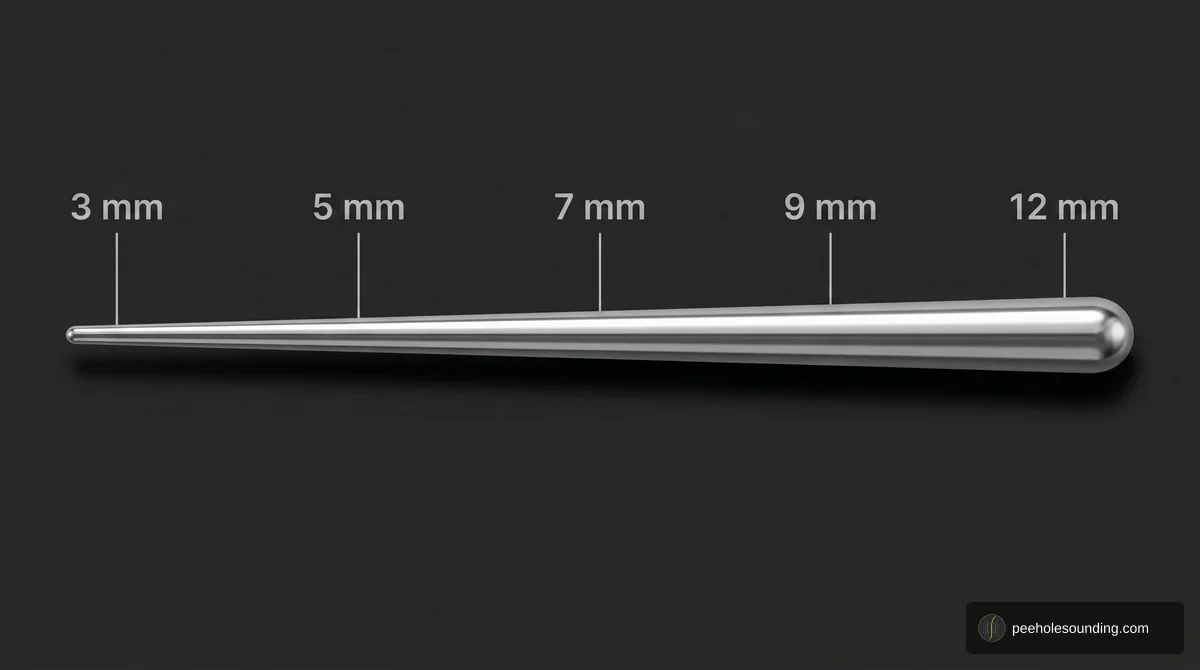
Urethral devices are sized in French gauge (Fr): Fr ÷ 3 = diameter in millimetres, so a 12 Fr insert is 4 mm across, a shade over 5/32 of an inch.
A comfortable beginner range is roughly 3 to 5 mm (9 to 15 Fr, about 1/8 to 3/16 of an inch). For wear, stay at the smaller end of what you take comfortably in a session: what is pleasurable for twenty minutes can be painful after six hours.
| French gauge | Diameter | Inches | Typical use for wear |
|---|---|---|---|
| 9 Fr | 3.0 mm | ~1/8” | Where the beginner range starts. Minimal sensation, easiest to wear |
| 12 Fr | 4.0 mm | ~5/32” | Common beginner size, and a sensible first insert to leave in |
| 15 Fr | 5.0 mm | ~3/16” | Top of the beginner range. Noticeable, still reasonable overnight |
| 18 Fr | 6.0 mm | ~1/4” | Intermediate. Fine for a session, a lot to wear for hours |
| 24 Fr | 8.0 mm | ~5/16” | Experienced session use only, not a wear size |
The sounding rod size chart has the full range, and what size sounding rod covers choosing a first one.
One warning on units. Sizes get quoted in inches, millimetres and French gauge across different shops, and the conversions get mangled often enough that you will run into figures that cannot be right. French gauge is the one to trust, and if a number looks impossibly large it is almost always a length being reported as a diameter.
On depth: a wear device should be shorter than a session sound. More length means more tissue contact, more pressure points, more to go wrong while you're asleep.
Hygiene When You Cannot Take It Out
Every competing page tells you to maintain good hygiene, then describes cleaning a device that has been removed. The actual problem is the other one.
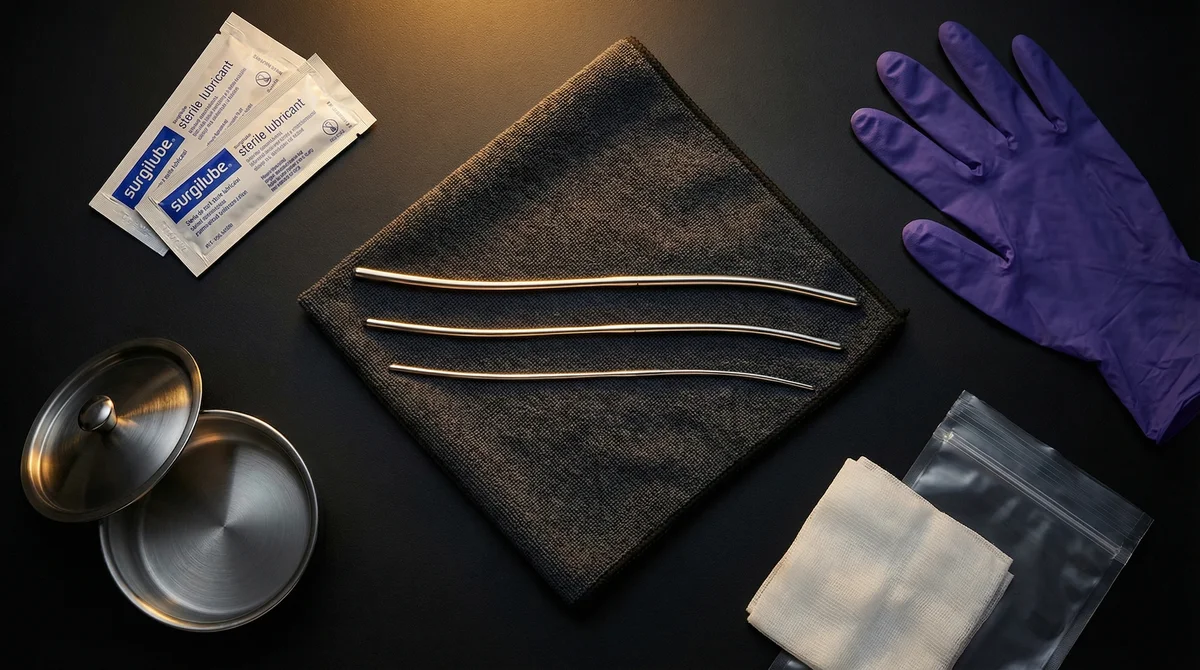
Going in, the standard is the same as any sounding session: sterilised insert, clean hands, glans and meatus cleaned, plenty of sterile lubricant. The cleaning and sterilisation guide has the protocols.
While it's locked on, shower daily and dry properly. What you can't do is clean the inside of the insert or the tissue it sits against. Plan around that, which mostly means drinking more water than you normally would: urine flow is the body's own flushing mechanism, and once a foreign surface is in the urethra, keeping that flow going is the one hygiene measure still available while locked.
Between wears, rest periods aren't optional extras. Every removal is a chance to clean the device properly and let irritated tissue recover before it turns into damaged tissue.
Catheter Chastity
Catheter chastity means a tube that sits further into the urethra than a plug and drains continuously, so the wearer never needs unlocking to urinate. Some designs run to the bladder.
For a session, it is close to deep sounding
Used for an hour and then removed, a catheter-style device is not a different practice from going deep with a sound, and it does not carry a different risk profile. It reaches further than a plug, so it asks what depth always asks: sterile equipment, an unhurried insertion, nothing forced, and stopping the moment anything turns sharp rather than full. How to insert a urethral sound covers that technique, and people meet that bar routinely.
The appeal is worth saying plainly too: it removes the last practical reason the cage ever has to come off.
What changes when it stays in
The risk is not in the device. It is in leaving it there.
Go back to the clinical evidence above: the 3 to 7 percent daily infection risk, 15% at three days against 68% at eight. That data is specifically about indwelling catheters, which is this device left in place rather than used and removed. Those catheters were placed by trained clinicians, using sterile technique, into a closed drainage system. Each of those is a reason the numbers weren't worse, and none are present in a bedroom.
So a session is fine on the same terms as any deep session. Days on end is the part with published numbers behind the warning, and the only part I would tell someone to think hard about.
If you are going to wear one continuously
You're an adult and it's your body. So, harm reduction rather than a lecture:
- Sterile, single-use equipment only. Not sterilised-at-home, not reused.
- Set a hard time limit before you start, agree it with your keyholder, and treat it as a ceiling rather than a target.
- Know the symptoms that end it immediately: fever, chills, back or flank pain, cloudy or foul-smelling urine, blood, or any inability to pass urine.
- Have a plan to reach a doctor that doesn't depend on your keyholder being reachable.
The Downsides You Only Find Out Later
Cleaning is relentless, a daily commitment rather than an occasional chore. It constrains your life: sitting to urinate, planning bathroom access, knowing a problem at work is one you can't immediately solve. Cheap hardware matters here, because surface finish stops being an aesthetic question in something inside your urethra for hours. Sizing mistakes are expensive, and you find them out hours in.
The keyholder question
If someone else holds the key, they hold your ability to respond to a medical problem. That's not dramatic framing, it's what the arrangement is.
Negotiate an unlock-on-symptoms rule before anything gets locked, and make it unconditional: not a favour, not something earned back, and explicitly not part of the game. A keyholder who won't agree in advance has told you how they'll behave when it matters. The sounding kink guide goes deeper on negotiating this kind of play.
When to Stop, and When to See a Doctor
Stop and remove the device now if: sharp or escalating pain, bleeding beyond a single spot, you cannot pass urine, or the insert has moved inward and you can't reach its base.
Get same-day medical care if: fever or chills, pain in your back or side, cloudy or foul-smelling urine, burning that persists after the device is out, or any inability to urinate. Retention and fever are urgent, not wait-and-see.
If a device has migrated inward and you can't retrieve it, go to an emergency department. Don't fish for it; you'll turn a retrieval into an injury.
The embarrassment is worth naming, because it's the real reason people delay care here. Urethral foreign bodies are a recognised presentation with a standard workup, so the account you have been rehearsing in your head is one the staff have taken before. Say what happened, plainly and early. Waiting is what turns a small problem into a real one.
Frequently Asked Questions
Related Guides
Sounding Kink: Why People Do It & How to Start
Jun 7
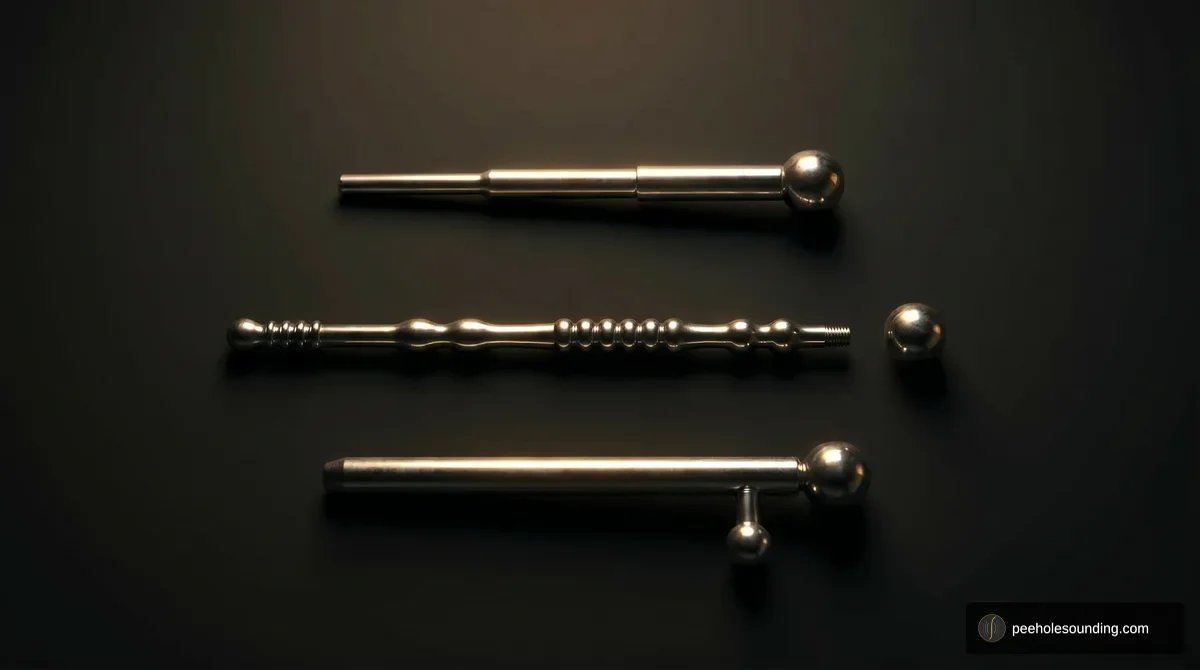
Best Penis Plugs in 2026: A Beginner-Friendly Buyer's Guide
Apr 16
Is Sounding Safe? Sounding Safety Protocols & Risks
Mar 5

How to Clean and Sterilize Urethral Sounds
Mar 20
Sounding Rods Sizes Chart: French Gauge to mm to Inches
Apr 28
The Sounding Glossary: Every Term in Urethral Play, Defined
Jul 6